
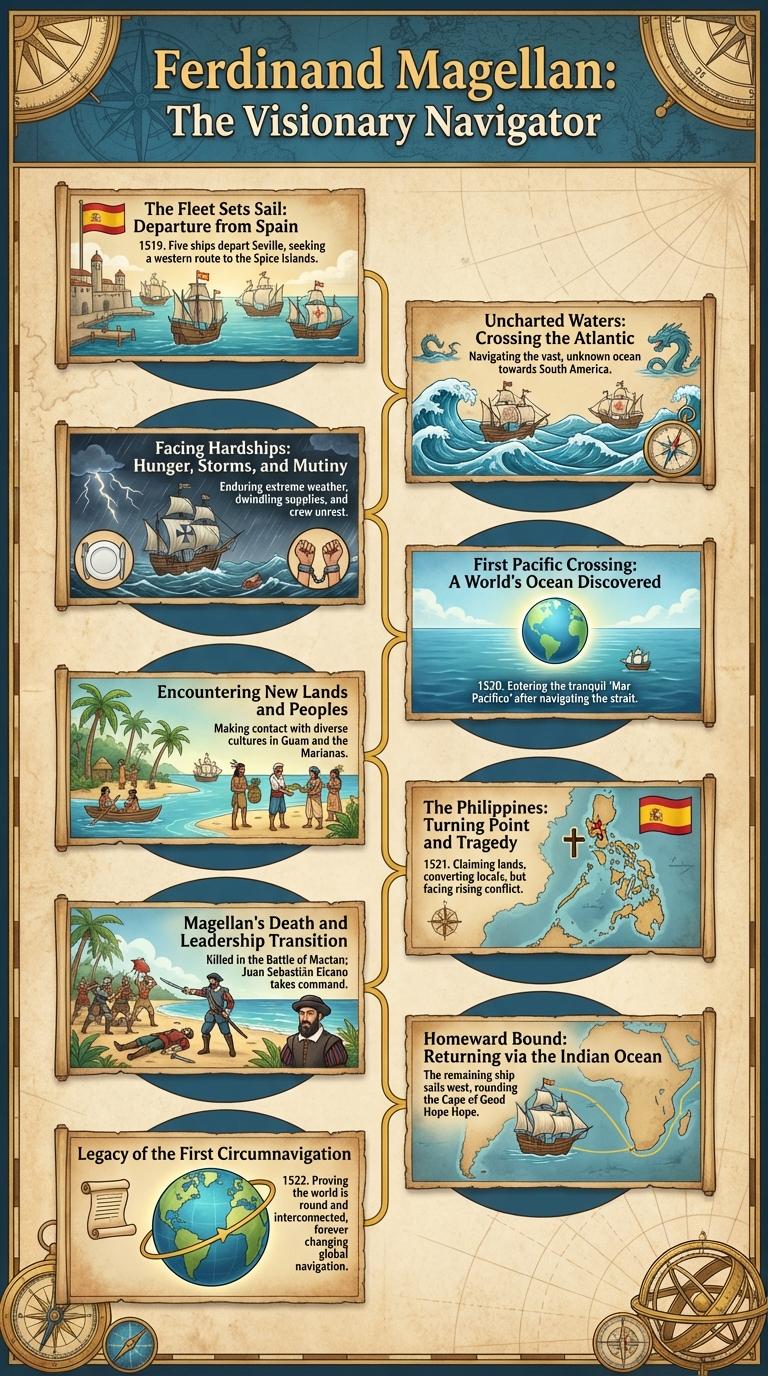
The first voyage around the world marked a monumental achievement in human exploration, showcasing navigational skill and endurance. This historic journey, led by Ferdinand Magellan, expanded global understanding of geography and opened new trade routes. The infographic highlights key events, challenges faced, and the voyage's lasting impact on world history.
Ferdinand Magellan: The Visionary Navigator
Ferdinand Magellan led the first expedition to circumnavigate the globe, a historic maritime journey that began in 1519. His visionary navigation proved the Earth is round and connected distant continents through sea routes.
Magellan's voyage lasted over three years, covering approximately 42,000 miles and involving five ships. Despite his death in the Philippines, his fleet completed the journey under Juan Sebastian Elcano's command, solidifying Magellan's legacy as a pioneering explorer.
The Fleet Sets Sail: Departure from Spain
The first voyage around the world began on September 20, 1519, when a fleet of five ships set sail from Seville, Spain. Led by the Portuguese explorer Ferdinand Magellan, the expedition aimed to find a westward route to the Spice Islands. This historic departure marked the start of the first successful circumnavigation of the globe.
Uncharted Waters: Crossing the Atlantic
The first voyage around the world marked a monumental achievement in maritime exploration, navigating uncharted waters. Crossing the Atlantic was a critical and perilous phase, showcasing the crew's resilience and navigational skills.
- Route Discovery - The expedition charted new paths across the Atlantic Ocean, previously unknown to Europeans.
- Navigational Challenges - Sailors faced unpredictable winds, storms, and vast stretches of open sea without landmarks.
- Technological Innovation - The voyage utilized advanced navigational tools like the compass and astrolabe to maintain course.
This Atlantic crossing laid the groundwork for global maritime navigation and future exploration endeavors.
Facing Hardships: Hunger, Storms, and Mutiny
The first voyage around the world, led by Ferdinand Magellan, faced numerous life-threatening challenges. Hunger, violent storms, and mutinies tested the resolve and leadership of the crew throughout the journey.
- Hunger and Scurvy - Sailors suffered severe malnutrition and scurvy due to limited fresh food and water supplies during the long sea voyage.
- Violent Storms - Frequent and powerful storms in unknown waters endangered the ships, causing damage and navigation difficulties.
- Mutiny Among Crew - Discontent and fear triggered mutinies, which were suppressed through strict discipline and decisive leadership to maintain order.
First Pacific Crossing: A World's Ocean Discovered
Ferdinand Magellan's expedition (1519-1522) achieved the first Pacific crossing, unveiling a vast, unknown ocean that linked the Americas and Asia. This journey revealed the true scope of the world's oceans, vastly expanding geographic knowledge and trade routes. The expedition's discovery marked a pivotal moment in global exploration and maritime history.
Encountering New Lands and Peoples
The first voyage around the world, led by Ferdinand Magellan in 1519, marked a monumental moment in global exploration. The expedition navigated uncharted waters and encountered diverse new lands and peoples across three continents.
Magellan's crew first reached the coast of South America, where they interacted with indigenous tribes unfamiliar to Europeans. Continuing westward, they discovered the Pacific Ocean and later encountered island communities in the Philippines, showcasing early cross-cultural exchanges.
The Philippines: Turning Point and Tragedy
What made The Philippines a turning point and tragedy during the first voyage around the world?
The Philippines marked a critical turning point in the expedition led by Ferdinand Magellan as the crew reached new territories and engaged with indigenous populations. Conflict and Magellan's death in the Battle of Mactan turned this milestone into a tragic moment that tested the survival and resolve of the remaining crew.
Magellan's Death and Leadership Transition
Ferdinand Magellan led the first expedition to circumnavigate the globe, showcasing unprecedented maritime ambition. His journey marked a pivotal moment in exploration history, despite his untimely death in the Philippines in 1521.
Magellan's death created a critical leadership vacuum during the voyage. Juan Sebastian Elcano assumed command, steering the expedition back to Spain. Under Elcano's leadership, the crew completed the first successful circumnavigation, proving the vastness and connectivity of the world.
Homeward Bound: Returning via the Indian Ocean
Ferdinand Magellan's expedition marked the first circumnavigation of the globe, concluding a historic journey with a critical passage through the Indian Ocean. The fleet's homeward leg was shaped by navigation challenges, supply shortages, and encounters with diverse cultures in the Indian Ocean region.
Returning via the Indian Ocean, the expedition utilized established maritime routes to reach familiar ports, facilitating resupply and repairs before crossing back to Spain.
- Strategic Navigation - The fleet followed the well-mapped monsoon routes to optimize sailing conditions and avoid prolonged exposure to storms.
- Supply Acquisition - Stopovers at ports such as Goa and the Cape of Good Hope provided essential food, water, and ship maintenance.
- Cultural Encounters - Interaction with Indian Ocean communities influenced trade dynamics and facilitated knowledge exchange crucial for the voyage.