
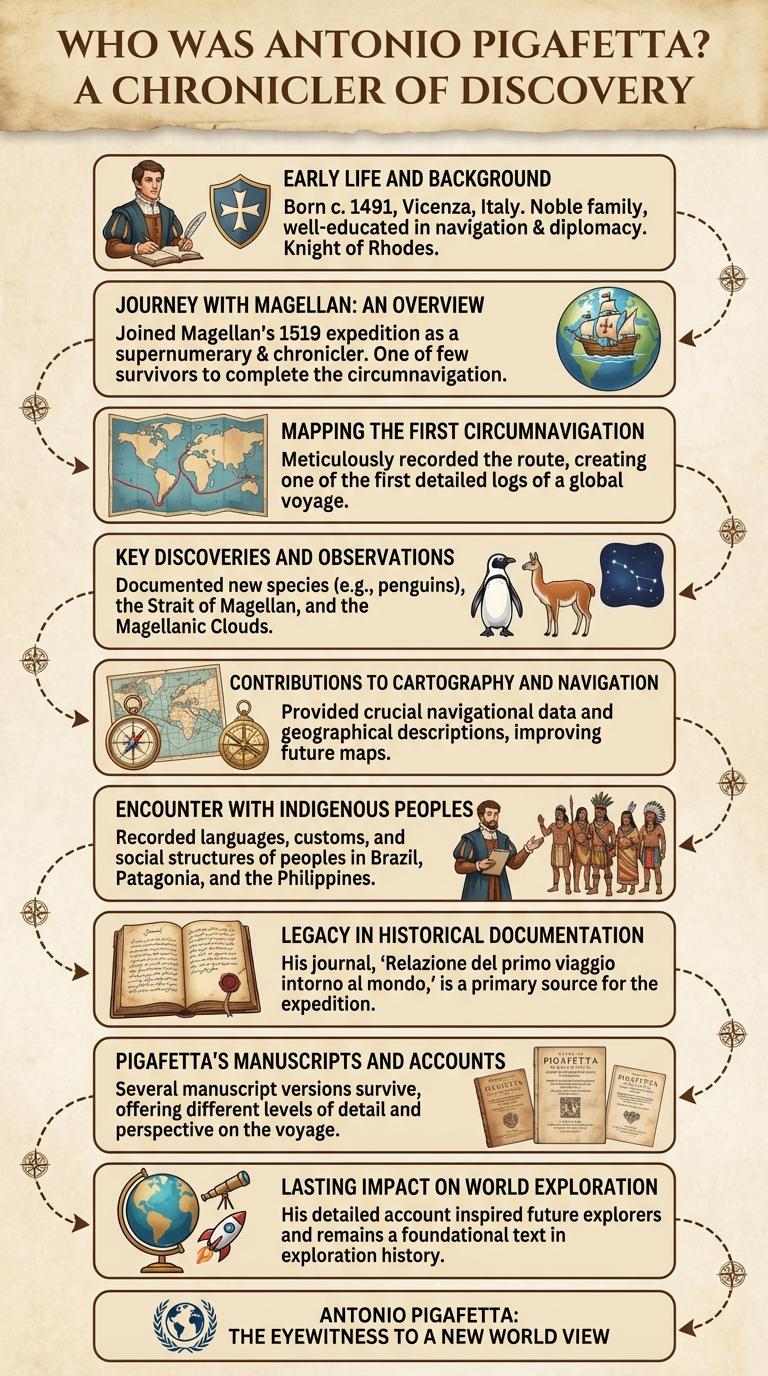
Antonio Pigafetta was an Italian explorer and chronicler renowned for documenting the first circumnavigation of the globe alongside Ferdinand Magellan. His detailed accounts provide invaluable insights into 16th-century maritime exploration, indigenous cultures, and the challenges faced during this historic voyage. This infographic highlights key moments and contributions of Pigafetta's journey, offering a visual summary of his enduring legacy.
Who Was Antonio Pigafetta?
Antonio Pigafetta was an Italian scholar and explorer who chronicled the first circumnavigation of the globe. He served as a historian and assistant to Ferdinand Magellan during the historic expedition.
- Voyage Chronicler - Pigafetta meticulously documented the events, cultures, and geography encountered during Magellan's expedition from 1519 to 1522.
- Italian Nobility Background - Born into a noble family in Vicenza, Pigafetta had a strong education that prepared him for detailed scientific and cultural observation.
- Legacy through Journals - His detailed travel journal became one of the most important primary sources for early 16th-century global exploration and maritime history.
Early Life and Background
Antonio Pigafetta was born around 1491 in Vicenza, Italy, into a noble Venetian family. He received a classical education which enabled him to become a skilled navigator and chronicler. Pigafetta's maritime knowledge and literary talent later made him a key figure in documenting the first circumnavigation of the globe.
Journey with Magellan: An Overview
Antonio Pigafetta was an Italian scholar and explorer who documented the first circumnavigation of the globe led by Ferdinand Magellan. His detailed journals provide valuable insights into this historic expedition.
Pigafetta joined Magellan's voyage in 1519 as a royal chronicler, recording events, geography, and ethnographic details. The journey lasted over three years, covering approximately 42,000 miles across uncharted seas. Pigafetta's observations remain one of the most important firsthand accounts of early maritime exploration.
Mapping the First Circumnavigation
Antonio Pigafetta was an Italian scholar and explorer who chronicled the first circumnavigation of the globe led by Ferdinand Magellan. His detailed accounts provide invaluable insights into early 16th-century navigation, geography, and cultures encountered during the voyage.
Pigafetta's meticulous mapping efforts helped document unknown lands and sea routes, significantly enhancing European understanding of world geography. His observations contributed to more accurate maps that guided future maritime explorations and global navigation.
Key Discoveries and Observations
Who was Antonio Pigafetta and what were his key discoveries during the Magellan expedition?
Antonio Pigafetta was a Venetian scholar and explorer who accompanied Ferdinand Magellan on the first circumnavigation of the globe. His detailed journals documented newly discovered lands, indigenous cultures, and oceanic routes, providing invaluable insights into early 16th-century exploration.
What geographical discoveries did Pigafetta document during the voyage?
Pigafetta recorded the first European descriptions of the Strait of Magellan, a crucial navigational passage at the southern tip of South America. He also chronicled the discovery of the Pacific Ocean and numerous islands in the Philippines.
How did Pigafetta's observations contribute to understanding indigenous cultures?
His journals offered detailed accounts of native customs, languages, and social structures encountered along the voyage. These ethnographic notes remain some of the earliest and most comprehensive records of Pacific and Southeast Asian indigenous populations.
What was Pigafetta's impact on cartography and maritime navigation?
His meticulous maps and coordinates refined European knowledge of global geography, influencing future exploration strategies. The precision of his recorded latitude and longitude helped improve sea route accuracy for subsequent navigators.
In what ways did Pigafetta's writings influence historical and scientific knowledge?
Pigafetta's firsthand narrative expanded European understanding of global biodiversity and human diversity. His works are considered foundational sources for historians, anthropologists, and geographers studying the Age of Discovery.
Contributions to Cartography and Navigation
Antonio Pigafetta played a crucial role in the advancement of cartography through his detailed journals documenting the first circumnavigation of the globe. His precise observations and maps provided valuable insights into previously uncharted territories, significantly improving the accuracy of world maps in the 16th century. Pigafetta's work contributed to enhanced navigation techniques, aiding future explorers in their voyages across unknown seas.
Encounter with Indigenous Peoples
Antonio Pigafetta, the chronicler of Magellan's expedition, documented detailed encounters with Indigenous Peoples during the voyage. His observations provide some of the earliest European insights into the cultures of the Pacific Islands.
Pigafetta described the hospitality and complex social structures of the islanders they met. His writings reveal both the challenges and exchanges that shaped early cross-cultural interactions in the 16th century.
Legacy in Historical Documentation
| Aspect | Details |
|---|---|
| Name | Antonio Pigafetta |
| Role | Chronicler and Explorer |
| Key Contribution | Detailed journals of Ferdinand Magellan's voyage (1519-1522) |
| Historical Impact | First recorded circumnavigation of the globe; vital primary source for 16th-century exploration |
| Legacy in Documentation | Extensive ethnographic, navigational, and cultural observations enhancing understanding of early global maritime history |
Pigafetta's Manuscripts and Accounts
Antonio Pigafetta was an Italian scholar and explorer who documented the first circumnavigation of the Earth led by Ferdinand Magellan. His detailed manuscripts provide valuable firsthand accounts of 16th-century global exploration and encounters.
Pigafetta's manuscripts include comprehensive journals that describe voyage events, indigenous cultures, and geographic discoveries. These writings are crucial primary sources for historians studying early maritime exploration and cross-cultural interactions.
- The First Draft of the Voyage - Pigafetta's initial manuscript written shortly after the expedition offers direct observations of the route and daily life aboard the ships.
- The Italian Manuscript - This version contains refined narrative elements and annotations, enriching the historical context and cultural insights of the journey.
- Translations and Copies - Multiple translations of Pigafetta's manuscripts have circulated, preserving and disseminating his detailed chronicles worldwide.
- Ethnographic Descriptions - His accounts include rich ethnographic details about indigenous peoples encountered, contributing to early anthropological records.
- Ship Logs and Maps - Pigafetta's notes also feature navigational data and sketches, aiding in the reconstruction of Magellan's route and the expedition's challenges.