
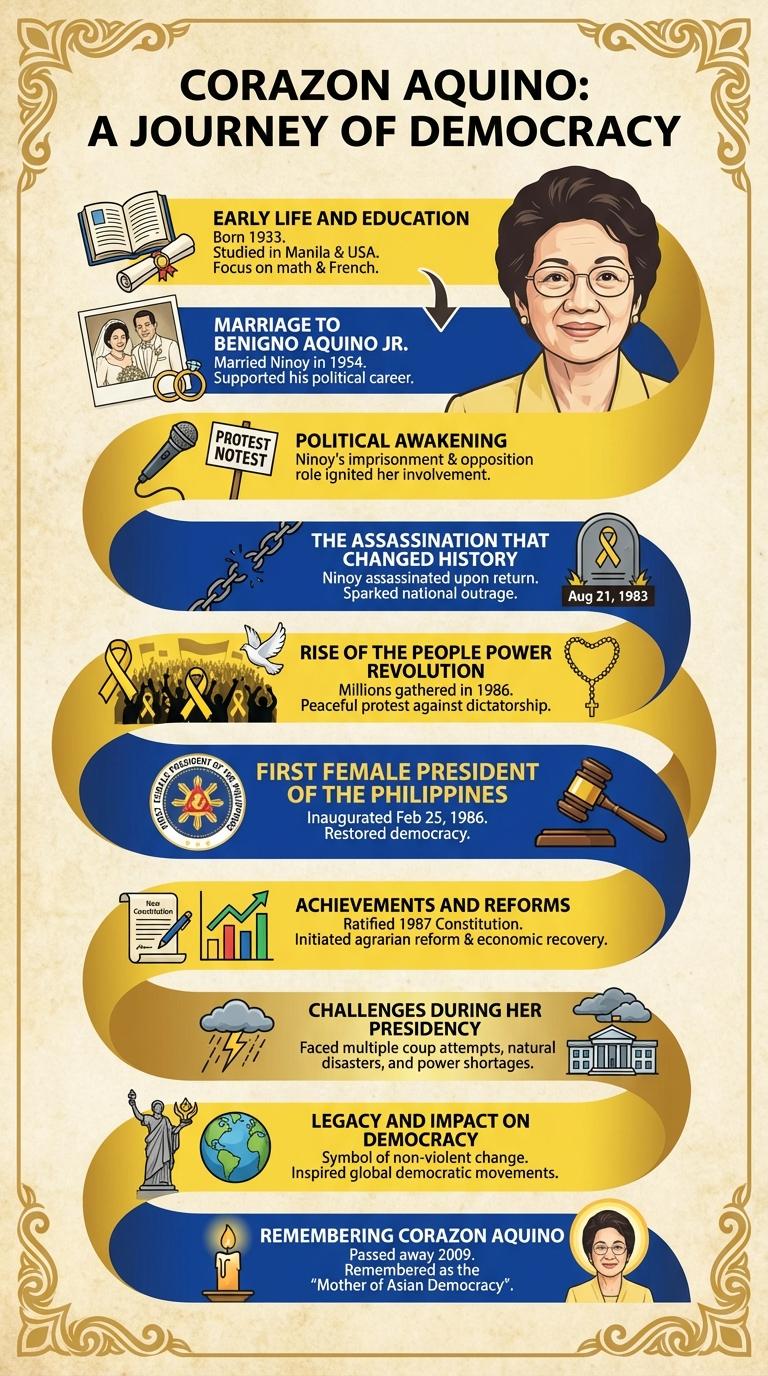
Corazon Aquino emerged as a pivotal figure in Philippine history, symbolizing democracy and resilience. Her leadership during the People Power Revolution marked a turning point, restoring democratic governance after years of authoritarian rule. This infographic highlights key moments and achievements of Aquino's presidency, illustrating her enduring legacy.
Early Life and Education
Corazon Aquino was born on January 25, 1933, in Tarlac, Philippines. She pursued her education in both the Philippines and the United States, shaping her future political career.
- Family Background - Born into a wealthy and politically influential family, daughter of a noted politician.
- Undergraduate Education - Graduated with a degree in French and Mathematics from the College of Mount Saint Vincent in New York.
- Postgraduate Studies - Attended a post-graduate program at the Ateneo de Manila University, focusing on mathematics and economics.
Marriage to Benigno Aquino Jr.
Who was Corazon Aquino married to?
Corazon Aquino was married to Benigno Aquino Jr., a prominent Filipino politician and opposition leader. Their marriage played a significant role in the political landscape of the Philippines during the Marcos regime.
Political Awakening
Corazon Aquino's political awakening was sparked by the assassination of her husband, Benigno Aquino Jr., in 1983, which galvanized her to oppose the Marcos dictatorship. She emerged as a unifying figure for the opposition, advocating for democratic reforms and human rights in the Philippines. Her leadership ultimately led to the People Power Revolution in 1986, ending decades of authoritarian rule.
The Assassination That Changed History
Corazon Aquino, the 11th President of the Philippines, rose to prominence after the assassination of her husband, Benigno Aquino Jr., in 1983. His death galvanized the Filipino people against the Marcos dictatorship.
The assassination occurred at Manila International Airport, sparking widespread protests and igniting the People Power Revolution. Corazon Aquino's leadership ultimately restored democracy and reshaped Philippine history.
Rise of the People Power Revolution
Corazon Aquino emerged as a central figure during the People Power Revolution in the Philippines in 1986. Her leadership symbolized the collective demand for democracy and the end of Ferdinand Marcos' dictatorship.
The revolution was marked by peaceful protests that united millions of Filipinos across all sectors. Aquino's presidency began after Marcos fled the country, restoring democratic governance and inspiring global movements for nonviolent change.
First Female President of the Philippines
Corazon Aquino was the first female president of the Philippines, serving from 1986 to 1992. She played a crucial role in restoring democracy after the dictatorship era.
- Historic Leadership - Aquino led the People Power Revolution that ended Ferdinand Marcos' 21-year rule.
- Democratic Reforms - She restored democratic institutions and promoted human rights during her presidency.
- Legacy - Aquino remains an iconic figure symbolizing courage and democratic resilience in Philippine history.
Her presidency marked a pivotal shift toward democratic governance in the Philippines.
Achievements and Reforms
Corazon Aquino, the first female president of the Philippines, is renowned for leading the country's return to democracy after years of dictatorship. Her tenure is marked by significant achievements and reforms that shaped modern Philippine governance.
- Restoration of Democracy - Aquino successfully ended the Marcos dictatorship through the 1986 People Power Revolution, reinstating democratic institutions.
- New Constitution - She enacted the 1987 Constitution, emphasizing human rights, social justice, and limiting presidential power.
- Agrarian Reform Program - Aquino initiated the Comprehensive Agrarian Reform Program to redistribute land to farmers and improve rural welfare.
Challenges During Her Presidency
| Challenge | Description |
|---|---|
| Political Instability | Faced numerous coup attempts by military factions aiming to overthrow her government after the 1986 People Power Revolution. |
| Economic Recovery | Inherited a crippled economy with high inflation and unemployment rates, requiring structural reforms and international aid. |
| Corruption Allegations | Confronted criticism and accusations of graft involving family members and government officials, undermining public trust. |
| Land Reform Issues | Implemented the Comprehensive Agrarian Reform Program (CARP) amidst resistance from landowners and implementation challenges. |
| Rebuilding Democratic Institutions | Faced the urgent need to restore democratic processes and constitutional order after years of authoritarian rule. |
Legacy and Impact on Democracy
Corazon Aquino, the 11th President of the Philippines, is celebrated for restoring democracy after years of authoritarian rule. Her leadership marked the end of the Marcos dictatorship and the reestablishment of democratic institutions.
Aquino's legacy lies in her successful peaceful revolution, the People Power Revolution of 1986, which inspired democratic movements worldwide. She championed constitutional reforms, including the 1987 Philippine Constitution that strengthened civil liberties and checks on government power. Her presidency set a precedent for democratic governance and human rights advocacy in the Philippines.