
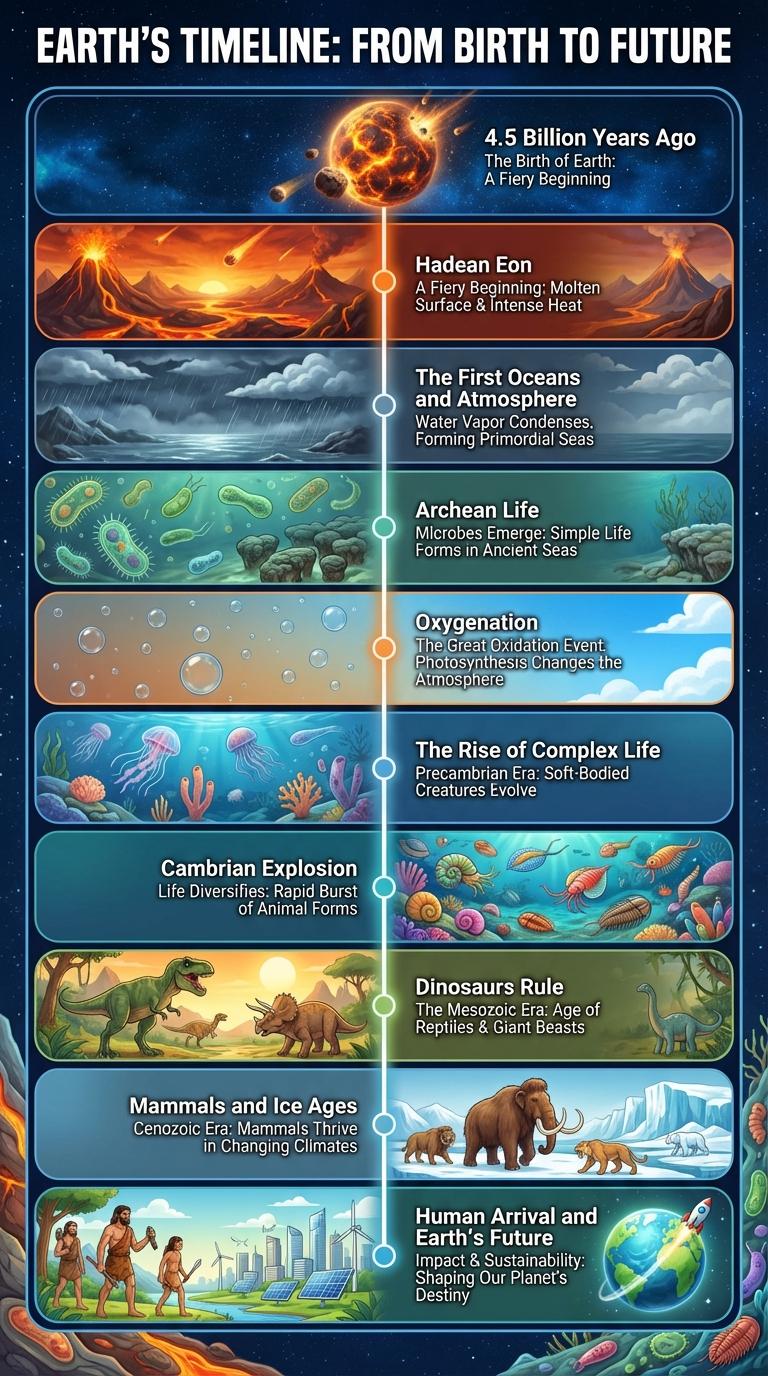
Earth's history spans billions of years marked by dramatic changes in climate, geography, and life forms. Fossil records and geological data reveal the dynamic processes that shaped continents and ecosystems over time. This infographic visually represents key milestones in Earth's development from its formation to the present day.
The Birth of Earth: 4.5 Billion Years Ago
The Earth formed approximately 4.5 billion years ago during the early solar system's development. This event marked the beginning of a dynamic planet that would support life.
- Formation from Solar Nebula - Earth originated from dust and gas orbiting the young Sun, coalescing into a solid planet.
- Heavy Bombardment Period - The early Earth experienced intense impacts from asteroids and comets, shaping its surface and atmosphere.
- Core Formation - Dense materials sank to form Earth's metallic core, creating its magnetic field.
Hadean Eon: A Fiery Beginning
What characterized the Hadean Eon, Earth's earliest geological period? The Hadean Eon, lasting from about 4.6 to 4 billion years ago, marks the fiery beginning of Earth's history. During this time, the planet was a molten mass, frequently bombarded by asteroids and undergoing intense volcanic activity.
The First Oceans and Atmosphere
The first oceans formed around 4 billion years ago as Earth cooled and water vapor condensed into liquid. Early atmosphere was primarily composed of volcanic gases like carbon dioxide, methane, and ammonia, lacking free oxygen. These conditions set the stage for the emergence of the first simple life forms in Earth's primordial seas.
Archean Life: Microbes Emerge
The Archean Eon, spanning from about 4 billion to 2.5 billion years ago, marks the emergence of life on Earth. Microbial life forms were the first to develop, thriving in extreme environments.
- Stromatolites Formation - Layered bio-chemical structures created by cyanobacteria indicate early microbial activity.
- Atmospheric Changes - Microbes began producing oxygen through photosynthesis, slowly altering Earth's atmosphere.
- Extremophiles Existence - Microbes adapted to high temperatures and harsh conditions, showcasing life's resilience.
Archean microbes laid the foundation for complex life by initiating biological and environmental transformations.
Oxygenation: The Great Oxidation Event
The Great Oxidation Event occurred around 2.4 billion years ago, marking a significant increase in Earth's atmospheric oxygen. This event was driven by photosynthetic cyanobacteria releasing oxygen as a byproduct, transforming the planet's atmosphere and enabling aerobic life. The rise in oxygen led to the formation of the ozone layer, which protected life from harmful ultraviolet radiation and paved the way for complex organisms.
The Rise of Complex Life: Precambrian Era
The Precambrian Era marks the vast span of time before complex life flourished on Earth. It covers approximately 88% of Earth's geological history, starting from the planet's formation about 4.6 billion years ago to 541 million years ago.
During the Precambrian, simple life forms such as single-celled bacteria and algae dominated the planet. Significant oxygenation of the atmosphere occurred due to photosynthetic cyanobacteria, leading to the Great Oxygenation Event. This environmental transformation set the stage for the emergence of complex multicellular organisms at the end of the Precambrian.
Cambrian Explosion: Life Diversifies
The Cambrian Explosion, occurring around 541 million years ago, marks a significant period in Earth's history when life rapidly diversified. This event introduced a wide array of complex organisms, including the first appearance of many major animal phyla.
During this era, ecosystems became more complex with the development of predation and new ecological interactions. Fossil evidence from this period reveals the emergence of hard body parts, which contributed to better preservation and our understanding of early life forms.
Dinosaurs Rule: The Mesozoic Era
| Period | Key Features |
|---|---|
| Triassic (252-201 million years ago) | Emergence of early dinosaurs and first mammals; recovery from Permian extinction |
| Jurassic (201-145 million years ago) | Dominance of large dinosaurs like Brachiosaurus and Stegosaurus; first birds appear |
| Cretaceous (145-66 million years ago) | Expansion of flowering plants; famous dinosaurs such as Tyrannosaurus rex and Triceratops |
| Climate | Generally warm, no polar ice caps; high sea levels creating shallow inland seas |
| Extinction Event | Cretaceous-Paleogene extinction caused by asteroid impact ending dinosaur reign |
Mammals and Ice Ages: Cenozoic Era
The Cenozoic Era marks a significant period in Earth's history characterized by the rise of mammals and the occurrence of multiple ice ages. This era shaped modern ecosystems through evolutionary advances and climatic shifts.
- Mammalian Evolution - Mammals diversified rapidly after the extinction of dinosaurs 66 million years ago, leading to the rise of many modern species.
- Ice Age Cycles - The Cenozoic experienced several glacial and interglacial periods that drastically affected global climates and habitats.
- Human Emergence - The latest part of the Cenozoic saw the evolution of Homo sapiens during the Quaternary Ice Age, shaping human history and culture.