
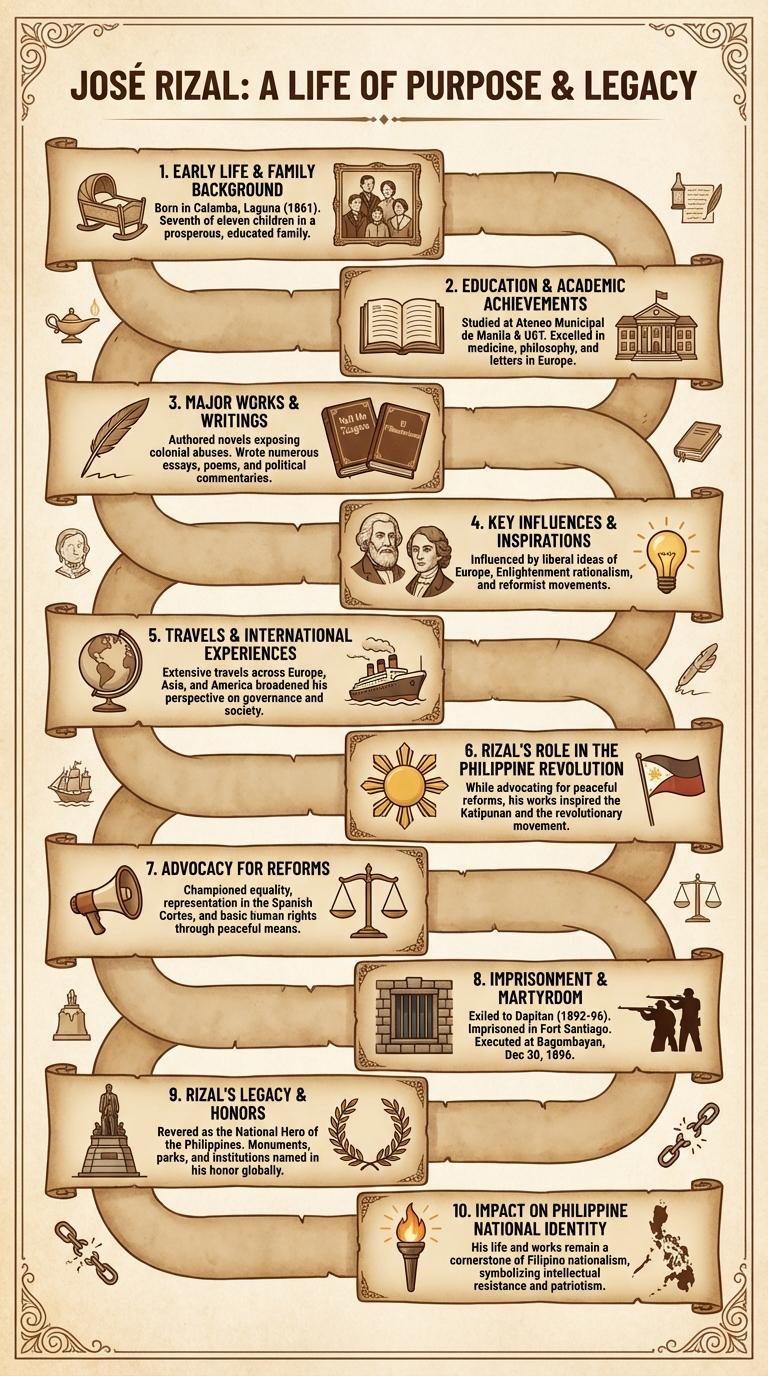
Jose Rizal remains a monumental figure in Philippine history, celebrated for his profound influence on the country's fight for independence. The infographic visually maps out his life, achievements, and lasting legacy, highlighting key moments and contributions. This clear and concise representation offers an engaging way to understand Rizal's impact on Filipino identity and nationalism.
Early Life and Family Background
Jose Rizal was born on June 19, 1861, in Calamba, Laguna, Philippines. He was the seventh child in a family of eleven siblings, known for their strong educational and patriotic values.
His parents, Francisco Mercado and Teodora Alonso, were well-educated and supportive of Rizal's intellectual pursuits. The family's deep sense of nationalism significantly influenced Rizal's dedication to Philippine independence.
Education and Academic Achievements
| Aspect | Details |
|---|---|
| Early Education | Studied at Ateneo Municipal de Manila; earned a Bachelor of Arts degree with highest honors |
| Medical Studies | Enrolled at the University of Santo Tomas; pursued medicine, focusing on ophthalmology |
| European Education | Attended Universidad Central de Madrid; obtained a degree in medicine; also studied philosophy and letters |
| Languages | Fluent in over 10 languages including Spanish, Tagalog, French, German, and Japanese |
| Academic Honors | Graduated with honors; recognized for exceptional scholarly dedication and multidisciplinary expertise |
Major Works and Writings
Jose Rizal, the Philippine national hero, authored several major works that contributed significantly to the country's fight for independence. His most famous novels are Noli Me Tangere and El Filibusterismo, which expose the social injustices under Spanish colonial rule. Rizal's essays and poems also reflect his advocacy for reform, education, and national identity.
Key Influences and Inspirations
What key influences shaped Jose Rizal's life and works?
Jose Rizal was profoundly influenced by the liberal ideas of the European Enlightenment and the reformist movements in Spain. His exposure to classical literature, sciences, and the injustices experienced by Filipinos fueled his passion for reform and nationalism.
Who inspired Rizal's advocacy for Philippine independence?
Rizal drew inspiration from national heroes such as Jose de San Martin and Simon Bolivar, who fought for Latin American independence. He admired their dedication to liberty and used their examples to promote peaceful reform in the Philippines.
How did Rizal's family influence his views?
Rizal's family, especially his parents, nurtured his love for education and patriotism. Their support helped him develop a strong sense of identity and responsibility toward his country's welfare.
What role did Rizal's travels play in his thinking?
Traveling across Europe and Asia exposed Rizal to diverse cultures and political ideas, broadening his worldview. These experiences reinforced his belief in equality and inspired his writings on social justice and human rights.
Which literary works inspired Rizal's writing style and themes?
Rizal was influenced by the novel "Noli Me Tangere" and "El Filibusterismo," which he authored to critique colonial rule. These works were shaped by his admiration for European novelists such as Victor Hugo and Miguel de Cervantes.
Travels and International Experiences
Jose Rizal's extensive travels shaped his perspectives on freedom, culture, and reform. His international experiences enriched his advocacy for Philippine independence through education and enlightenment.
- European Studies - Rizal studied medicine and humanities in Madrid, Paris, and Heidelberg, immersing in contemporary intellectual movements.
- Residency in Germany - He lived in Heidelberg, where he completed his ophthalmology training and deepened his engagement with European liberal ideas.
- Asian and American Travels - Rizal visited Hong Kong, Japan, and the United States, observing diverse societies and promoting Filipino identity globally.
Rizal's Role in the Philippine Revolution
Jose Rizal played a pivotal role in inspiring the Philippine Revolution through his writings and intellectual leadership. His novels and essays fueled Filipino nationalism and exposed the abuses of Spanish colonial rule.
Rizal's works, particularly "Noli Me Tangere" and "El Filibusterismo," awakened a sense of identity and unity among Filipinos. Although he advocated for peaceful reform rather than violent uprising, his ideas galvanized revolutionary groups like the Katipunan. Rizal's execution in 1896 transformed him into a martyr, further igniting the fight for independence.
Advocacy for Reforms
Jose Rizal was a Filipino nationalist and reform advocate who sought peaceful change during the Spanish colonial period. His writings and actions laid the groundwork for Philippine independence.
Rizal promoted civil rights, education, and equality for Filipinos under Spanish rule.
- Support for Education Reform - Rizal believed education was essential for empowering Filipinos and advocated for accessible public schooling.
- Equality and Human Rights - He called for equal treatment of Filipinos and Spaniards, opposing racial discrimination and abuse.
- Critique of Spanish Colonial Rule - Through his novels and essays, Rizal exposed the corrupt practices of colonial authorities and clergy.
Imprisonment and Martyrdom
Jose Rizal, a Filipino nationalist and revolutionary, was imprisoned for his role in inspiring the fight for Philippine independence. His martyrdom significantly influenced the Philippine Revolution against Spanish colonial rule.
- Imprisonment in Fort Santiago - Rizal was detained in Fort Santiago, Manila, after being accused of sedition and rebellion by Spanish authorities.
- Trial and Conviction - He was tried by a military court, found guilty of inciting insurrection, and sentenced to death despite lack of direct involvement in violent acts.
- Execution by Firing Squad - On December 30, 1896, Rizal was executed by firing squad at Bagumbayan (now Luneta Park), becoming a national martyr.
His death galvanized Filipinos to intensify their struggle for independence, making him a lasting symbol of patriotism and sacrifice.
Rizal's Legacy and Honors
Jose Rizal, the Philippine national hero, left a profound legacy that inspired the country's fight for independence. His writings, including "Noli Me Tangere" and "El Filibusterismo," sparked nationalist movements and reform efforts. Rizal's honors include monuments, schools named after him, and his designation as a martyr and symbol of Filipino pride.