
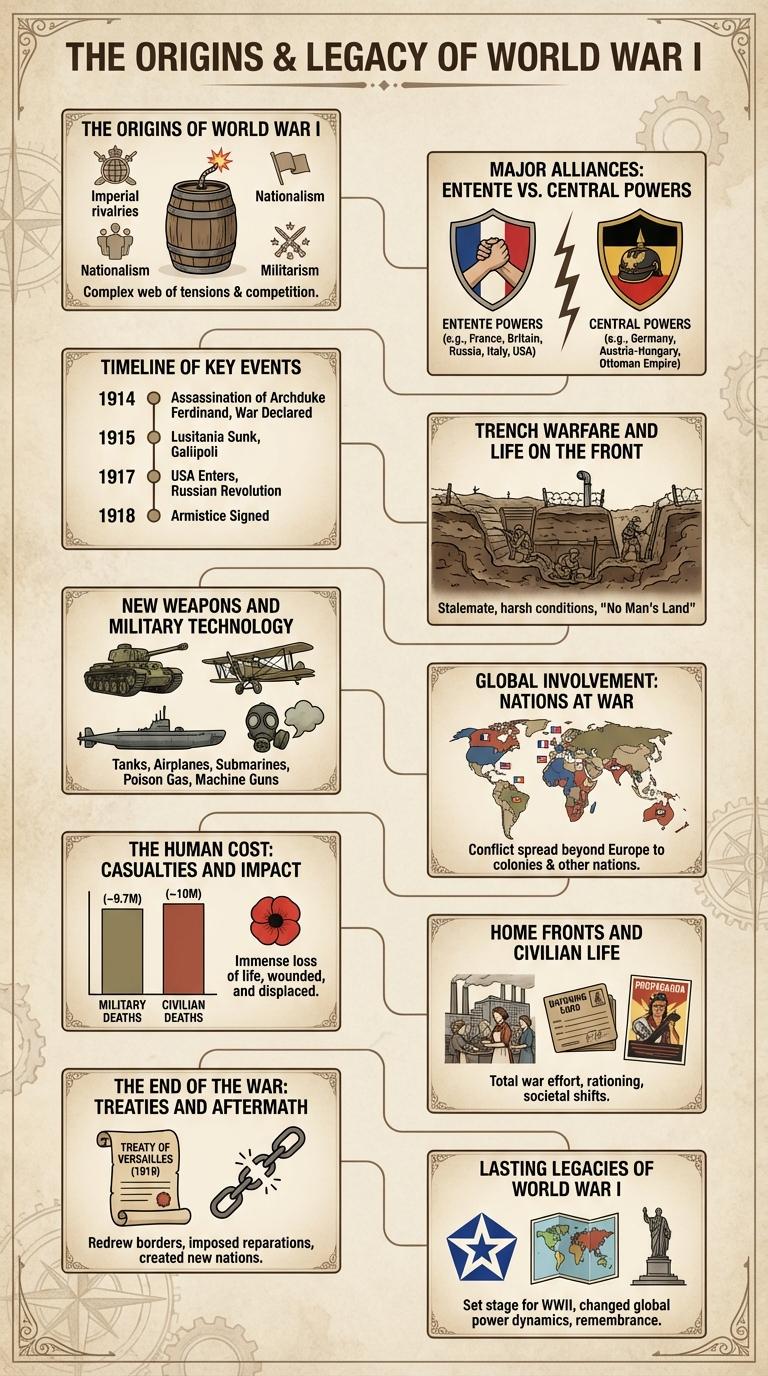
World War 1 reshaped the global political landscape through unprecedented military conflict and alliances. The infographic highlights key battles, major powers involved, and the war's lasting impact on society and technology. Understanding these elements provides insight into the conflict that defined the early 20th century.
The Origins of World War I
The origins of World War I trace back to complex alliances, militarism, imperialism, and nationalism in early 20th-century Europe. The assassination of Archduke Franz Ferdinand of Austria-Hungary in 1914 acted as the immediate trigger for the conflict.
Major powers like Germany, Austria-Hungary, Russia, France, and Britain were entangled in rivalries and strategic alliances. These tensions escalated quickly, leading to a global war that lasted from 1914 to 1918.
Major Alliances: Entente vs. Central Powers
The First World War featured two primary coalitions: the Entente Powers and the Central Powers. These alliances shaped the strategic battles and political landscape from 1914 to 1918.
The Entente Powers comprised countries unified against the Central Powers' military expansion.
- Entente Powers Formation - Comprised mainly of France, Russia, and the United Kingdom, the Entente sought to counterbalance German and Austro-Hungarian influence.
- Central Powers Composition - Including Germany, Austria-Hungary, Ottoman Empire, and Bulgaria, this alliance focused on territorial gains and maintaining imperial dominance.
- Alliance Impact - The entangled alliances escalated the conflict from a regional dispute to a full-scale global war, influencing diplomatic relations worldwide.
Timeline of Key Events
| Year | Key Event |
|---|---|
| 1914 | Assassination of Archduke Franz Ferdinand triggers war; Austria-Hungary declares war on Serbia. |
| 1915 | Introduction of chemical warfare; Second Battle of Ypres marks first large-scale use of poison gas. |
| 1916 | Battle of the Somme results in over one million casualties, symbolizing trench warfare devastation. |
| 1917 | United States enters the war; Russian Revolution leads to Russia's withdrawal from the conflict. |
| 1918 | Armistice signed on November 11, ending fighting on the Western Front and marking the war's conclusion. |
Trench Warfare and Life on the Front
World War 1 was marked by extensive trench warfare, where soldiers lived and fought in deep, narrow ditches stretching across the Western Front. These trenches provided protection from enemy fire but created harsh and dangerous living conditions.
Life on the front involved constant exposure to mud, water, and disease, leading to severe health problems like trench foot. Daily routines included guard duty, repairing trenches, and enduring artillery bombardments, making survival a relentless challenge.
New Weapons and Military Technology
World War 1 introduced groundbreaking weapons such as tanks, machine guns, and chemical warfare agents, transforming the nature of combat. Advancements in military technology included the widespread use of aircraft for reconnaissance and strategic bombing. These innovations resulted in unprecedented levels of destruction and altered battlefield strategies permanently.
Global Involvement: Nations at War
Which nations were involved in World War 1 on a global scale? Over 30 countries participated in World War 1, making it one of the most widespread conflicts in history. Major powers included the Allies--such as France, the United Kingdom, Russia, and later the United States--and the Central Powers, primarily Germany, Austria-Hungary, and the Ottoman Empire.
How did global alliances impact the scale of World War 1? The complex web of alliances escalated the conflict from a regional dispute into a world war. Countries from every inhabited continent were drawn in, including colonies and dominions like Canada, Australia, India, and South Africa, which contributed troops and resources.
| Allied Powers | Central Powers |
|---|---|
| France | Germany |
| United Kingdom | Austria-Hungary |
| Russia | Ottoman Empire |
| United States | Bulgaria |
| Italy |
The Human Cost: Casualties and Impact
World War 1 resulted in unprecedented human casualties and widespread societal trauma. The conflict profoundly altered populations and left lasting impacts on families worldwide.
- Military Deaths - Approximately 9.7 million soldiers died during the war, including combat and disease-related fatalities.
- Civilian Casualties - Civilian deaths reached an estimated 10 million due to famine, disease, and military actions.
- Psychological Impact - Millions of veterans suffered from "shell shock," now recognized as post-traumatic stress disorder (PTSD), affecting mental health globally.
The human cost of World War 1 shaped post-war policies and international relations for decades.
Home Fronts and Civilian Life
World War 1 deeply affected the daily lives of civilians and reshaped home fronts across participating nations. Societies mobilized resources, adapted to shortages, and endured social changes as economies shifted toward war efforts.
- Women in the Workforce - Millions of women entered industrial and agricultural jobs to replace men who went to fight, significantly advancing women's labor roles.
- Rationing and Shortages - Governments imposed strict rationing of food, fuel, and materials to prioritize military needs and manage civilian consumption.
- Propaganda and Morale - States used posters, newspapers, and films to boost patriotism, encourage enlistment, and sustain public support for the war.
- Economic Mobilization - Industries converted to producing military supplies, creating war economies that increased production but strained civilian goods availability.
- Social Tensions - Ethnic minorities and dissenters faced discrimination and suspicion, while strikes and protests highlighted war fatigue among civilians.
The End of the War: Treaties and Aftermath
World War 1 ended in 1918 with the signing of several key treaties, the most notable being the Treaty of Versailles in 1919. This treaty imposed heavy reparations and territorial losses on Germany, reshaping the political landscape of Europe. The aftermath of the war led to significant geopolitical changes, the collapse of empires, and set the stage for World War 2.