
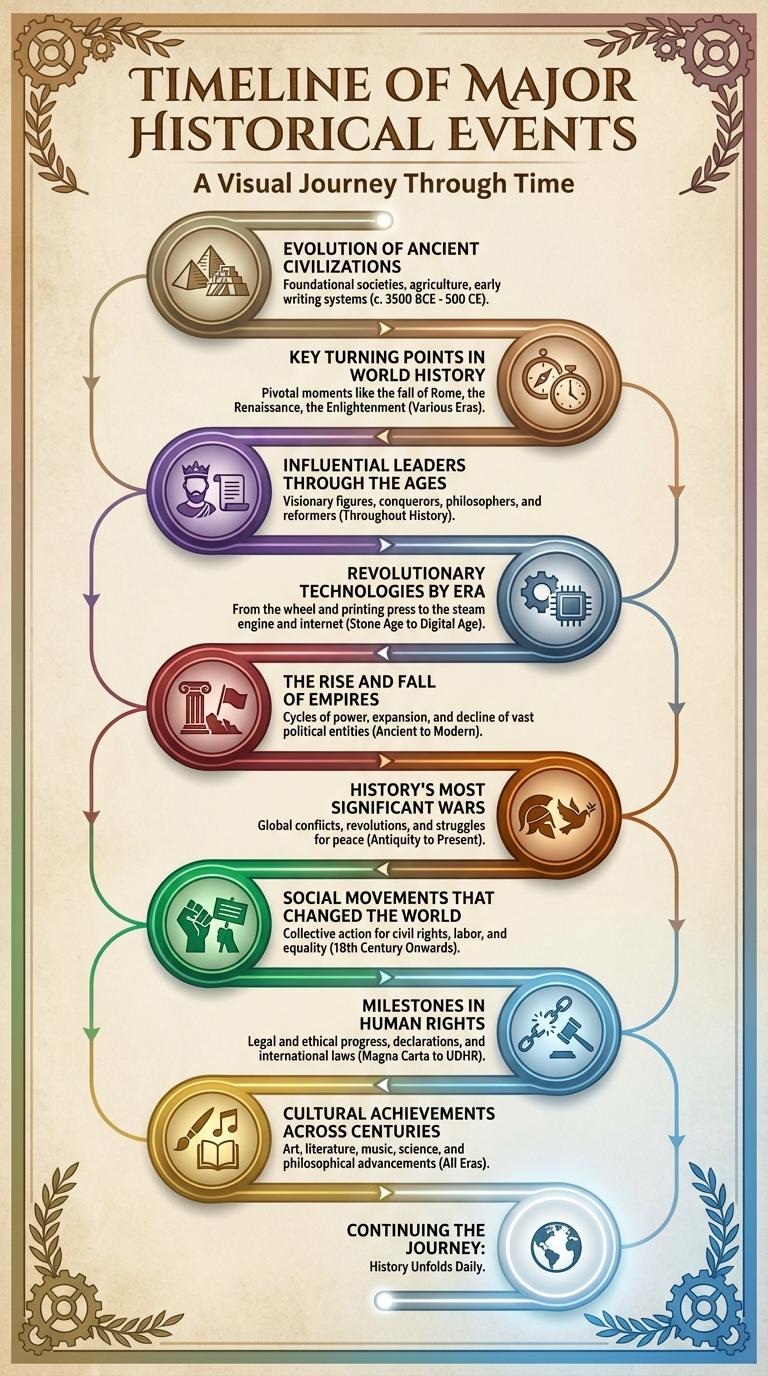
Infographics visually summarize complex historical events and timelines, making information easier to understand. They combine images, data, and brief text to highlight key moments and trends effectively. This format enhances learning by presenting history in an engaging, accessible way.
Timeline of Major Historical Events
An infographic detailing the Timeline of Major Historical Events highlights key moments that shaped human civilization. This visual representation covers milestones from ancient times, such as the construction of the Pyramids of Giza, to modern achievements like the Moon landing in 1969. Recognizing these pivotal events provides insight into the progression of technological, cultural, and political developments throughout history.
Evolution of Ancient Civilizations
Ancient civilizations emerged along major river valleys, such as the Nile, Tigris-Euphrates, Indus, and Yellow River, facilitating the development of agriculture and urban centers. These societies developed writing systems, complex governance, and monumental architecture that laid the foundation for future cultures.
The Sumerians pioneered cuneiform script and city-states around 3000 BCE, while Ancient Egypt is renowned for its hieroglyphics and pyramids. The Indus Valley Civilization exhibited advanced urban planning, and early Chinese dynasties introduced centralized rule and significant technological innovations.
Key Turning Points in World History
Key turning points in world history have reshaped civilizations and influenced the course of human development. Events such as the Agricultural Revolution, the Industrial Revolution, and the Digital Revolution marked significant shifts in technology, economy, and society. These milestones highlight humanity's progress and adaptation through transformative periods over millennia.
| Turning Point | Impact |
|---|---|
| Agricultural Revolution (circa 10,000 BCE) | Transition from nomadic societies to settled farming communities |
| Fall of the Roman Empire (476 CE) | End of classical antiquity and beginning of the Middle Ages |
| Industrial Revolution (18th-19th Century) | Shift to mechanized production and urbanization |
| World War II (1939-1945) | Global political realignment and UN establishment |
| Digital Revolution (late 20th Century) | Transformation through information technology and internet |
Influential Leaders Through the Ages
Influential leaders throughout history have shaped societies, cultures, and global events. Their decisions and visions have left lasting impacts on the world.
- Alexander the Great - Conquered vast territories, spreading Greek culture across three continents.
- Queen Elizabeth I - Stabilized England and fostered the Elizabethan Renaissance during her reign.
- Mahatma Gandhi - Led non-violent resistance movements that inspired independence for India and civil rights worldwide.
Understanding the achievements of these leaders provides insight into the evolution of global history and governance.
Revolutionary Technologies by Era
The history of technology is marked by revolutionary advancements that transformed societies across different eras. Each period introduced innovations that redefined human capabilities and daily life.
In the Industrial Revolution, inventions like the steam engine and mechanized looms accelerated manufacturing and transportation. The Digital Era brought microprocessors and the internet, enabling global connectivity and information exchange.
The Age of Discovery was powered by navigational tools such as the compass and astrolabe, expanding world exploration. In the Modern Era, breakthroughs in artificial intelligence and renewable energy are shaping future technologies.
The Rise and Fall of Empires
The rise and fall of empires shaped human civilization over millennia. Empires expanded through conquest, trade, and cultural influence, leaving lasting legacies.
Ancient empires like Rome and Persia dominated vast territories, influencing law, architecture, and governance. The Mongol Empire unified Eurasia under one rule, enhancing trade via the Silk Road. Declining empires often faced internal strife, economic troubles, and external invasions, leading to their collapse and paving the way for new powers.
History's Most Significant Wars
Throughout history, wars have shaped civilizations, borders, and cultures. Understanding the most significant wars offers insight into global political and social transformations.
- The Trojan War - Legendary conflict in ancient Greece symbolizing the clash of powerful kingdoms and heroic legends.
- The Hundred Years' War - Prolonged struggle between England and France that influenced medieval European power dynamics.
- The Napoleonic Wars - Series of military campaigns led by Napoleon Bonaparte that altered European political landscape.
- World War I - Global conflict driven by alliances and nationalism, resulting in vast casualties and geopolitical shifts.
- World War II - Devastating worldwide war that reshaped international order and led to the creation of the United Nations.
Social Movements that Changed the World
Which social movements have significantly shaped global history? Social movements have driven profound changes in societies by challenging injustices and advocating for rights. These collective efforts have transformed political, social, and economic landscapes worldwide.
| Social Movement | Impact on the World |
|---|---|
| Civil Rights Movement | Ended racial segregation and advanced equality laws in the United States. |
| Women's Suffrage Movement | Secured voting rights for women, promoting gender equality globally. |
| Anti-Apartheid Movement | Led to the dismantling of racial segregation policies in South Africa. |
| Environmental Movement | Raised global awareness on climate change and promoted sustainable practices. |
| LGBTQ+ Rights Movement | Advanced legal protections and social acceptance for LGBTQ+ communities worldwide. |
Milestones in Human Rights
Human rights have evolved through pivotal milestones that shaped global justice and equality. These moments represent significant strides toward universal freedoms and protections.
- Magna Carta (1215) - Established the principle that everyone, including the king, is subject to the law.
- Universal Declaration of Human Rights (1948) - Adopted by the United Nations to outline fundamental human rights worldwide.
- Civil Rights Act (1964) - Prohibited discrimination based on race, color, religion, sex, or national origin in the United States.