
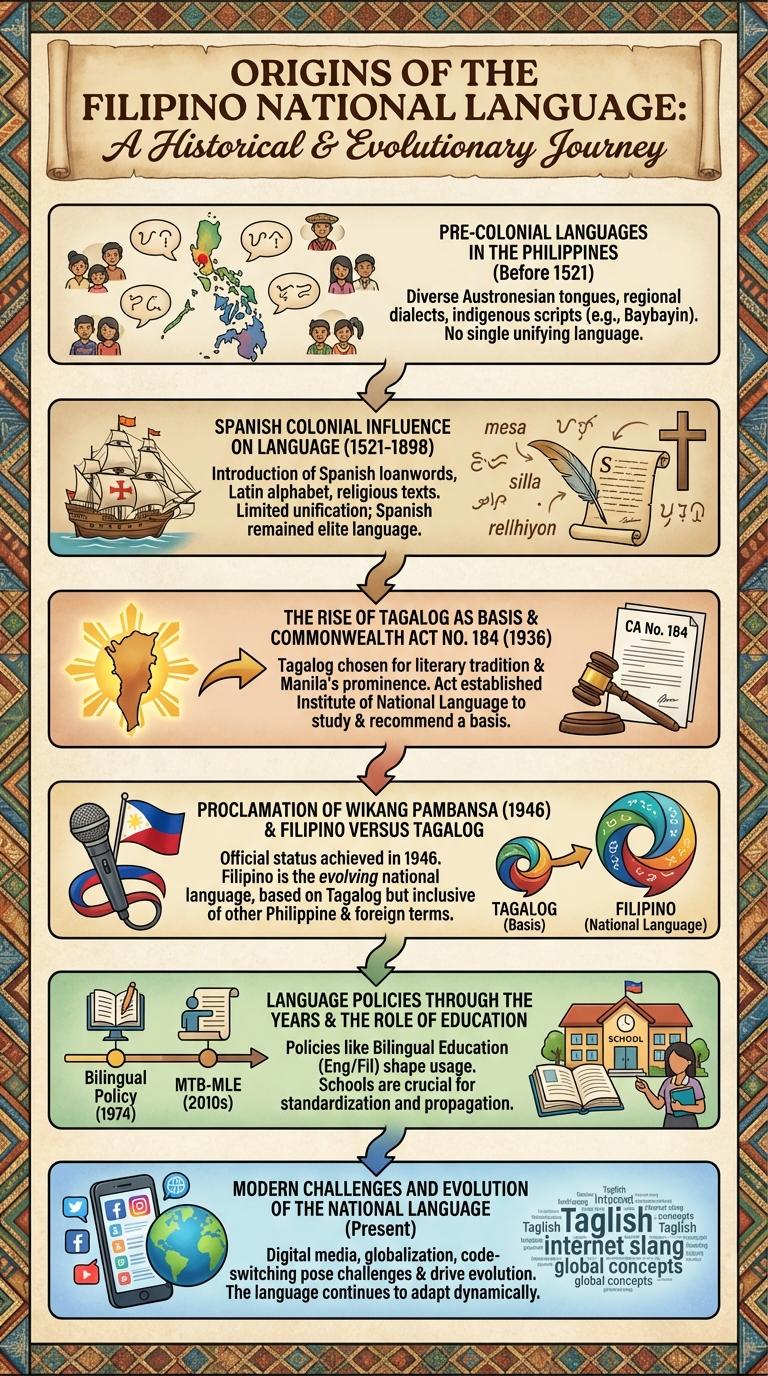
The kasaysayan ng wikang pambansa highlights the evolution of the Filipino language from its early roots to its official recognition in the 20th century. Key milestones include the declaration of Tagalog as the basis of the national language in 1937 and the subsequent development into what is now Filipino. This infographic visually presents significant events and figures that shaped the identity and growth of the national language.
Origins of the Filipino National Language
The Filipino national language has its roots in the diverse linguistic heritage of the Philippines. It evolved to unify various regional dialects and promote national identity.
- Pre-colonial Languages - Early Filipinos spoke multiple Austronesian languages that laid the foundation for the national language.
- Spanish Colonial Influence - Spanish colonization introduced loanwords and influenced linguistic development, although native languages remained dominant.
- Tagalog Basis - The Filipino language is primarily based on Tagalog, chosen for its widespread use and rich literary tradition.
Pre-Colonial Languages in the Philippines
The pre-colonial period in the Philippines featured a rich diversity of indigenous languages spoken across various ethno-linguistic groups. These languages formed the foundation of the nation's cultural and linguistic heritage before Spanish colonization.
- Austronesian Origins - Philippine languages belong to the Austronesian language family, spreading through migration and trade networks in Southeast Asia.
- Regional Variations - Prominent pre-colonial languages included Tagalog, Cebuano, Ilocano, Kapampangan, and Bikol, among others.
- Oral Traditions - These languages were primarily oral, used in storytelling, rituals, and everyday communication with limited early writing systems like Baybayin.
Pre-colonial languages established the groundwork for the modern Filipino language and enriched the nation's identity.
Spanish Colonial Influence on Language
Spanish colonial rule in the Philippines lasted for over 300 years, profoundly impacting the development of the Filipino language. During this period, many Spanish words and linguistic structures were integrated into local dialects.
The use of Spanish as the language of government, religion, and education also influenced Filipino linguistic identity. This colonial legacy contributed to the evolution of the national language, enriching it with a diverse vocabulary.
The Rise of Tagalog as Basis
The rise of Tagalog as the basis of the wikang pambansa (national language) began in the early 20th century during the American colonial period. In 1937, President Manuel L. Quezon declared Tagalog as the foundation of the national language to foster unity among the diverse Filipino peoples. This decision was influenced by Tagalog's widespread usage, rich literary tradition, and central geographic location in the Philippines.
Commonwealth Act No. 184 (1936)
Commonwealth Act No. 184, enacted in 1936, established the Surian ng Wikang Pambansa (National Language Institute) in the Philippines. This law aimed to develop and propagate a national language based on existing Philippine languages.
The act marked a significant step in the codification of Filipino as the national language. It emphasized the selection of a common language to promote unity and national identity among Filipinos.
Proclamation of Wikang Pambansa (1946)
The Proclamation of Wikang Pambansa in 1946 marked a pivotal moment in the history of the Filipino language. It officially recognized Filipino as the national language, promoting unity and cultural identity across the Philippines.
This proclamation laid the foundation for the development and propagation of a common language among Filipinos of diverse dialects and regions.
- Executive Order No. 134 - Issued by President Manuel Roxas, it declared Tagalog as the basis of the national language.
- Language Unification - The proclamation aimed to foster national unity by adopting a single national language understood by the majority.
- Foundation for Language Development - It paved the way for formal education and media to integrate the national language, enhancing communication.
Filipino versus Tagalog: Key Differences
The Filipino language, designated as the national language of the Philippines, is a standardized and enriched version of Tagalog. Tagalog is one of the many native languages spoken in the Philippines and serves as the foundation for the Filipino language. Filipino incorporates elements from other Philippine languages, as well as Spanish, English, and other foreign languages, making it more inclusive and dynamic compared to Tagalog.
Language Policies through the Years
| Year | Language Policy and Significance |
|---|---|
| 1935 | Commonwealth Act No. 184 mandated the development and adoption of a national language based on a native dialect to promote unity. |
| 1937 | Tagalog was selected as the basis for the national language, emphasizing cultural identity and communication among Filipinos. |
| 1959 | Executive Order No. 335 renamed the national language to "Pilipino," reflecting a more inclusive national identity. |
| 1973 | The 1973 Constitution codified Filipino as the national language, expanding its scope beyond Tagalog with incorporation of other Philippine languages. |
| 1987 | The 1987 Constitution officially designated Filipino as the national and official language alongside English, highlighting language development and preservation efforts. |
The Role of Education in Language Development
How has education influenced the development of the Filipino language?
Education played a crucial role in standardizing and promoting Filipino as the national language. Schools integrated Filipino into the curriculum, ensuring widespread literacy and cultural unity.