
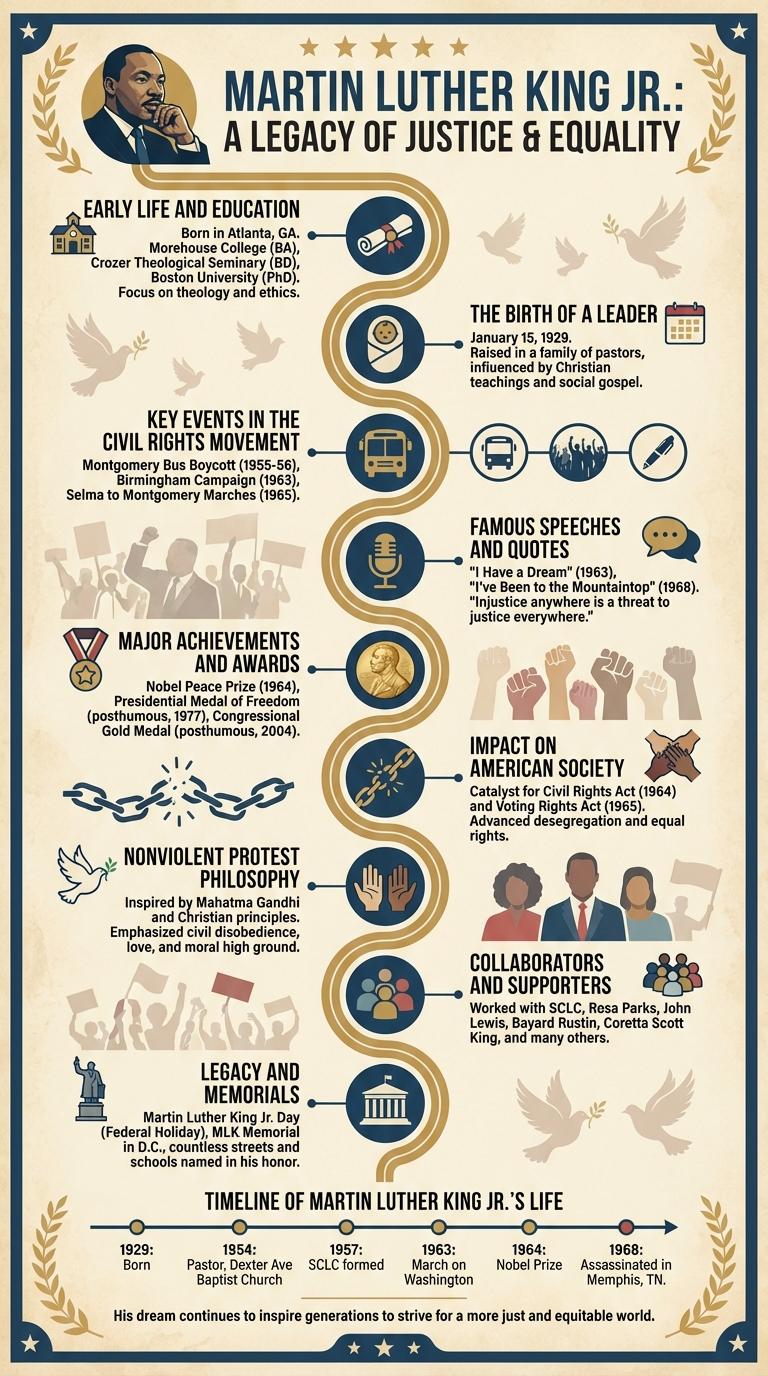
Martin Luther King Jr. stands as a monumental figure in the fight for civil rights and social justice. His leadership in nonviolent activism and powerful speeches inspired generations to challenge racial inequality. This infographic highlights key moments and achievements that define his enduring legacy.
Early Life and Education
Who was Martin Luther King Jr. during his early life and education? Martin Luther King Jr. was born on January 15, 1929, in Atlanta, Georgia. He excelled academically and entered Morehouse College at the age of 15.
Where did King pursue his higher education? King studied sociology at Morehouse College and later earned a Bachelor of Divinity from Crozer Theological Seminary. He completed his Ph.D. in Systematic Theology at Boston University in 1955.
The Birth of a Leader
Martin Luther King Jr. was born on January 15, 1929, in Atlanta, Georgia. His early life in a religious and socially active family laid the foundation for his future leadership.
As a child, King was influenced by his father, a Baptist minister, and by the struggles faced by African Americans in the segregated South. These experiences ignited his passion for justice and equality.
Key Events in the Civil Rights Movement
Martin Luther King Jr. was a pivotal leader in the American Civil Rights Movement, advocating for nonviolent resistance and racial equality. His leadership shaped key events that transformed civil rights legislation and social attitudes.
Significant moments in the Civil Rights Movement showcase the impact of King's activism and the broader struggle for justice.
- Montgomery Bus Boycott (1955-1956) - King led a successful year-long boycott protesting racial segregation on public buses in Montgomery, Alabama.
- March on Washington (1963) - King delivered his iconic "I Have a Dream" speech, advocating for racial harmony and economic rights before 250,000 attendees.
- Selma to Montgomery Marches (1965) - Organized to demand voting rights, these marches highlighted racial discrimination and led to the Voting Rights Act.
Famous Speeches and Quotes
Martin Luther King Jr. is renowned for his powerful speeches that advanced civil rights and social justice. His words continue to inspire movements worldwide for equality and nonviolence.
- "I Have a Dream" - Delivered during the 1963 March on Washington, this speech envisions racial harmony and freedom.
- "Letter from Birmingham Jail" - A profound written statement defending nonviolent resistance to injustice.
- "I've Been to the Mountaintop" - King's final speech emphasizing perseverance and hope in the struggle for civil rights.
Major Achievements and Awards
Martin Luther King Jr. played a pivotal role in the American civil rights movement, achieving landmark victories such as the 1963 March on Washington and the passage of the Civil Rights Act of 1964. He was awarded the Nobel Peace Prize in 1964 for his nonviolent struggle against racial segregation and discrimination. King's legacy includes his powerful speeches, especially the iconic "I Have a Dream," which continue to inspire movements for equality worldwide.
Impact on American Society
Martin Luther King Jr. significantly advanced civil rights in American society through his leadership in nonviolent protests and powerful speeches. His advocacy contributed to the passage of landmark legislation such as the Civil Rights Act of 1964 and the Voting Rights Act of 1965. King's legacy continues to inspire movements for racial equality and social justice across the United States.
Nonviolent Protest Philosophy
| Key Concept | Details |
|---|---|
| Nonviolent Protest Philosophy | Martin Luther King Jr. embraced nonviolence as the primary strategy for civil rights activism, inspired by Mahatma Gandhi's approach to peaceful resistance. |
| Core Beliefs | Committed to love, respect, and justice, King believed nonviolence could dismantle racial segregation and promote social change without hatred or physical conflict. |
| Major Campaigns | Led the 1955 Montgomery Bus Boycott and 1963 Birmingham Campaign, both emphasizing peaceful demonstrations and civil disobedience to challenge systemic racism. |
| Philosophical Influences | Incorporated Christian teachings and the concept of "agape" (unconditional love) to foster empathy and moral courage in activists. |
| Legacy | Nonviolent protest philosophy became foundational to the Civil Rights Movement, influencing future social justice movements worldwide. |
Collaborators and Supporters
Martin Luther King Jr. collaborated with key figures such as Ralph Abernathy and Bayard Rustin, who played crucial roles in organizing nonviolent protests and the 1963 March on Washington. Support from organizations like the Southern Christian Leadership Conference (SCLC) and the NAACP bolstered his civil rights campaigns nationwide.
Prominent supporters included religious leaders, students, and ordinary citizens who participated in sit-ins, boycotts, and marches to demand racial equality. King's ability to unite diverse groups contributed significantly to the success of the civil rights movement.
Legacy and Memorials
Martin Luther King Jr. remains a powerful symbol of the civil rights movement and nonviolent activism. His legacy continues to inspire millions worldwide in the fight for equality and justice.
Numerous memorials honor Martin Luther King Jr., including the Martin Luther King Jr. Memorial in Washington, D.C., which features a 30-foot statue known as the "Stone of Hope." National holidays like Martin Luther King Jr. Day celebrate his impact every year on the third Monday of January. Schools, streets, and institutions across the United States bear his name, reflecting his enduring influence on American society.