
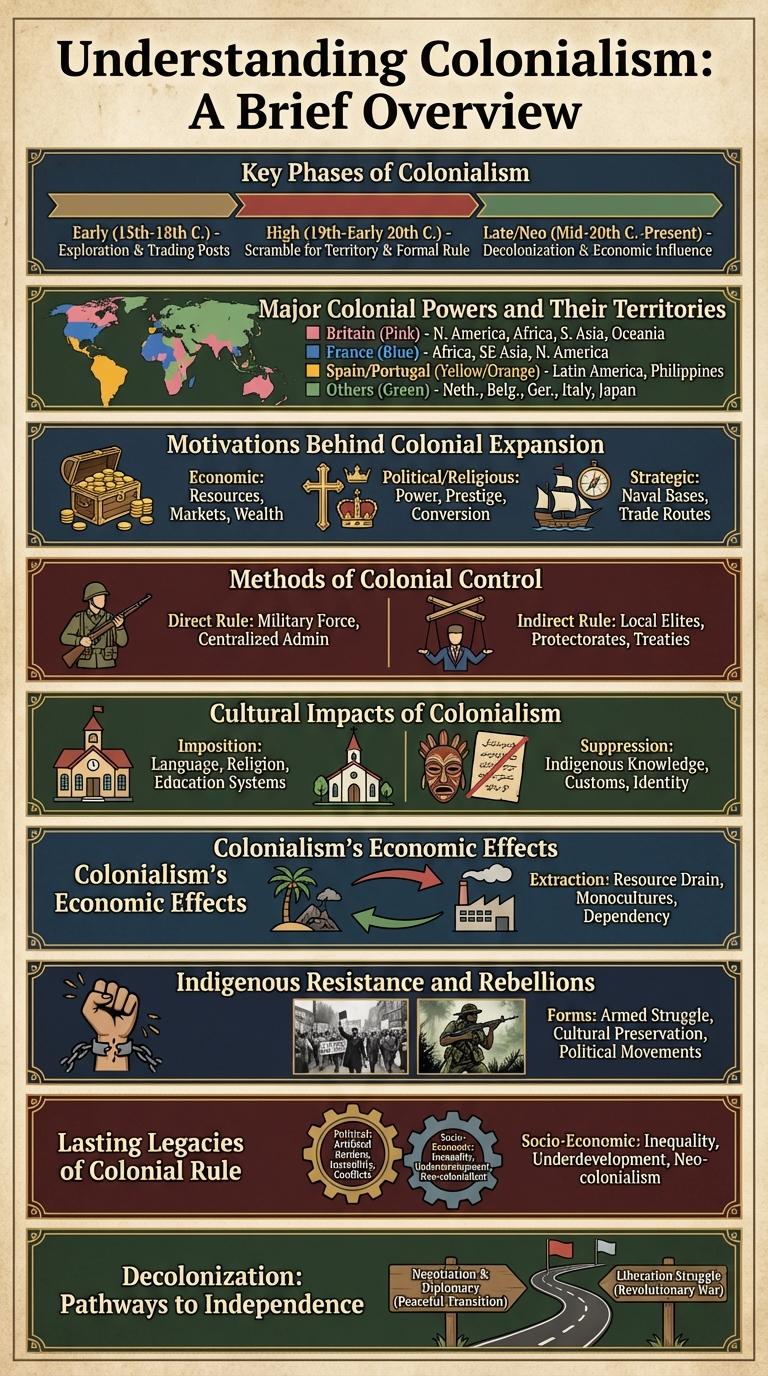
Kolonyalismo reshaped global history by establishing control over territories and cultures through imperial conquest and economic exploitation. It influenced social structures, economies, and political systems across continents, leaving a lasting legacy. Understanding the dynamics and impacts of kolonyalismo reveals critical insights into contemporary international relations and cultural interactions.
Understanding Colonialism: A Brief Overview
Colonialism refers to the practice of acquiring and maintaining colonies by a foreign power, often for economic and political control. It has significantly shaped global history through cultural, social, and economic impacts.
- Definition of Colonialism - Colonialism involves domination and exploitation of one nation over another, establishing control and settling populations.
- Economic Motivations - Colonizing powers sought resources, labor, and new markets to fuel industrial growth and wealth accumulation.
- Cultural Impact - Colonialism led to the spread of languages, religions, and cultural practices, often at the expense of indigenous traditions.
Key Phases of Colonialism
Colonialism shaped global history through distinct key phases, each marking significant changes in control and cultural influence. These phases reflect the evolving motives and methods used by colonial powers across centuries.
The first phase, Early Colonialism (15th-17th centuries), was driven by exploration and trade expansion, mainly by European powers like Spain and Portugal. Establishing trade routes and initial settlements laid the foundation for later dominance.
The second phase, High Colonialism (18th-19th centuries), focused on territorial conquest and resource exploitation, with Britain and France leading global expansion. This era saw intensified competition, political control, and economic extraction in Asia, Africa, and the Americas.
The third phase, Decolonization (mid-20th century), involved the dismantling of colonial empires as colonies gained independence through movements and negotiations. The impact of colonial rule remains evident in political borders and cultural identities worldwide.
Major Colonial Powers and Their Territories
Kolonyalismo involved powerful nations expanding their control over foreign territories to exploit resources and assert dominance. Major colonial powers included Britain, France, Spain, Portugal, and the Netherlands, each establishing vast empires across multiple continents. These empires influenced global trade, culture, and political boundaries that persist today.
| Colonial Power | Key Territories |
|---|---|
| Britain | India, Canada, Australia, East Africa |
| France | West Africa, Southeast Asia, Caribbean |
| Spain | Latin America, Philippines |
| Portugal | Brazil, Angola, Mozambique |
| Netherlands | Indonesia, Suriname, Caribbean islands |
Motivations Behind Colonial Expansion
Colonial expansion was driven by economic, political, and cultural motivations. European powers sought new territories to increase wealth, influence, and global dominance.
Economic motives included the desire for valuable resources such as gold, spices, and raw materials. Political ambitions aimed at strengthening national power through territorial acquisition. Cultural factors involved spreading religion and Western civilization.
Methods of Colonial Control
What were the primary methods of colonial control used during the era of kolonyalismo? Colonial powers employed various strategies to maintain dominance over their territories. These methods ensured political, economic, and social control over the colonized populations.
How did direct rule function as a method of colonial control? Direct rule involved the colonizers administering the territory through their own officials and institutions. This allowed for tight control and immediate implementation of colonial policies.
What role did indirect rule play in colonial governance? Indirect rule utilized local leaders and traditional power structures to enforce colonial authority. This method reduced administrative costs and resistance by maintaining a semblance of local governance.
In what ways was economic exploitation a tool of control during kolonyalismo? Colonizers extracted resources and labor to benefit the colonial economy, often through forced labor and taxation. Economic dependency reinforced colonial dominance by limiting the colonized population's autonomy.
How were cultural assimilation and education used to control colonized populations? Colonial powers imposed their language, religion, and education systems to reshape identities and social structures. This aimed to create loyal subjects and reduce opposition to colonial rule.
Cultural Impacts of Colonialism
Colonialism reshaped societies by imposing new cultural norms and disrupting indigenous traditions. The long-term effects continue to influence identity and heritage in formerly colonized regions.
- Language Displacement - Colonizers often imposed their language, leading to the decline or loss of native tongues.
- Religious Transformation - Indigenous spiritual practices were frequently suppressed in favor of the colonizers' religions.
- Education Systems - Colonial powers introduced Western education models that altered local knowledge transmission.
Cultural hybridity emerged, blending native and colonial elements, shaping modern cultural identities.
Colonialism's Economic Effects
Colonialism significantly transformed the economies of colonized regions by exploiting natural resources and redirecting wealth to colonial powers. Indigenous industries were often undermined to favor the import of manufactured goods from the colonizers. This economic restructuring led to long-term underdevelopment and dependence in former colonies.
Indigenous Resistance and Rebellions
Indigenous resistance against kolonyalismo involved diverse strategies such as armed rebellion, cultural preservation, and strategic alliances. These efforts aimed to defend ancestral lands, maintain sovereignty, and protect indigenous identities from colonial oppression.
Notable rebellions include the Philippine Revolution against Spanish rule and the Maji Maji Rebellion in German East Africa. These uprisings showcased the resilience of indigenous populations and their determination to end foreign domination.
Lasting Legacies of Colonial Rule
Colonial rule has left enduring impacts on the political, economic, and social structures of formerly colonized nations. These legacies continue to influence global relations and internal development challenges today.
- Political Boundaries - Many colonial borders were arbitrarily drawn, causing ongoing territorial disputes and ethnic conflicts.
- Economic Systems - Colonial economies were oriented toward resource extraction and export, limiting industrial diversification post-independence.
- Cultural Influence - Languages, religions, and customs imposed during colonization often remain dominant, shaping national identities.