
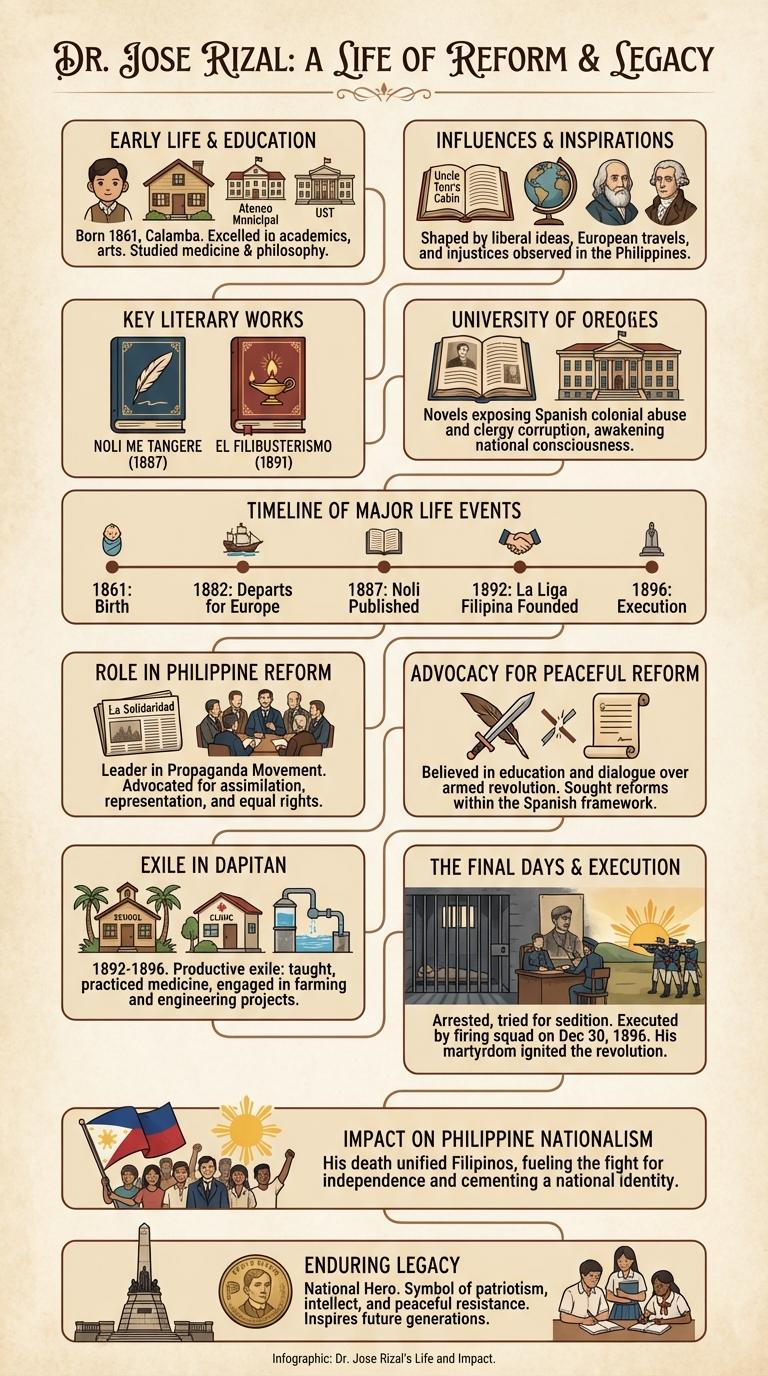
Dr. Jose Rizal stands as a national hero whose life and legacy profoundly shaped Philippine history. This infographic highlights key moments of his intellectual achievements, revolutionary ideas, and enduring impact on Filipino identity. Explore the visual journey of Rizal's contributions to education, literature, and nation-building.
Early Life and Education of Dr. Jose Rizal
Dr. Jose Rizal, a Filipino nationalist and hero, was born on June 19, 1861, in Calamba, Laguna. His early life and education laid the foundation for his contributions to Philippine independence.
- Birthplace and Family - Rizal was born into a wealthy and educated family, which valued learning and patriotism.
- Primary Education - He began his formal education at a local school under private tutors before attending Ateneo Municipal de Manila.
- Higher Education - Rizal earned degrees in Philosophy, Letters, and Medicine from the University of Santo Tomas and later studied in Europe.
His diverse education and early experiences shaped his intellectual growth and nationalistic ideals.
Rizal's Key Literary Works
Dr. Jose Rizal, the national hero of the Philippines, was a prolific writer whose literary works inspired the Filipino revolution against Spanish colonization. His writings combine nationalism, reformist ideas, and vivid portrayals of Philippine society in the 19th century.
Rizal's most famous novels, "Noli Me Tangere" and "El Filibusterismo," expose the injustices faced by Filipinos under Spanish rule. These works played a crucial role in awakening Filipino consciousness and promoting national identity.
Timeline of Major Life Events
Dr. Jose Rizal was a Filipino nationalist, writer, and revolutionary whose life significantly influenced the Philippine fight for independence. Born in 1861, Rizal's contributions as a reformist and intellectual shaped the nation's history.
In 1882, Rizal traveled to Spain to study medicine and wrote his famous novel "Noli Me Tangere" in 1887, exposing social injustices. He returned to the Philippines in 1892, founded the reformist group La Liga Filipina, and was later arrested by Spanish authorities. Rizal was executed on December 30, 1896, becoming a martyr and symbol of Filipino nationalism.
Rizal's Role in Philippine Reform
Dr. Jose Rizal was a pivotal figure in the Philippine reform movement during the Spanish colonial era. His writings, particularly the novels "Noli Me Tangere" and "El Filibusterismo," exposed the injustices faced by Filipinos under Spanish rule.
Rizal advocated for peaceful reform and equal rights rather than violent revolution. His efforts inspired a new sense of national identity and played a crucial role in the eventual push for Philippine independence.
Influences and Inspirations
Dr. Jose Rizal drew inspiration from European Enlightenment thinkers, embracing ideas of liberty, equality, and national identity. His exposure to diverse cultures during his travels in Europe enriched his perspectives on social reform and justice. Rizal was deeply influenced by Filipino heroes and the plight of his fellow countrymen, fueling his dedication to the Philippine reform movement.
Exile in Dapitan
Dr. Jose Rizal was exiled to Dapitan from 1892 to 1896, a period marked by significant contributions to community development and scientific study. Despite the exile, Rizal continued his advocacy for reform through education, medicine, and civic projects.
His time in Dapitan showcased his dedication to social progress and intellectual growth amid adversity.
- Community Development - Rizal established a school, improved agriculture, and built a water system to aid the local population.
- Medical Practice - He served as a physician, providing free medical care to natives and improving public health.
- Scientific Research - Rizal conducted studies in zoology and botany, contributing specimens to Philippine museums.
Advocacy for Peaceful Reform
| Aspect | Details |
|---|---|
| Full Name | Jose Protacio Rizal Mercado y Alonso Realonda |
| Key Advocacy | Peaceful reform and social justice in the Philippines during Spanish colonization |
| Primary Methods | Writing novels, essays, and poems advocating nonviolent change |
| Notable Works | Noli Me Tangere and El Filibusterismo |
| Legacy | Inspired Philippine nationalism and reform movements through peaceful means |
Rizal's Impact on Philippine Nationalism
Dr. Jose Rizal is regarded as the foremost national hero of the Philippines, whose writings inspired the Philippine Revolution against Spanish colonization. His novels, particularly "Noli Me Tangere" and "El Filibusterismo," exposed social injustices and awakened Filipino national consciousness. Rizal's advocacy for reform and peaceful resistance significantly shaped the ideals of Philippine nationalism and identity.
The Final Days and Execution
What were the final days of Dr. Jose Rizal like before his execution?
Dr. Jose Rizal spent his last days in Fort Santiago, under constant guard. He wrote several letters and poems reflecting on his love for the Philippines and his hope for freedom.
How was the execution of Dr. Jose Rizal carried out?
Rizal was executed by firing squad on December 30, 1896, at Bagumbayan Field (now Luneta Park) in Manila. His death became a pivotal moment in the Philippine Revolution against Spanish colonial rule.