
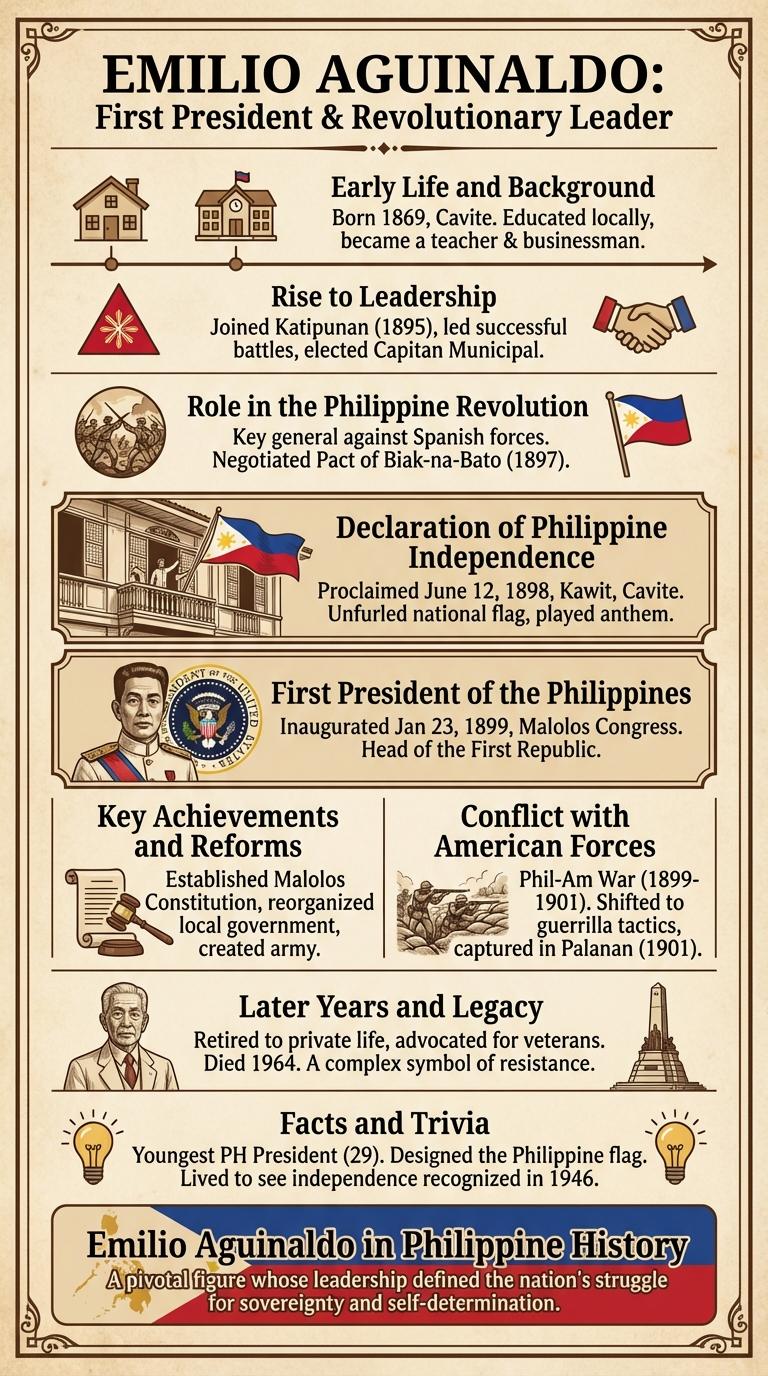
Emilio Aguinaldo played a crucial role in Philippine history as the leader of the Philippine Revolution against Spanish rule. This infographic highlights key events of his life, including his declaration of independence in 1898 and his presidency in the First Philippine Republic. Understanding Aguinaldo's legacy offers insight into the country's struggle for freedom and nationhood.
Early Life and Background
Emilio Aguinaldo was a Filipino revolutionary leader and the first President of the Philippines. His early life shaped his future role in the nation's fight for independence.
- Born in Kawit, Cavite - Aguinaldo was born on March 22, 1869, in a prominent family.
- Education - He studied at a local school and later at a Catholic seminary in Manila.
- Family influence - Aguinaldo's family was involved in local politics and the struggle against Spanish rule.
These formative experiences prepared him for leadership during the Philippine Revolution.
Rise to Leadership
Emilio Aguinaldo emerged as a key figure during the Philippine Revolution against Spanish colonial rule. His leadership skills became apparent after his successful participation in several battles.
Aguinaldo was elected president of the revolutionary government in 1897, marking his formal rise to power. His strategic vision and dedication played a crucial role in the pursuit of Philippine independence.
Role in the Philippine Revolution
Emilio Aguinaldo was a key figure in the Philippine Revolution against Spanish colonial rule. He served as the leader of the Filipino independence movement in the late 19th century.
Aguinaldo declared Philippine independence on June 12, 1898, establishing the First Philippine Republic. He coordinated military strategies that led to significant victories against Spanish forces. His leadership helped unify various revolutionary factions toward a common goal of freedom.
Declaration of Philippine Independence
Emilio Aguinaldo led the historic Declaration of Philippine Independence on June 12, 1898, at Kawit, Cavite. This moment marked the Philippines' assertion of freedom from Spanish colonial rule after over 300 years. The declaration featured the unfurling of the Philippine flag and the playing of the national anthem, symbolizing a new era of sovereignty.
First President of the Philippines
Emilio Aguinaldo was the first President of the Philippines, serving from 1899 to 1901. He played a pivotal role in the Philippine Revolution against Spanish colonial rule.
Aguinaldo declared Philippine independence on June 12, 1898, establishing the First Philippine Republic. His leadership laid the foundation for the country's fight for sovereignty and self-governance.
Key Achievements and Reforms
Emilio Aguinaldo was a Filipino revolutionary leader and the first President of the Philippines. His key achievements and reforms significantly shaped the country's fight for independence and early governance.
- Declaration of Philippine Independence - Aguinaldo proclaimed Philippine independence from Spanish rule on June 12, 1898, marking a pivotal moment in Filipino history.
- Establishment of the First Philippine Republic - He led the formation of the Malolos Republic in 1899, the first democratic government in Asia.
- Implementation of Administrative Reforms - Aguinaldo introduced reforms such as the creation of a revolutionary government and efforts to modernize the military and civil administration.
Conflict with American Forces
What was the nature of Emilio Aguinaldo's conflict with American forces during the Philippine-American War?
Emilio Aguinaldo led Filipino forces in resistance against American colonization after the Spanish-American War. The conflict began in 1899, marked by battles such as the Battle of Manila and widespread guerrilla warfare across the Philippines.
Later Years and Legacy
Emilio Aguinaldo, after his revolutionary leadership, lived a quieter life focused on politics and public service. His legacy remains integral to Philippine history and nationalism.
- Political Career - Aguinaldo served in various governmental roles, including as a member of the Philippine Assembly and the House of Representatives.
- Recognition - He received honors for his role in the independence movement, solidifying his place as a national hero.
- Historical Impact - Aguinaldo's leadership during the Philippine Revolution shaped the country's path to independence and inspired future generations.
Facts and Trivia
| Fact | Details |
|---|---|
| Full Name | Emilio Famy Aguinaldo y Famy |
| Born | March 22, 1869, Kawit, Cavite, Philippines |
| Role | First President of the Philippines (1899-1901) |
| Declaration | Proclaimed Philippine Independence on June 12, 1898 |
| Trivia | His residence in Kawit is now a national museum dedicated to the Philippine Revolution |