
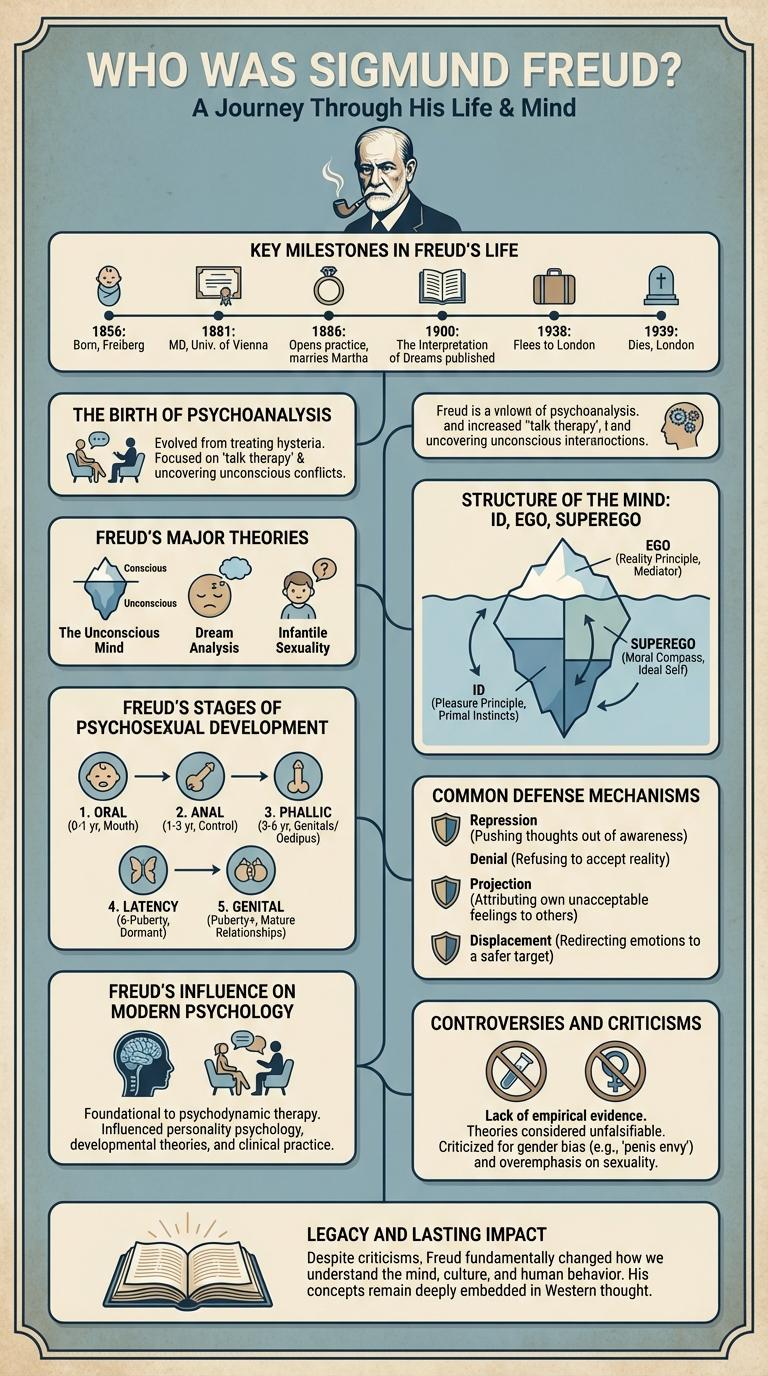
Sigmund Freud revolutionized psychology with his theories on the unconscious mind, dreams, and human behavior. His concepts, such as the id, ego, and superego, continue to influence modern psychotherapy and popular culture. This infographic visually summarizes Freud's key ideas and their lasting impact on the study of the mind.
Who Was Sigmund Freud?
Sigmund Freud was an Austrian neurologist and the father of psychoanalysis, a revolutionary approach to understanding human psychology. He developed influential theories on the unconscious mind, defense mechanisms, and the structure of personality, including the id, ego, and superego. Freud's work laid the foundation for modern psychotherapy and remains a cornerstone in psychology and psychiatry.
Key Milestones in Freud's Life
Who was Sigmund Freud, and what were the key milestones in his life?
Sigmund Freud was the founding father of psychoanalysis, a groundbreaking theory of the human mind. His work revolutionized psychology by introducing concepts like the unconscious, defense mechanisms, and the structure of personality.
| Year | Milestone |
|---|---|
| 1856 | Born in Freiberg, Moravia (now Pribor, Czech Republic). |
| 1886 | Established his private practice specializing in neurology in Vienna. |
| 1899 | Published "The Interpretation of Dreams," introducing the unconscious mind concept. |
| 1923 | Published "The Ego and the Id," outlining the structural model of the mind. |
| 1938 | Fled Nazi-occupied Austria, relocating to London, where he died in 1939. |
The Birth of Psychoanalysis
| Topic | Details |
|---|---|
| Sigmund Freud | Founder of psychoanalysis, Austrian neurologist, born 1856 in Freiberg, Moravia |
| The Birth of Psychoanalysis | Developed in the late 19th century as a method to explore the unconscious mind |
| Core Concepts | Unconscious, repression, free association, dream analysis, and transference |
| First Major Work | "Studies on Hysteria" (1895) co-authored with Josef Breuer, foundational text for psychoanalysis |
| Impact | Revolutionized psychology and psychotherapy, influencing clinical practices and cultural understanding of human behavior |
Freud's Major Theories
Sigmund Freud, the founding father of psychoanalysis, developed groundbreaking theories that revolutionized psychology. His work emphasized the unconscious mind's influence on behavior and personality formation.
Freud's major theories include the structure of the psyche, comprising the id, ego, and superego, which interact to shape human behavior. He introduced the concept of psychosexual development, highlighting stages such as oral, anal, and phallic, essential for personality development. Freud also proposed defense mechanisms, unconscious strategies the ego uses to manage conflict and anxiety.
Structure of the Mind: Id, Ego, Superego
Sigmund Freud developed the structural model of the mind, dividing it into three parts: the Id, Ego, and Superego. This model explains human behavior and the interplay of unconscious and conscious motivations.
The Id represents primal desires and operates based on the pleasure principle.
- Id - The instinctual part of the mind seeking immediate gratification and driven by basic urges.
- Ego - The rational part that mediates between the Id and reality using the reality principle.
- Superego - The moral conscience that internalizes societal rules and ideals, guiding ethical behavior.
Freud's Stages of Psychosexual Development
Sigmund Freud's Stages of Psychosexual Development outline how personality develops through five key phases from infancy to adulthood. Each stage centers on the pleasure-seeking energies of the id focusing on different erogenous zones.
The stages include Oral, Anal, Phallic, Latency, and Genital, each representing a critical period for psychological growth. Conflicts unresolved at any stage can result in fixation, influencing adult behavior and personality traits.
Common Defense Mechanisms
Sigmund Freud, the founding father of psychoanalysis, introduced the concept of defense mechanisms as unconscious strategies used to protect the ego from anxiety. These mechanisms operate to reduce psychological stress by distorting reality.
- Repression - Involuntarily blocking unpleasant thoughts from conscious awareness.
- Denial - Refusing to accept reality or facts to avoid emotional distress.
- Projection - Attributing one's own unacceptable feelings to others.
- Rationalization - Justifying behaviors or feelings with logical reasons despite underlying unconscious motives.
- Displacement - Shifting emotions from a threatening object to a safer substitute.
These defense mechanisms reveal how the mind unconsciously copes with conflict and anxiety in daily life.
Freud's Influence on Modern Psychology
Sigmund Freud revolutionized modern psychology by introducing the psychoanalytic theory, emphasizing the unconscious mind's role in human behavior. His concepts of defense mechanisms, childhood experiences, and the structure of personality (id, ego, superego) remain foundational in therapy and psychological research. Freud's influence extends to understanding mental disorders, shaping psychotherapeutic techniques, and inspiring diverse psychological schools of thought worldwide.
Controversies and Criticisms
Sigmund Freud remains one of the most influential yet controversial figures in psychology. His theories have sparked extensive debate and criticism from various academic and clinical perspectives.
- Lack of Scientific Rigor - Freud's methods are often criticized for lacking empirical evidence and relying heavily on subjective interpretations.
- Oedipus Complex Controversy - The universal application of the Oedipus complex has been challenged for cultural bias and overgeneralization.
- Overemphasis on Sexuality - Freud's focus on sexual drives as the primary motivator of human behavior is seen by many as reductionist and outdated.