
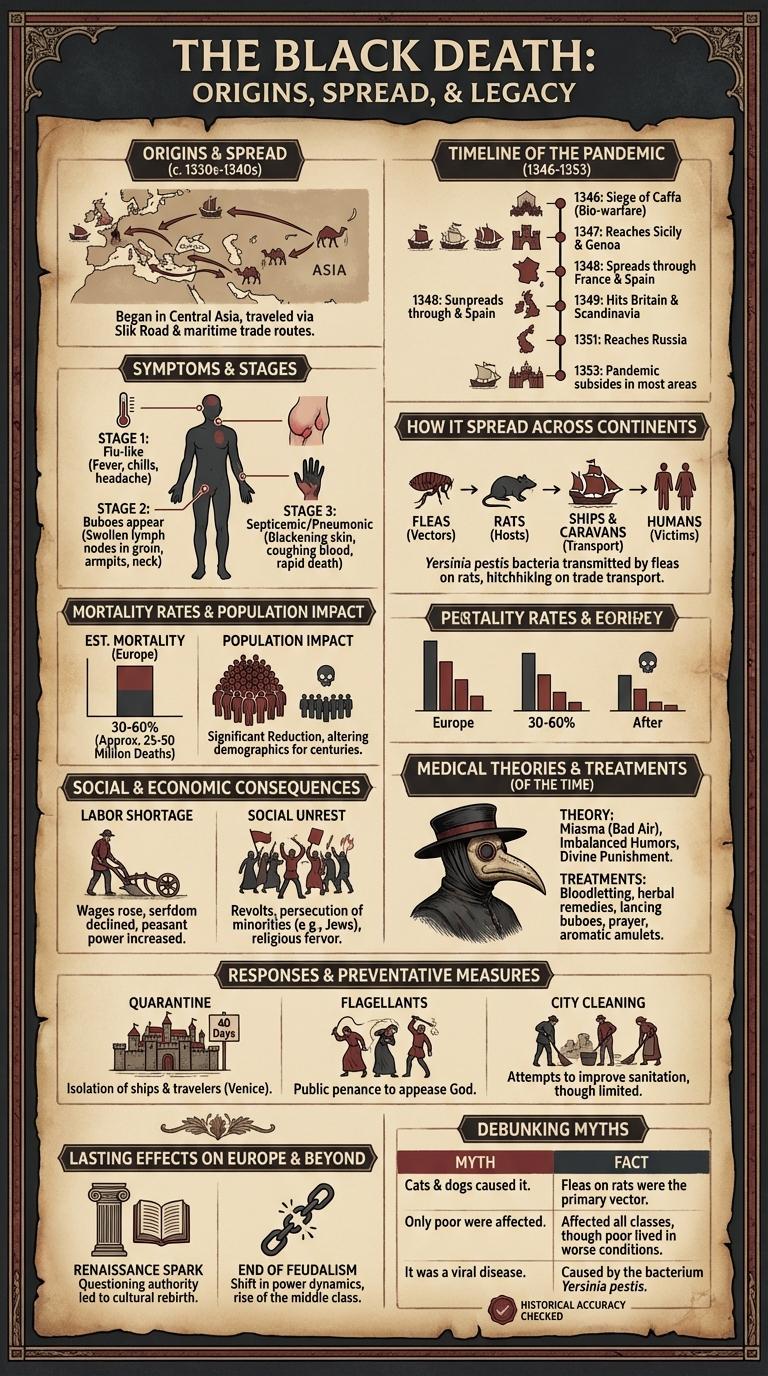
The Black Death, one of history's deadliest pandemics, caused catastrophic global population declines during the 14th century. Transmitted primarily through fleas on rats, the plague rapidly spread across continents, reshaping social, economic, and cultural landscapes. This infographic visually presents key facts, timelines, and impacts of the Black Death to enhance understanding of its historical significance.
Origins and Spread of the Black Death
The Black Death, originating in Central Asia in the early 14th century, was caused by the bacterium Yersinia pestis transmitted through fleas on black rats. It entered Europe via trade routes, particularly through ports like Genoa and Venice, rapidly spreading across the continent. The pandemic devastated populations, killing an estimated 25-30 million Europeans between 1347 and 1351.
Timeline of the Black Death Pandemic
The Black Death pandemic, one of the deadliest in human history, devastated Europe during the mid-14th century. It caused widespread mortality, reshaping societies and economies across continents.
The pandemic began in 1347 when infected fleas on rats arrived in Europe via trade ships from Asia. The disease rapidly spread, causing massive death tolls from 1347 to 1351. Subsequent outbreaks continued throughout the 14th and 15th centuries, leaving a lasting impact on population and health.
Symptoms and Stages of the Plague
The Black Death was a devastating pandemic that struck Europe in the 14th century. It caused severe symptoms and progressed through distinct stages, leading to high mortality rates.
- Initial Symptoms - High fever, chills, headache, and fatigue typically appeared within days of infection.
- Buboes Formation - Painful, swollen lymph nodes called buboes developed, often in the groin, armpits, or neck.
- Advanced Stage - Patients experienced septicemia or pneumonia, causing bleeding, skin discoloration, and respiratory distress.
The rapid progression and severity of symptoms made the Black Death one of the deadliest pandemics in human history.
How the Plague Spread Across Continents
How did the Black Death spread across continents? The plague traveled primarily through fleas living on rats, moving along trade routes. Ships carrying infected rats facilitated the disease's rapid transmission from Asia to Europe.
What role did trade routes play in the spread of the plague? Major trade routes such as the Silk Road and maritime paths connected Asia, the Middle East, and Europe, enabling the plague to cross vast distances. Merchants and travelers unknowingly carried infected fleas and rats between continents.
How did urban environments influence the spread of the Black Death? Crowded medieval cities with poor sanitation provided ideal conditions for rat populations to thrive. The close proximity of people allowed the plague to transmit quickly among human hosts.
Which continents were most affected by the Black Death's spread? Asia, Europe, and parts of North Africa experienced major outbreaks from 1347 to 1351. The pandemic caused drastic population declines and profound social changes in these regions.
What factors accelerated the transcontinental spread of the plague? Shipping lanes across the Mediterranean and Black Sea carried infected rats to port cities. Overland caravan routes linked Asia's plague centers to European markets, expediting the disease's expansion.
Mortality Rates and Population Impact
| Mortality Rates | Population Impact |
|---|---|
| Estimated 30% to 60% of Europe's population died | Europe's population dropped from approximately 75 million to 50 million |
| Urban areas experienced mortality rates up to 70% | Massive labor shortages affected agriculture and industry |
| Rural mortality rates ranged from 25% to 50% | Feudal system weakened due to population decline |
| Death toll in some regions reached nearly 75% (e.g. parts of Italy) | Significant social and economic transformations followed the depopulation |
| Global death estimate ranges from 75 to 200 million | Long-term demographic shifts reshaped Europe for centuries |
Social and Economic Consequences
The Black Death, which swept through Europe in the mid-14th century, led to profound social and economic transformations. Its devastating impact reshaped labor dynamics, societal structures, and economic practices across affected regions.
- Labor Shortage - The massive population loss caused a critical shortage of workers, increasing wages and worker bargaining power.
- Decline of Feudalism - The decreased workforce undermined the feudal system as peasants left manors seeking better opportunities.
- Plummeting Demand for Goods - Reduced population led to decreased consumption, resulting in economic contraction and shifting trade patterns.
Medical Theories and Treatments of the Time
The Black Death, which struck Europe in the mid-14th century, was poorly understood by contemporary physicians, who attributed the plague to miasma, or "bad air," and imbalances in the body's humors. Treatments included bloodletting, the use of aromatic herbs, and quarantine measures aimed at controlling the spread of the disease. Despite limited medical knowledge, these practices reflected early attempts to manage infectious diseases during one of history's most devastating pandemics.
Responses and Preventative Measures
The Black Death triggered a range of responses aimed at controlling the spread of the plague. Communities implemented various preventative measures to reduce infection and manage public health crises.
Efforts included quarantine protocols, improvements in sanitation, and public health regulations to limit disease transmission.
- Quarantine Implementation - Affected cities established 40-day isolation periods for ships and travelers to prevent contagion.
- Sanitation Improvements - Urban areas increased waste disposal efforts to reduce rodent populations that carried infected fleas.
- Public Health Legislation - Authorities introduced laws restricting gatherings and requiring plague doctors to monitor symptoms and care for the sick.
Lasting Effects on Europe and Beyond
The Black Death, which struck Europe between 1347 and 1351, decimated approximately 30-60% of the population, leading to profound social and economic transformations. This pandemic accelerated changes in labor systems, weakening feudalism and empowering the working class.
The dramatic population decline caused widespread urban migration and a shift towards wage-based economies, fostering early capitalist structures. Long-term impacts included advancements in public health policies and a shift in religious attitudes, influencing both Europe and adjacent regions.