
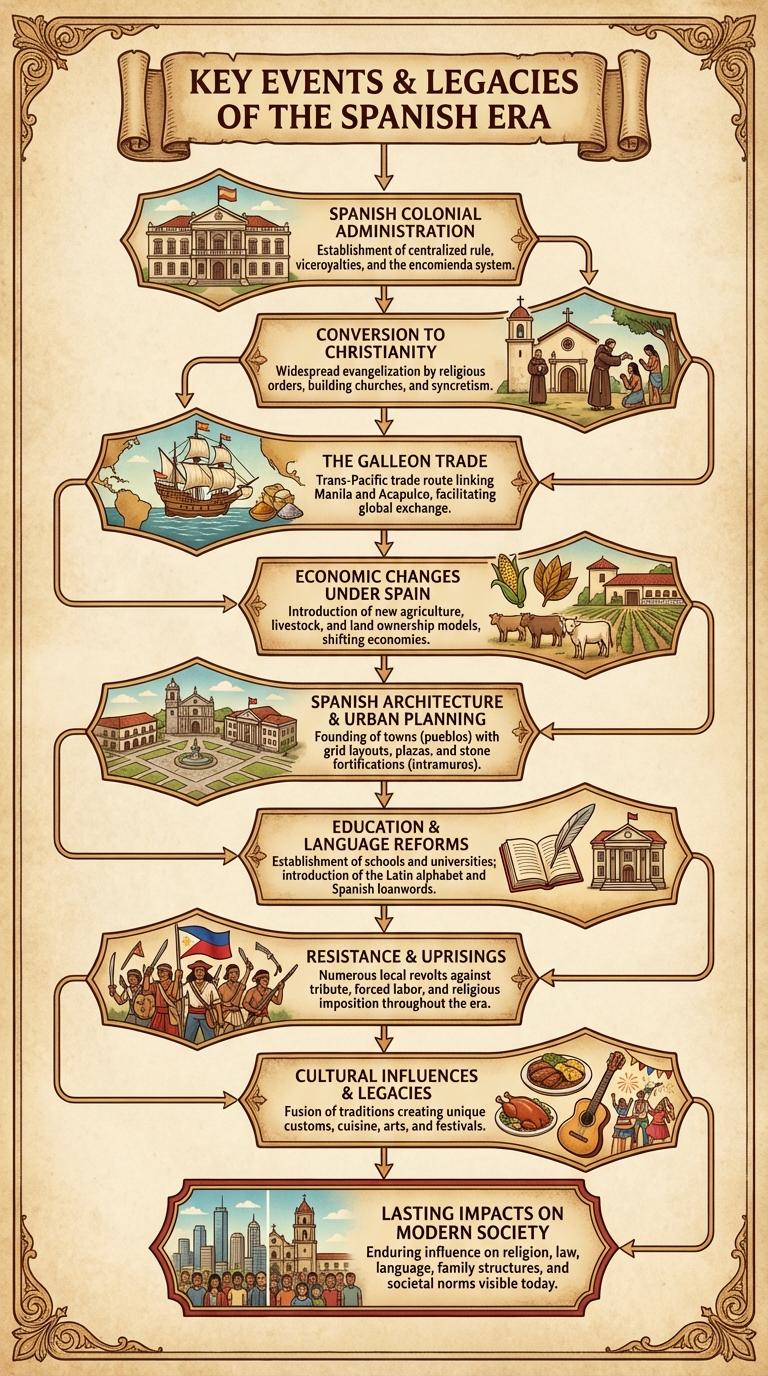
The Spanish Era marked a significant period of cultural exchange, colonization, and architectural development that shaped the history of many regions. This infographic highlights key events, influential figures, and lasting legacies of the Spanish colonial period. Understanding these elements provides insight into the profound impact of Spain's expansion on global history.
Key Events of the Spanish Era
The Spanish Era in the Philippines lasted from 1565 to 1898, marking over three centuries of colonial rule. This period significantly influenced the country's culture, religion, and governance.
Key events during the Spanish Era include the arrival of Miguel Lopez de Legazpi in 1565, who established the first permanent Spanish settlement. The introduction of Christianity played a crucial role in shaping Filipino society. The British occupation of Manila from 1762 to 1764 was a brief interruption in Spanish control but highlighted the strategic importance of the Philippines.
Cultural Influences and Legacies
The Spanish Era significantly shaped cultural landscapes through language, religion, and architecture. These influences remain integral to societies in former Spanish colonies.
- Language Integration - Spanish became the dominant language, influencing literature and daily communication in many regions.
- Religious Influence - The introduction of Catholicism altered religious practices and motivated the construction of iconic churches.
- Architectural Heritage - Colonial Spanish architecture introduced distinct styles visible in government buildings and churches.
Spanish Colonial Administration
The Spanish Colonial Administration governed the Philippines from 1565 to 1898, establishing a centralized structure headed by the Governor-General. This system integrated local leaders, such as the principalia, under Spanish authority to maintain control and facilitate taxation. Key administrative divisions included provinces called encomiendas, each managed by encomenderos responsible for local governance and resource extraction.
Conversion to Christianity
How did the Spanish Era influence the conversion to Christianity? The Spanish Era marked a significant period of religious transformation, as Spanish colonizers introduced Christianity to indigenous populations. Missionaries established churches and schools to facilitate the widespread adoption of Christian beliefs.
The Galleon Trade
The Spanish era significantly shaped global trade through the Galleon Trade, a crucial maritime link between Asia and the Americas from 1565 to 1815. Spanish galleons transported valuable goods such as silver, spices, silk, and porcelain, fostering economic and cultural exchanges.
This trade route connected Manila in the Philippines to Acapulco in Mexico, facilitating one of the longest and most profitable sea trades in history. The Galleon Trade influenced urban development, commerce, and international relations during the Spanish colonial period.
Education and Language Reforms
The Spanish era significantly influenced education and language reforms, shaping the cultural and intellectual landscape. These reforms aimed to standardize language use and expand educational access across colonies.
- Establishment of Schools - Spanish authorities founded public and religious schools to promote literacy and educate indigenous populations.
- Introduction of Spanish Language - Spanish became the primary language of instruction and governance, replacing many local dialects.
- Curriculum Standardization - Educational content was standardized to include religious teachings, Spanish history, and language proficiency.
Resistance and Uprisings
| Event | Details |
|---|---|
| Dagohoy Rebellion | Longest Filipino revolt against Spanish rule (1744-1829); led by Francisco Dagohoy in Bohol; aimed to resist forced labor and religious impositions. |
| Silang Revolt | 1770-1771 uprising led by Diego Silang in Ilocos; sought to overthrow Spanish authorities and establish indigenous governance; continued briefly by his wife, Gabriela Silang. |
| Pamulak Manobo Resistance | Indigenous Mindanao group actively opposed Spanish colonization through guerrilla tactics; preserved tribal autonomy and culture throughout the Spanish era. |
| 1840 Novales Revolt | Led by Andres Novales, a mestizo criollo officer dissatisfied with Spanish favoritism; attempted a coup in Manila but was quickly suppressed. |
| Katipunan | Founded in 1892 by Andres Bonifacio; secret society aimed to gain independence from Spain through armed revolution; sparked the Philippine Revolution in 1896. |
Economic Changes Under Spain
The Spanish Era brought significant economic transformations to the Philippines. These changes laid the foundation for modern trade and agriculture in the region.
- Galleon Trade Introduction - Established a trans-Pacific trade route connecting Manila and Acapulco, boosting commerce between Asia and the Americas.
- Land Ownership Reforms - The encomienda system centralized land control under Spanish officials, impacting traditional land use and agriculture.
- Cash Crop Cultivation - Introduction of crops like tobacco and sugarcane transformed local agriculture into export-oriented production.
The economic shifts under Spanish rule markedly influenced the Philippines' social and commercial structures for centuries.
Spanish Architecture and Urban Planning
The Spanish Era significantly influenced architecture and urban planning in the Philippines, introducing Baroque-style churches, forts, and public buildings characterized by intricately carved facades and massive stone constructions. Cities were designed using the "Laws of the Indies," a guideline that emphasized a central plaza surrounded by key institutions like the church, government offices, and schools. This urban blueprint created organized, fortified settlements that remain evident in historic town centers throughout the country.