
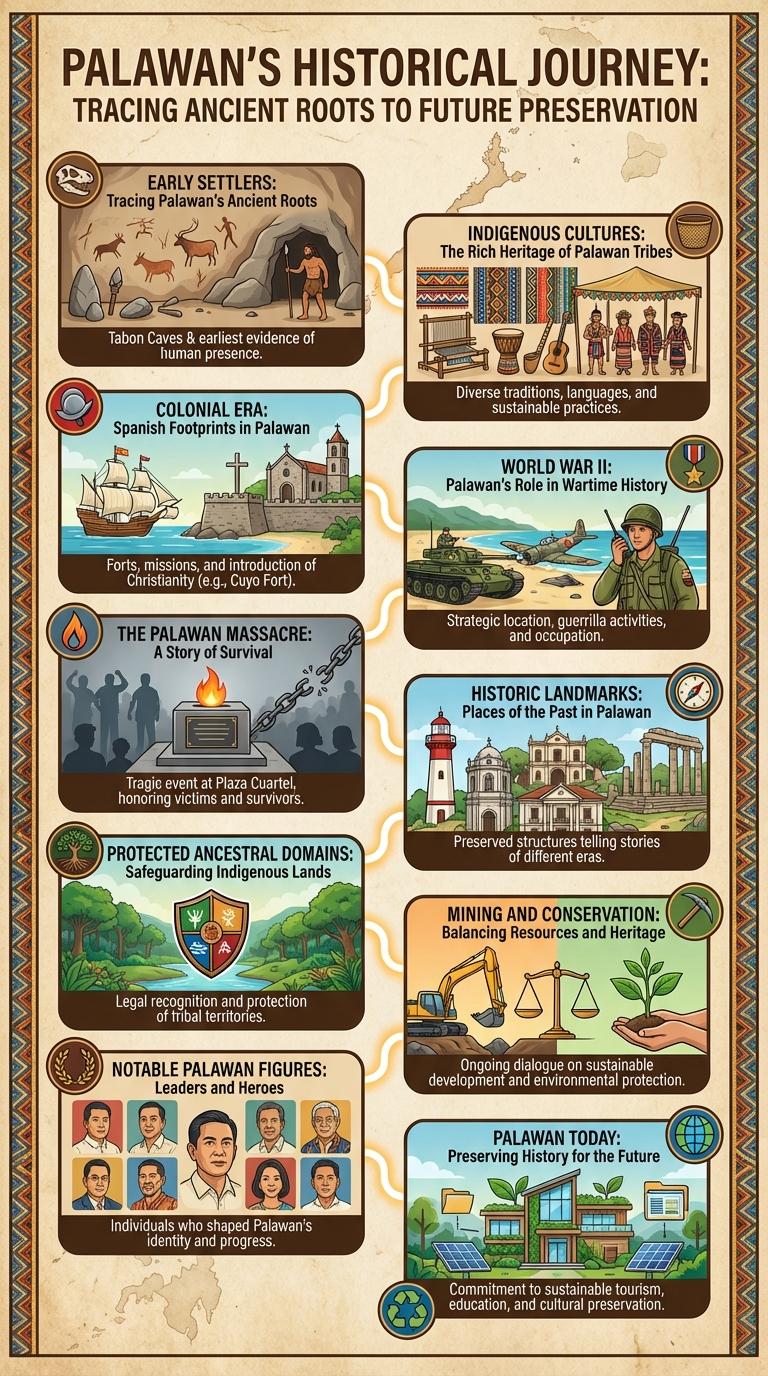
Explore the rich heritage of Palawan through this detailed infographic, highlighting key events, cultural milestones, and historical landmarks. Discover how diverse influences shaped the island's unique identity and contributed to its natural and cultural treasures. Visual elements bring to life the stories that define Palawan's past and continue to inspire its future.
Early Settlers: Tracing Palawan's Ancient Roots
Palawan's history begins with its early settlers, who laid the foundation for the island's rich cultural heritage. Archaeological discoveries reveal the ancient roots of these communities, highlighting their adaptation to Palawan's unique environment.
- Negrito populations - Considered among the earliest inhabitants, Negritos lived as hunter-gatherers dated back over 30,000 years.
- Tabon Caves artifacts - These caves contain tools and human remains dating approximately 22,000 years, evidencing early human activity.
- Austronesian migration - Around 3,000 years ago, Austronesian settlers introduced agriculture and pottery, enhancing Palawan's cultural complexity.
Indigenous Cultures: The Rich Heritage of Palawan Tribes
Palawan is home to diverse indigenous groups such as the Tagbanua, Palaw'an, and Batak tribes, each with unique traditions and practices. These communities have preserved ancient rituals, art, and knowledge connected to the land and nature. Their rich heritage plays a vital role in Palawan's cultural identity and environmental stewardship.
Colonial Era: Spanish Footprints in Palawan
Palawan's colonial history is deeply influenced by Spanish exploration and settlement from the 16th century onwards. The Spanish established missions and garrisons to control the island and promote Christianity among indigenous communities.
Spanish architecture, such as old churches and fortifications, still marks Palawan's landscape today. Cultural exchanges during this era introduced new customs, crops, and governance systems shaping Palawan's identity.
World War II: Palawan's Role in Wartime History
What was Palawan's significance during World War II?
Palawan served as a strategic military base due to its geographical location in the Philippines. It was a site of intense conflict and played a key role in the resistance against Japanese occupation.
How did the Palawan Massacre impact the course of the war?
The Palawan Massacre, where over 100 American POWs were killed by Japanese forces in 1944, highlighted the brutality of the occupation. This event galvanized Allied efforts to liberate the Philippines.
What military installations were established in Palawan during WWII?
| Installation | Purpose |
|---|---|
| Puerto Princesa Airfield | Air operations hub for Allied forces |
| San Vicente Naval Base | Naval defense and supply station |
| Underground Tunnels | Shelters and command centers |
| Guindulman Camps | Prisoner of war camps |
| Navigation Stations | Coordinates and intel gathering |
Which local groups contributed to the war effort in Palawan?
Local guerrilla fighters played a crucial role in intelligence and sabotage missions. Civilian support helped sustain Allied forces through supplies and information.
What is Palawan's legacy from World War II today?
The island hosts memorials and museums commemorating its wartime sacrifices. Palawan remains a symbol of resilience and freedom in Philippine history.
The Palawan Massacre: A Story of Survival
The Palawan Massacre took place during World War II on December 14, 1944. This tragic event involved the mass killing of American prisoners of war by Japanese forces in Palawan, Philippines.
Approximately 150 American POWs were brutally executed in the massacre, leading to one of the deadliest atrocities in the Pacific Theater. Some prisoners managed to survive by hiding in the jungle or escaping. Their stories of resilience highlight the courageous spirit amid extreme hardship during the occupation of Palawan.
Historic Landmarks: Places of the Past in Palawan
Palawan's rich history is reflected in its numerous historic landmarks that tell stories of the past. Notable sites include the Palawan Heritage Center, the Iwahig Penal Colony, and the Fort Santa Isabel, each preserving unique aspects of local culture and colonial history. These landmarks serve as vital connections to Palawan's heritage, attracting both historians and tourists alike.
Protected Ancestral Domains: Safeguarding Indigenous Lands
| Topic | Details |
|---|---|
| Region | Palawan, Philippines |
| Protected Ancestral Domains | Land areas legally recognized and reserved for Indigenous Peoples in Palawan |
| Key Indigenous Groups | Palaw'an, Tagbanua, Batak, and Tau't Batu |
| Legal Framework | Republic Act No. 8371 (Indigenous Peoples' Rights Act of 1997) |
| Importance | Protects indigenous cultural heritage, natural resources, and biodiversity in ancestral lands |
Mining and Conservation: Balancing Resources and Heritage
Palawan's rich mineral resources have driven mining activities that support local economies while posing challenges to environmental preservation. Efforts to balance mining development with conservation are integral to protecting Palawan's unique biodiversity and cultural heritage.
- Mining Industry Growth - Palawan's deposits of nickel, chromite, and gold contribute significantly to regional employment and revenue.
- Environmental Impact - Unregulated mining has threatened coastal ecosystems, forest areas, and endangered species habitats.
- Conservation Initiatives - Government and NGOs promote sustainable mining practices alongside the establishment of protected areas.
Strategic policies aim to harmonize resource extraction with the preservation of Palawan's natural and historical legacy for future generations.
Notable Palawan Figures: Leaders and Heroes
Palawan boasts a rich history shaped by notable leaders and heroes who fought for the island's freedom and cultural identity. These figures played critical roles in resisting colonial powers and preserving indigenous traditions.
One prominent hero is Francisco dela Cruz, known for his leadership during the Philippine Revolution against Spanish rule. Another significant figure is Datuk Mamindang, a tribal leader who defended Palawan's native communities from external threats.