
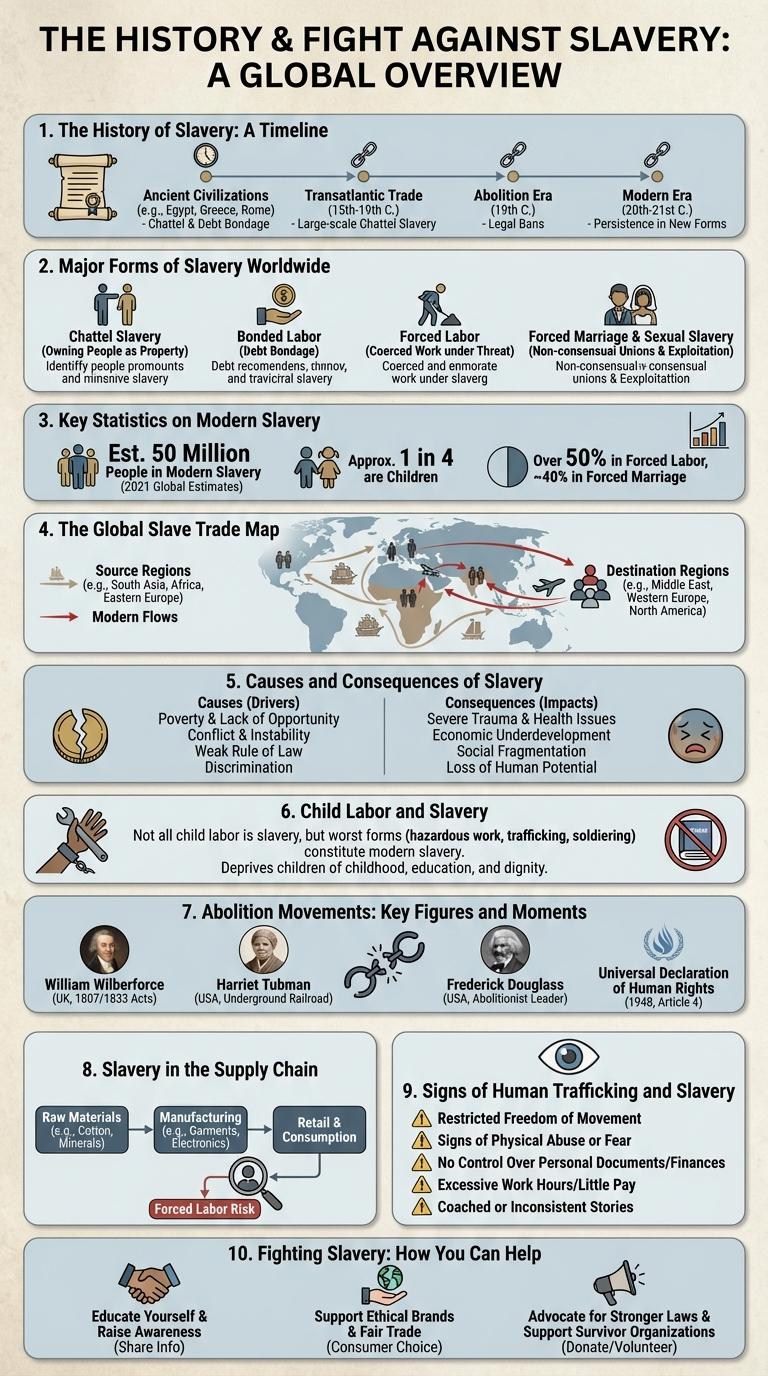
Slavery represents one of the darkest chapters in human history marked by oppression and the denial of basic rights. Visualizing key statistics and timelines through an infographic elucidates the vast impact and legacy of this inhumane practice. Such a tool facilitates understanding by highlighting the historical scope and lasting consequences of slavery globally.
The History of Slavery: A Timeline
Slavery has existed for thousands of years, with roots tracing back to ancient civilizations such as Mesopotamia, Egypt, and Greece. It evolved through different eras, profoundly shaping social and economic structures worldwide.
Key milestones include the transatlantic slave trade from the 15th to the 19th century, which transported millions of Africans to the Americas. The abolition movements of the 18th and 19th centuries led to the official end of slavery in many countries, though its legacies persist today.
Major Forms of Slavery Worldwide
| Major Form of Slavery | Description |
|---|---|
| Forced Labor | Individuals compelled to work under threat, often in agriculture, construction, or manufacturing, without freedom to leave or fair pay. |
| Debt Bondage | People pledge labor to repay a debt, with terms that trap them in cycles of involuntary servitude, common in South Asia. |
| Human Trafficking | Coercion or deception used to exploit victims for labor or sex, involving millions worldwide in illegal trade and exploitation networks. |
| Child Slavery | Children forced into labor, armed conflict, or sexual exploitation, violating rights and impairing development. |
| Forced Marriage | Individuals, often women and girls, compelled to marry against their will, leading to exploitation and loss of autonomy. |
Key Statistics on Modern Slavery
Modern slavery affects over 40 million people worldwide, with forced labor and human trafficking as the most common forms. Approximately 71% of victims are women and girls, highlighting significant gender disparities. The global economic impact of modern slavery is estimated at $150 billion annually, emphasizing the urgent need for intervention.
The Global Slave Trade Map
The Global Slave Trade Map visualizes the extensive routes exploited during the transatlantic and trans-Saharan slave trades. It highlights the major regions involved in the capture, transportation, and sale of enslaved people from the 15th to 19th centuries.
The map demonstrates the scale and geographic complexity of forced human migration driven by slavery.
- Transatlantic Routes - These pathways connected West Africa to the Americas, facilitating the forced transport of millions of Africans.
- Major Slave Ports - Cities such as Luanda, Goree Island, and Rio de Janeiro were critical hubs in the slave trade network.
- Volume of Enslaved People - Over 12 million Africans were estimated to have been shipped across the Atlantic during this period.
Causes and Consequences of Slavery
Slavery began as a system driven by economic demand for cheap labor, particularly in agriculture and mining. Social hierarchies and racial ideologies further entrenched slavery, making it a widespread institution across continents.
The causes of slavery include the pursuit of profit, colonization, and racial discrimination. Consequences involved the severe deprivation of human rights, cultural disintegration, and long-lasting socio-economic inequalities. The legacy of slavery continues to impact modern societies through systemic racism and social disparities.
Child Labor and Slavery
Child labor remains a critical issue linked with modern slavery, affecting millions worldwide. Exploited children often endure harsh working conditions, depriving them of education and basic rights.
- Global Impact - Over 160 million children are engaged in child labor, many trapped in forced work and slavery-like conditions.
- Economic Exploitation - Children are often forced to work long hours for little or no pay in industries such as agriculture, mining, and manufacturing.
- Health and Safety Risks - Child laborers face physical harm, abuse, and psychological trauma due to unsafe and exploitative environments.
Efforts to combat child labor and slavery focus on enforcement of laws, education access, and global awareness campaigns.
Abolition Movements: Key Figures and Moments
What were the key abolition movements that shaped history? Abolition movements were crucial in ending slavery worldwide. Many courageous individuals and landmark events played pivotal roles in this fight for freedom.
| Key Figure | Contribution |
|---|---|
| Frederick Douglass | Former enslaved person turned powerful abolitionist speaker and writer |
| William Wilberforce | Led the campaign to abolish the slave trade in the British Parliament |
| Harriet Tubman | Conducted the Underground Railroad, helping slaves escape to freedom |
| Sojourner Truth | Advocated for abolition and women's rights through speeches and activism |
| John Brown | Radical abolitionist known for armed resistance against slavery |
| Key Moment | Impact |
|---|---|
| Abolition of the Slave Trade Act (1807) | Ended the British transatlantic slave trade |
| Emancipation Proclamation (1863) | Declared freedom for slaves in Confederate states |
| 13th Amendment (1865) | Constitutionally abolished slavery in the United States |
| Haitian Revolution (1791-1804) | First successful slave revolt leading to independence and abolition |
| International Convention for the Suppression of the Slave Trade (1926) | Established global efforts to abolish slavery |
Slavery in the Supply Chain
Slavery in the supply chain affects millions of workers worldwide, hidden within industries like agriculture, manufacturing, and mining. Companies may unknowingly source products tied to forced labor due to complex, multi-tiered supply networks. Transparency and ethical sourcing practices are essential to combat slavery and promote human rights across global markets.
Signs of Human Trafficking and Slavery
Human trafficking and modern slavery involve exploiting individuals through force, fraud, or coercion. Recognizing the signs can help identify victims and provide necessary support and intervention.
- Restricted Freedom - Victims often cannot leave their workplace or living environment without permission.
- Withholding of Identification - Traffickers typically confiscate passports or ID documents to control victims.
- Unusual Work or Living Conditions - Overcrowded, unsafe, or secretive locations may indicate forced labor or captivity.
- Signs of Physical Abuse - Bruises, scars, or signs of neglect can be indicators of abuse and exploitation.
- Lack of Control Over Finances - Victims usually have no access to their earnings or financial resources.