
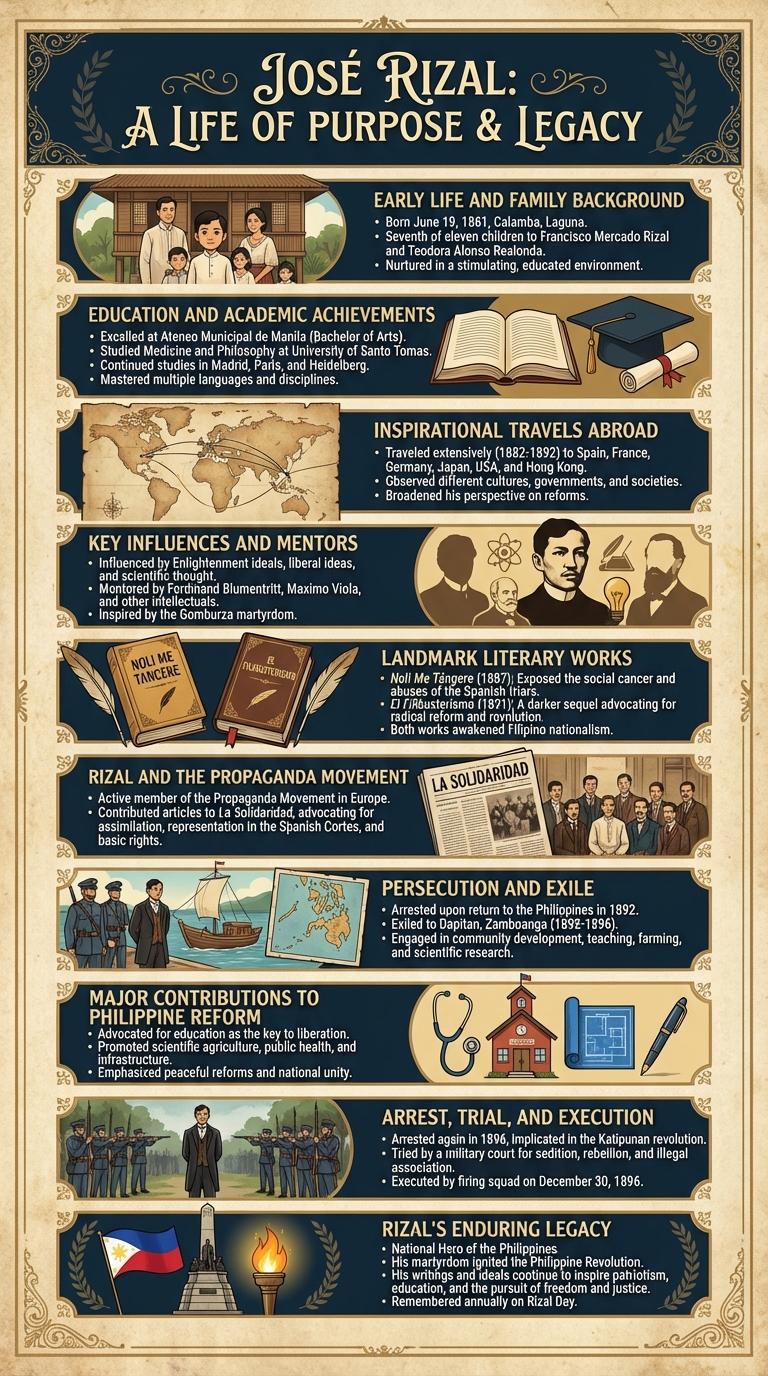
Jose Rizal's life and works showcase the profound impact of a national hero whose writings inspired a revolution for freedom. His literary masterpieces, including *Noli Me Tangere* and *El Filibusterismo*, exposed social injustices under colonial rule and fueled Filipino nationalism. This infographic captures key events and achievements that shaped Rizal's enduring legacy in Philippine history.
Early Life and Family Background
Jose Rizal was born on June 19, 1861, in Calamba, Laguna, Philippines, into a wealthy and influential family. His parents, Francisco Mercado and Teodora Alonso, were well-educated and deeply valued education and patriotism. Rizal's early life was marked by a supportive environment that nurtured his talents in writing, art, and languages.
Education and Academic Achievements
Jose Rizal's education was instrumental in shaping his role as a national hero and intellectual leader of the Philippines. His academic achievements reflect his dedication to learning and his commitment to social reform through knowledge.
Rizal studied at the Ateneo Municipal de Manila and later pursued higher education in Europe, where he excelled in various fields including medicine, literature, and philosophy.
- Ateneo Municipal de Manila Graduate - Rizal graduated with a Bachelor of Arts degree with highest honors in 1877.
- University of Santo Tomas Attendee - He studied medicine at the University but continued his education abroad to further specialize.
- University of Madrid Medical Degree - Rizal earned a Doctor of Medicine and Philosophy degree in 1884.
- Multilingual Scholar - Mastery of multiple languages enabled Rizal to write influential works and correspond with European intellectuals.
- Published Literary Works - His novels, including "Noli Me Tangere" and "El Filibusterismo," demonstrated his academic excellence and advocacy for reform.
Inspirational Travels Abroad
| Year | Destination |
|---|---|
| 1882 | Spain (Madrid) - Studied Medicine and Philosophy |
| 1885 | Germany (Heidelberg) - Specialized in Ophthalmology |
| 1887 | France (Paris) - Wrote "Noli Me Tangere" |
| 1888 | Belgium (Brussels) - Wrote "El Filibusterismo" |
| 1890-1891 | United States and United Kingdom - Advocated for Philippine reforms |
Key Influences and Mentors
Jose Rizal, a Filipino national hero, was deeply influenced by his family and prominent mentors throughout his life. His parents instilled strong values of education and patriotism that shaped his character from an early age.
Rizal's mentors included his uncle, Fr. Jose Alberto, who guided his early studies, and Dr. Ferdinand Blumentritt, a European scholar who supported Rizal's reformist ideas. These influences helped Rizal develop his skills as a writer, thinker, and advocate for Philippine independence.
Landmark Literary Works
Jose Rizal, a Filipino nationalist and polymath, profoundly impacted literature with his revolutionary works. His writings fueled the Philippine reform movement and inspired the fight for independence.
- Noli Me Tangere - A novel exposing the abuses of Spanish colonial rule and the clerical power in the Philippines.
- El Filibusterismo - A sequel to Noli Me Tangere that critiques social injustices and advocates for reform through a darker, revolutionary lens.
- Mi Ultimo Adios - A poignant farewell poem expressing Rizal's patriotism and sacrifice for his country's freedom.
Rizal and the Propaganda Movement
Jose Rizal played a pivotal role in the Propaganda Movement, advocating for Philippine reforms through his writings and activism. His works inspired collective Filipino identity and resistance against Spanish colonial rule.
- Rizal's novels - "Noli Me Tangere" and "El Filibusterismo" exposed social injustices under Spanish rule and sparked nationalist sentiments.
- Membership in La Liga Filipina - Rizal founded this organization to promote social reforms and peaceful advocacy among Filipinos.
- Contributions to La Solidaridad - He wrote essays and letters supporting reformist ideas alongside other Filipino expatriates in Europe.
Rizal's intellectual leadership significantly advanced the goals of the Propaganda Movement, laying the groundwork for Philippine independence.
Persecution and Exile
Jose Rizal, a national hero of the Philippines, faced intense persecution by Spanish colonial authorities due to his writings that inspired Filipino nationalism. His novels, particularly "Noli Me Tangere" and "El Filibusterismo," exposed the abuses of the colonial government and the church.
Rizal's activism led to his exile in Dapitan, where he continued to contribute to society through education, agriculture, and community projects. Despite the harsh conditions, his work during exile demonstrated his unwavering commitment to the Filipino people and their quest for freedom.
Major Contributions to Philippine Reform
Jose Rizal, a Filipino nationalist and revolutionary, played a pivotal role in advocating for reforms during Spanish colonial rule in the Philippines. His writings and activism inspired the movement towards Philippine independence.
Rizal's major contributions to Philippine reform include his novels "Noli Me Tangere" and "El Filibusterismo," which exposed the social injustices under Spanish rule. He called for equal rights, education reforms, and the end of abusive practices by the clergy. His works galvanized Filipinos to seek peaceful reforms and national identity.
Arrest, Trial, and Execution
What events led to Jose Rizal's arrest, trial, and execution?
Jose Rizal was arrested in 1896 during the Philippine Revolution for allegedly inciting rebellion against Spanish rule. His trial was swift, resulting in a death sentence despite debates about his actual involvement in the revolt.
How was Rizal's trial conducted and what were its outcomes?
Rizal's trial by a Spanish military court focused on charges of rebellion, sedition, and conspiracy. Despite a lack of concrete evidence, the court found him guilty, leading to a death sentence confirmed by the Spanish Governor-General.
What was the significance of Rizal's execution for the Philippines?
Rizal was executed by firing squad on December 30, 1896, at Bagumbayan (now Luneta Park), Manila. His martyrdom inspired Filipinos to unite and intensify their fight for independence from Spanish colonial rule.