
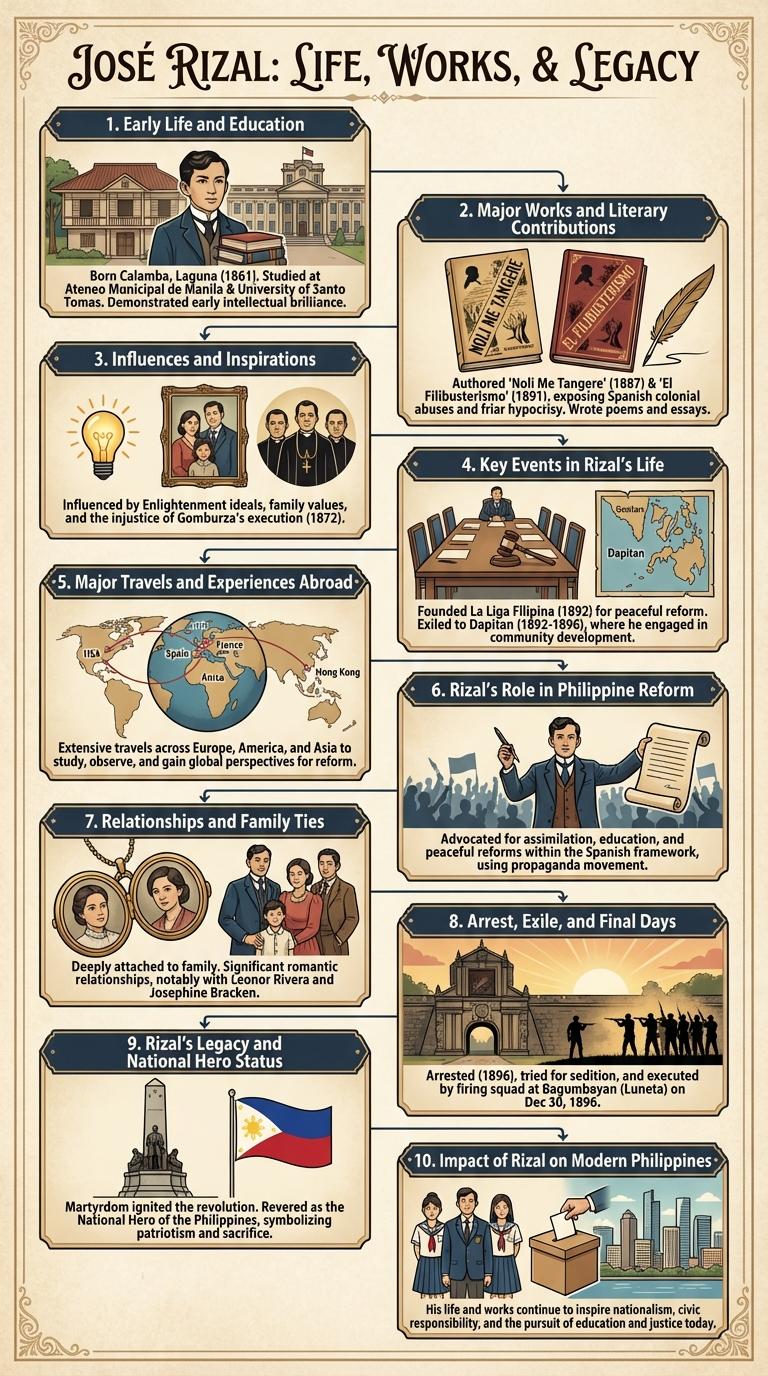
Jose Rizal remains a national hero whose life and works significantly shaped Philippine history and identity. This infographic highlights key events, achievements, and contributions that define Rizal's enduring legacy. Discover how his advocacy for reform and education continues to inspire generations.
Early Life and Education of Rizal
Jose Rizal, a Filipino nationalist and hero, was born on June 19, 1861, in Calamba, Laguna. His early education laid the foundation for his notable contributions to Philippine history and literature.
- Birthplace and Date - Rizal was born in Calamba, Laguna, into a well-to-do family with deep Filipino and Chinese roots.
- Primary Education - He first studied under private tutors and then at a local school where he excelled in various subjects.
- Higher Education - Rizal attended Ateneo Municipal de Manila and later the University of Santo Tomas before pursuing medicine in Europe.
Rizal's early academic excellence and intellectual curiosity shaped him into a pivotal figure in the Philippine reform movement.
Major Works and Literary Contributions
Jose Rizal, the national hero of the Philippines, made significant contributions to Filipino literature and nationalism. His major works include novels, poems, and essays that inspired the Philippine revolution against Spanish colonization.
Rizal's most famous novels, "Noli Me Tangere" and "El Filibusterismo," exposed social injustices and fueled the desire for reform. His literary contributions also include powerful poems like "Mi Ultimo Adios," which remains a symbol of patriotism and sacrifice.
Influences and Inspirations
Dr. Jose Rizal was deeply influenced by the European Enlightenment, which fueled his advocacy for reform and equality in the Philippines. His exposure to liberal ideas during his studies in Spain and Germany inspired his writings advocating for freedom and justice. Rizal's dedication to his country was also shaped by his love for Filipino culture and history, driving his lifelong pursuit of national identity and independence.
Key Events in Rizal's Life
Jose Rizal, a national hero of the Philippines, was born on June 19, 1861, in Calamba, Laguna. He published his two famous novels, "Noli Me Tangere" and "El Filibusterismo," which exposed Spanish colonial abuses. Rizal was executed on December 30, 1896, by the Spanish colonial government for his role in inspiring the Philippine revolution.
Major Travels and Experiences Abroad
| Major Travel | Key Experiences |
|---|---|
| 1869 - Manila to Spain | Studied medicine at the University of Santo Tomas and later at Universidad Central de Madrid; honed writing skills and became active in political reform movements. |
| 1888 - Spain to France and Germany | Traveled across Europe to study ophthalmology; improved medical knowledge and immersed in European culture. |
| 1889 - Germany and Belgium | Completed specialization in ophthalmology at the University of Heidelberg; encountered liberal ideas influencing his reformist ideology. |
| 1888-1891 - Visits to London, Paris, and other European cities | Engaged with Filipino expatriates and European intellectuals; further developed nationalist writings such as "Noli Me Tangere" and "El Filibusterismo". |
| 1896 - Return from Hong Kong | Exile in Dapitan, Philippines; applied medical skills to community development; planned revolution against Spanish colonial rule. |
Rizal's Role in Philippine Reform
Jose Rizal was a key figure in the Philippine reform movement during Spanish colonial rule. His writings and actions inspired a nationwide quest for political and social change.
Rizal advocated peaceful reform through education and civic engagement rather than violent revolution. He exposed colonial abuses and encouraged Filipino identity and pride.
- Author of Reformist Literature - Rizal wrote seminal works like Noli Me Tangere and El Filibusterismo that highlighted colonial injustices.
- Founder of La Liga Filipina - He established an organization promoting social reforms, unity, and mutual aid among Filipinos.
- Symbol of Filipino Nationalism - His martyrdom galvanized Filipinos to pursue independence and reforms systematically.
Relationships and Family Ties
What role did family play in Jose Rizal's life and work?
Family was central to Jose Rizal's identity and motivation. His close relationships, especially with his parents Francisco Mercado and Teodora Alonso, shaped his values and aspirations.
How did Rizal's siblings influence his personal and professional journey?
Rizal's siblings, such as Paciano and Trinidad, provided emotional support and shared his nationalist ideals. Paciano, in particular, was a key figure in advancing the Philippine revolution.
In what way did Rizal's relationships reflect his advocacy for reform?
Rizal maintained strong ties with friends and intellectuals who contributed to his reformist vision. His correspondence with family and allies strengthened the network behind his advocacy.
What was the impact of Rizal's family on his writings?
Personal experiences with his family inspired many themes in Rizal's novels and essays. His works often emphasized familial love, social justice, and national pride.
How did Rizal balance his family commitments with his revolutionary activities?
Despite his activism, Rizal prioritized communication with his loved ones through letters and visits. This balance provided him with resilience and a grounding sense of purpose.
Arrest, Exile, and Final Days
Dr. Jose Rizal, the national hero of the Philippines, faced significant hardships during the final years of his life that underscored his dedication to reform and national sovereignty. His arrest, exile, and eventual execution marked pivotal moments in the Filipino struggle for independence against Spanish colonial rule.
- Arrest - Rizal was arrested in 1896 on charges of rebellion, sedition, and conspiracy against the Spanish government after the outbreak of the Philippine Revolution.
- Exile - Before his arrest, Rizal was exiled to Dapitan in Mindanao for four years, where he engaged in community development, teaching, and medical practice.
- Final Days - Rizal was executed by firing squad on December 30, 1896, in Bagumbayan (now Luneta Park), solidifying his role as a martyr for Philippine independence.
Rizal's Legacy and National Hero Status
Dr. Jose Rizal is revered as the national hero of the Philippines due to his pivotal role in inspiring the Filipino people towards independence. His writings, most notably "Noli Me Tangere" and "El Filibusterismo," exposed the injustices of Spanish colonial rule and ignited a sense of nationalism.
Rizal's legacy endures in the Philippines through monuments, educational institutions, and national holidays commemorating his life and achievements. His advocacy for reform, non-violent resistance, and intellectual empowerment remains central to Filipino identity and patriotism.