
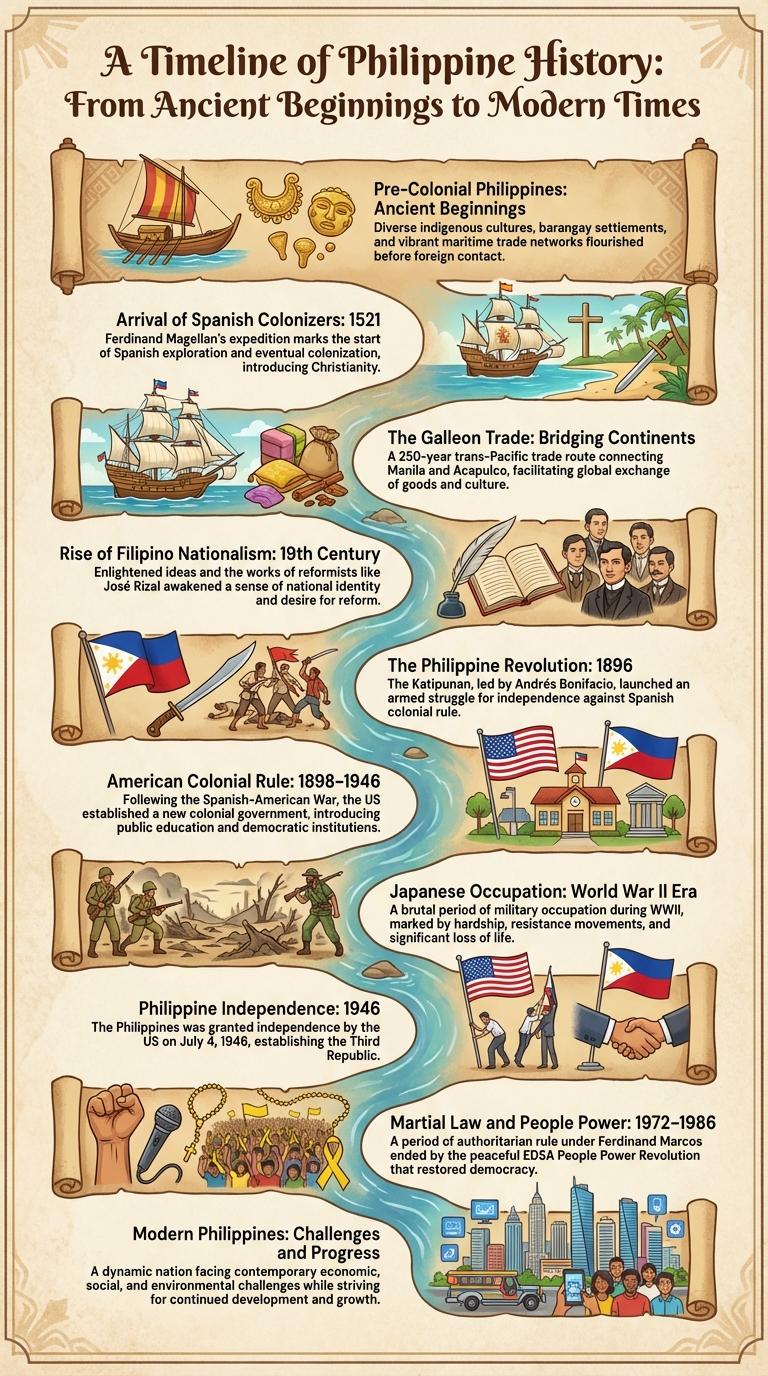
The infographic chronicles the rich and diverse history of the Philippines, highlighting key events from pre-colonial times to modern independence. It showcases significant cultural, political, and social milestones that shaped the nation's identity. Visual elements emphasize important dates, influential figures, and historical transformations that continue to impact Filipino society today.
Pre-Colonial Philippines: Ancient Beginnings
The Pre-Colonial Philippines era spans thousands of years before Spanish colonization, marked by diverse indigenous communities. Early Filipinos engaged in trade, agriculture, and craftsmanship, with rich oral traditions shaping their cultures. Archaeological finds, such as the Laguna Copperplate Inscription, reveal advanced social and political organization in ancient Philippine societies.
Arrival of Spanish Colonizers: 1521
The arrival of Spanish colonizers in the Philippines marks a significant turning point in the nation's history, beginning in 1521. This event initiated over three centuries of Spanish influence on the culture, religion, and governance of the islands.
- Ferdinand Magellan's Expedition - The Portuguese explorer, sailing for Spain, arrived in the Philippines in March 1521, marking the first recorded European contact.
- Introduction of Christianity - Spanish colonizers introduced Roman Catholicism, which became a dominant religion in the Philippines.
- Establishment of Spanish Rule - The arrival in 1521 laid the foundation for Spanish colonial governance that lasted until 1898.
The Galleon Trade: Bridging Continents
The Galleon Trade was a significant maritime trading route linking the Philippines and Mexico from 1565 to 1815. It facilitated the exchange of goods, culture, and ideas between Asia and the Americas.
This trade route operated through large Spanish galleons that sailed annually across the Pacific Ocean. Manila became a central hub for Asian goods like silk, spices, and porcelain. The trade fostered economic growth in the Philippines and connected continents in an unprecedented way.
Rise of Filipino Nationalism: 19th Century
What events sparked the rise of Filipino nationalism in the 19th century?
The 19th century marked the emergence of Filipino nationalism influenced by Spanish colonial rule and exposure to liberal ideas. Key events like the Propaganda Movement and the publication of Jose Rizal's novels fueled national consciousness.
The Philippine Revolution: 1896
The Philippine Revolution of 1896 marked a significant uprising against Spanish colonial rule. It was primarily led by the secret society, Katipunan, founded by Andres Bonifacio.
The revolution aimed to gain independence from over 300 years of Spanish dominance. Key battles, such as the Cry of Pugad Lawin, ignited widespread Filipino resistance across the archipelago.
American Colonial Rule: 1898–1946
The American Colonial Rule in the Philippines began in 1898 after the Treaty of Paris ended the Spanish-American War. The United States established civil government and introduced public education, infrastructure, and legal reforms.
This period lasted until 1946 when the Philippines gained full independence. American influence shaped the country's political institutions, economy, and cultural landscape throughout these decades.
Japanese Occupation: World War II Era
The Japanese Occupation of the Philippines lasted from 1942 to 1945 during World War II, marking a period of intense struggle and resistance. The harsh military rule included widespread atrocities, forced labor, and severe shortages of food and medicine. Filipino guerrillas, alongside Allied forces, played a crucial role in the eventual liberation of the country in 1945.
Philippine Independence: 1946
| Event | Description |
|---|---|
| Philippine Independence Date | July 4, 1946 |
| Recognizing Authority | United States of America |
| Historical Context | End of American colonial rule after World War II |
| Key Figure | Manuel Roxas, First President of the independent Philippines |
| Significance | Official birth of the Third Philippine Republic and full sovereignty |
Martial Law and People Power: 1972–1986
The period between 1972 and 1986 in Philippine history is marked by the declaration of Martial Law and the People Power Revolution. These events significantly shaped the nation's political landscape and democratic processes.
Martial Law was declared by President Ferdinand Marcos in 1972, leading to increased authoritarian rule. The People Power Revolution in 1986 successfully ended Marcos's regime and restored democracy.
- Declaration of Martial Law (1972) - President Ferdinand Marcos declared Martial Law on September 21, 1972, to suppress dissent and extend his power.
- Human Rights Violations - Under Martial Law, political opposition was silenced, resulting in arrests, censorship, and human rights abuses across the country.
- Economic and Social Impact - The regime's corrupt practices led to economic decline and growing public discontent during this period.
- Assassination of Benigno Aquino Jr. (1983) - The murder of opposition leader Benigno Aquino Jr. intensified public outrage and mobilized opposition forces.
- People Power Revolution (1986) - Millions of Filipinos peacefully protested, leading to Marcos's ousting and the inauguration of Corazon Aquino as president, restoring democratic governance.