
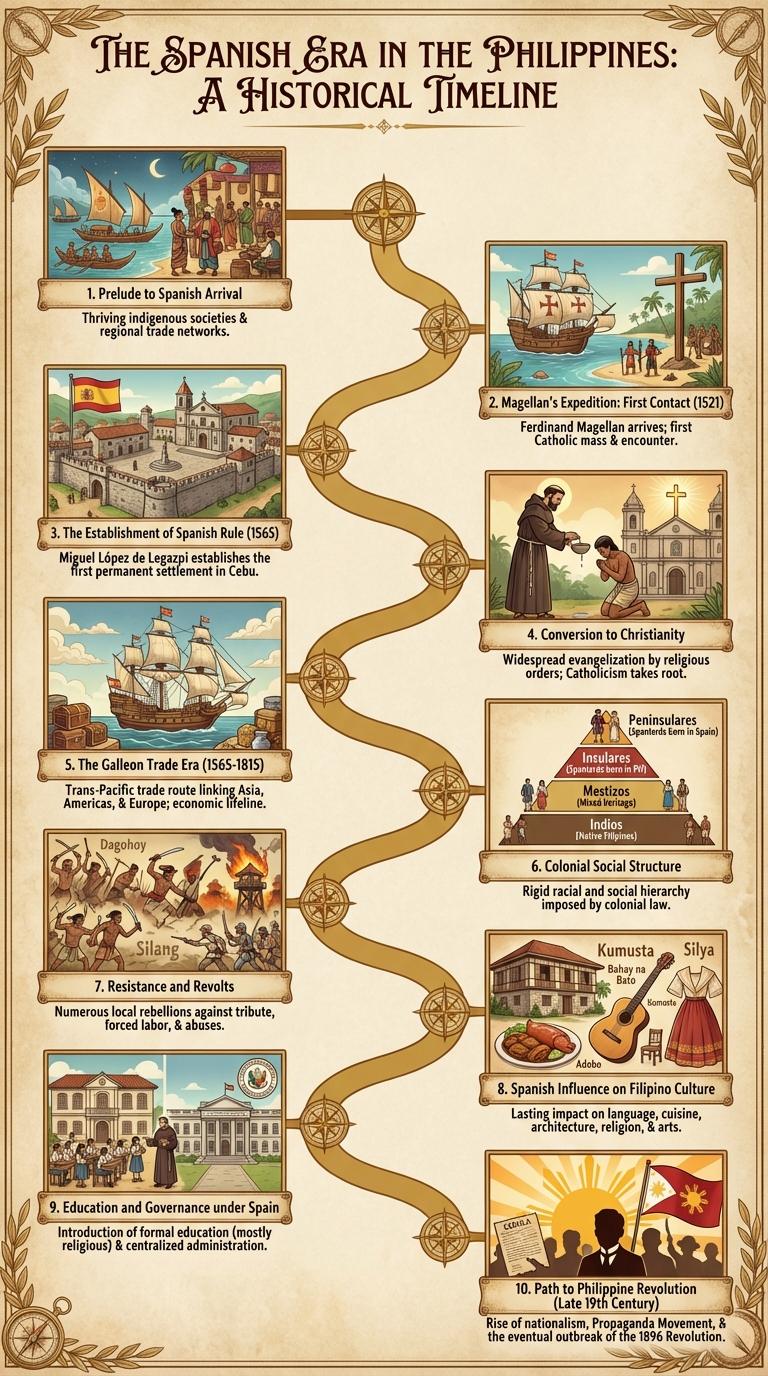
Spanish colonization in the Philippines profoundly shaped the country's culture, religion, and governance for over three centuries. This infographic illustrates key events, influential figures, and lasting impacts of Spanish rule from 1565 to 1898. Visualizing these historical details helps deepen understanding of how colonial legacies continue to influence Filipino identity today.
Prelude to Spanish Arrival
The Spanish arrival in the Philippines was preceded by extensive maritime trade among Southeast Asian kingdoms, creating a vibrant cultural and economic landscape. Chinese, Malay, and Arab traders had established key ports, influencing local societies before Spanish contact. Magellan's expedition in 1521 marked the beginning of Spanish interest, driven by the quest for new trade routes and Christian conversion.
Magellan's Expedition: First Contact
| Magellan's Expedition: First Contact | |
|---|---|
| Date of Arrival | March 16, 1521 |
| Leader | Ferdinand Magellan, Portuguese navigator under Spanish crown |
| Location of First Contact | Homeland island of Cebu, Philippines |
| Significant Event | Meeting with Rajah Humabon and conversion of local chiefs to Christianity |
| Historical Impact | Start of Spanish colonial presence and influence in the Philippines |
The Establishment of Spanish Rule
Spanish colonization in the Philippines began in the 16th century, marking the start of over 300 years of Spanish rule. The establishment of Spanish authority involved military conquest, religious conversion, and administrative organization.
- Arrival of Miguel Lopez de Legazpi - In 1565, Legazpi led the first Spanish expedition to establish a permanent settlement in Cebu, initiating Spanish control.
- Formation of the Manila Galleon Trade - Established in 1565, it connected the Philippines to Mexico, strengthening Spanish economic influence.
- Conversion to Christianity - Spanish missionaries introduced Catholicism, which became a central aspect of Filipino culture and governance.
The foundation of Spanish rule in the Philippines reshaped the islands' political, social, and religious landscape for centuries.
Conversion to Christianity
The Spanish colonization of the Philippines significantly impacted the religious landscape of the archipelago through the widespread conversion to Christianity. Missionaries introduced Roman Catholicism, which became a central element of Filipino culture and identity.
- Establishment of Churches - Spanish friars built numerous churches across the islands as centers for worship and conversion.
- Integration of Indigenous Beliefs - Christian teachings were blended with local customs to facilitate acceptance among native populations.
- Role of Education - Religious schools were established by the Spanish to educate Filipinos and promote Catholic doctrine.
The Galleon Trade Era
The Spanish colonization of the Philippines from 1565 to 1815 was marked prominently by the Galleon Trade Era, connecting Manila and Acapulco. This trade route facilitated the exchange of goods such as silk, spices, silver, and other valuable commodities between Asia and the Americas, boosting the colonial economy. The Galleon Trade also played a crucial role in cultural and religious diffusion, influencing Filipino society significantly.
Colonial Social Structure
The Spanish colonization in the Philippines established a rigid colonial social structure that influenced Filipino society for centuries. This hierarchy was dominated by Spanish officials and clergy at the top, followed by the principalia or local elites, and the indios or native Filipinos at the bottom.
The Spanish authorities governed through a centralized system, appointing Gobernadorcillos from the local principalia to assist in administration. Indigenous peoples were often subjected to tribute and forced labor under this system, reinforcing colonial control and social stratification.
Resistance and Revolts
What were the main causes of resistance during the Spanish colonization of the Philippines?
Resistance against Spanish rule was primarily driven by forced labor, high taxes, and religious imposition. Indigenous Filipinos sought to protect their land, culture, and freedom from colonial exploitation.
Which major revolts marked Filipino opposition to Spanish domination?
Notable uprisings include the Dagohoy Rebellion, the longest revolt lasting 85 years, and the 1896 Philippine Revolution led by the Katipunan. These revolts demonstrated widespread dissatisfaction with Spanish colonial policies.
How did indigenous leaders influence Filipino resistance?
Local chieftains and nobles often led revolts by organizing communities and leveraging native social structures. Their leadership was crucial in sustaining prolonged resistance efforts.
What role did religion play in sparking revolts against the Spanish?
Spanish attempts to suppress indigenous beliefs and enforce Catholicism caused cultural conflicts. Religious persecution often fueled native dissatisfaction and inspired uprisings.
How did the Spanish colonial government respond to these revolts?
The Spanish authorities frequently employed military force, enforced harsher laws, and executed rebel leaders. These measures aimed to quash dissent but often intensified resistance movements.
Spanish Influence on Filipino Culture
Spanish colonization profoundly shaped Filipino culture, leaving a lasting impact on language, religion, and traditions. These influences continue to define the Philippines' unique cultural identity today.
- Language Integration - Spanish introduced many loanwords to Filipino languages, enriching vocabulary and everyday communication.
- Religious Practices - Christianity, particularly Roman Catholicism, became deeply rooted, shaping festivals, rituals, and moral values.
- Architectural Heritage - Spanish colonial architecture is evident in churches, fortresses, and ancestral houses across the Philippines.
- Festivals and Traditions - Catholic feast days and fiestas reflect Spanish cultural and religious customs integrated into local celebrations.
- Culinary Influence - Spanish cuisine influenced Filipino food with dishes like adobo, lechon, and various sweets becoming staples.
Education and Governance under Spain
Spanish colonization in the Philippines introduced a centralized system of governance and established formal education rooted in religious instruction. The Spanish colonial government implemented a structured administrative framework that lasted for over 300 years.
Governance under Spain involved the creation of provinces called encomiendas led by local leaders called Gobernadorcillos, supervised by Spanish officials. Education primarily focused on spreading Catholicism, with schools run by religious orders such as the Jesuits and Franciscans. This system led to the foundation of the first schools and universities in the Philippines, including the University of Santo Tomas in 1611.