
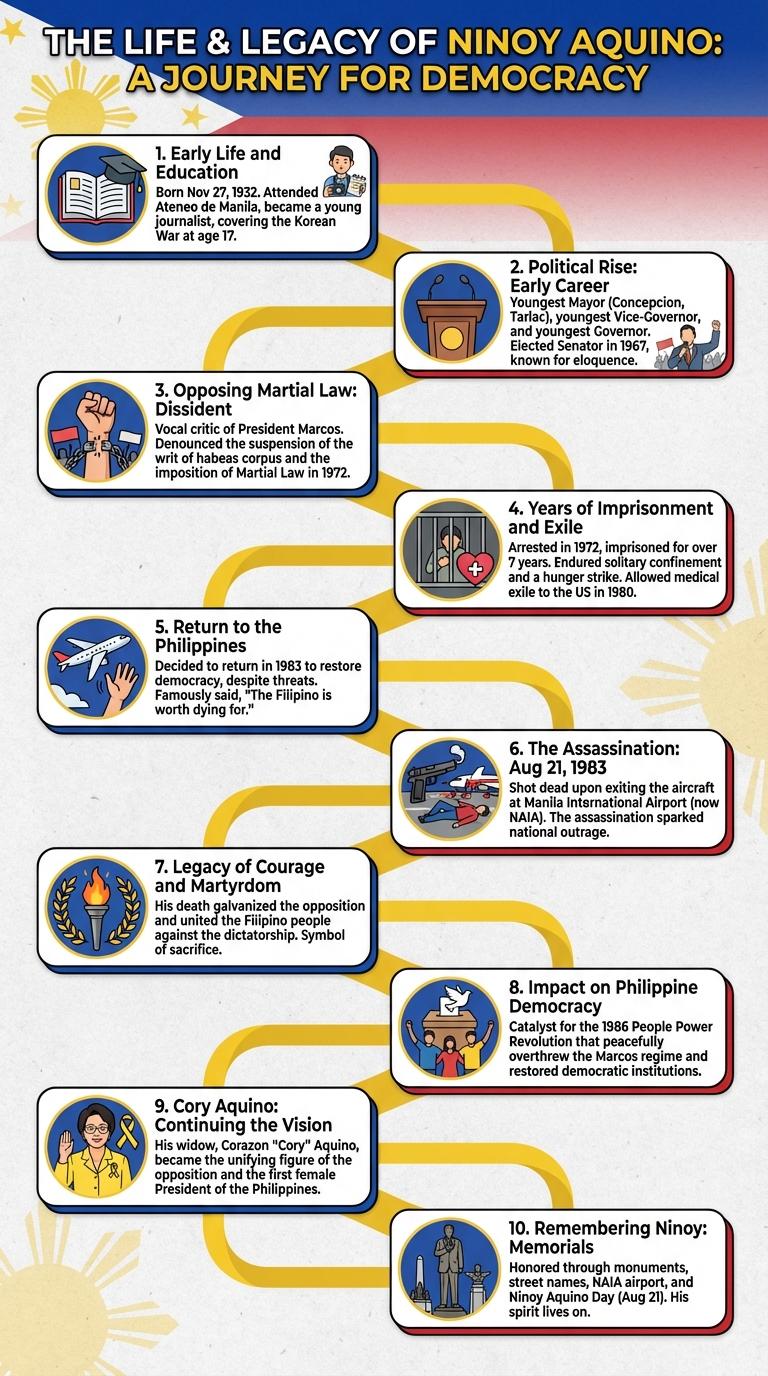
Ninoy Aquino remains a pivotal figure in Philippine history, symbolizing courage and resistance against oppression. His legacy inspires ongoing movements for democracy and human rights across the nation. This infographic visually captures key moments and achievements that defined his impactful life.
Early Life and Education of Ninoy Aquino
Benigno "Ninoy" Aquino Jr. was born on November 27, 1932, in Concepcion, Tarlac, Philippines. He was a prominent Filipino senator and a key figure in the opposition against the Marcos dictatorship.
Ninoy Aquino attended Ateneo de Manila University, where he excelled in both academics and athletics. He later studied at Harvard University, enhancing his knowledge in political science and public administration.
Political Rise: Ninoy's Early Career
Benigno "Ninoy" Aquino Jr. began his political journey as the youngest mayor in the Philippines, elected in Concepcion, Tarlac at age 22. He quickly rose through the ranks, becoming a provincial governor and later a senator known for his strong opposition to the Marcos regime. His early career was marked by a passionate advocacy for democracy and social justice, setting the stage for his influential role in Philippine politics.
Opposing Martial Law: Ninoy as a Dissident
Ninoy Aquino emerged as a leading dissident during the Martial Law era in the Philippines. His vocal opposition symbolized the struggle for democracy and human rights under authoritarian rule.
- Critic of Marcos Regime - Aquino openly challenged President Ferdinand Marcos' declaration of Martial Law in 1972, condemning abuses and corruption.
- Imprisonment and Exile - He was arrested and detained for seven years, then allowed to go into exile in the United States in 1980 after his health declined.
- Voice for Freedom - From exile, Aquino continued to inspire resistance through speeches and writings calling for Philippine democracy and justice.
Ninoy Aquino's sacrifice and unwavering stand against Martial Law made him a martyr and catalyst for the People Power Revolution that restored democracy in 1986.
Years of Imprisonment and Exile
How long was Ninoy Aquino imprisoned before his exile? Ninoy Aquino was imprisoned for approximately seven years from 1969 to 1977 during the Marcos regime. After his release, he lived in exile in the United States for about eight years before returning to the Philippines in 1983.
Ninoy Aquino's Return to the Philippines
Benigno "Ninoy" Aquino Jr. returned to the Philippines on August 21, 1983, after nearly eight years of exile in the United States. His arrival at Manila International Airport was met with a violent assassination, sparking nationwide outrage. Aquino's return and subsequent death became a catalyst for the People Power Revolution and the fall of the Marcos dictatorship.
The Assassination: August 21, 1983
The assassination of Benigno "Ninoy" Aquino Jr. occurred on August 21, 1983, at Manila International Airport. He was a prominent opposition leader against the Marcos regime in the Philippines.
Ninoy Aquino was shot dead as he disembarked from a plane after three years of exile in the United States. The killing shocked the nation and ignited widespread protests against the dictatorship. His death became a catalyst for the People Power Revolution that eventually ended Ferdinand Marcos's rule.
Legacy of Courage and Martyrdom
| Aspect | Description |
|---|---|
| Full Name | Benigno "Ninoy" Aquino Jr. |
| Legacy | Symbol of Filipino resistance against dictatorship and heroism |
| Courage | Opposed Ferdinand Marcos' Martial Law despite repeated arrests and imprisonment |
| Martyrdom | Assassinated in 1983 upon returning to the Philippines, sparking national outrage |
| Impact | Inspired the People Power Revolution and restored democracy in the Philippines |
Impact on Philippine Democracy
Benigno "Ninoy" Aquino Jr. was a pivotal figure in the struggle for democracy in the Philippines. His assassination in 1983 ignited widespread public outrage and galvanized the movement to restore democratic governance.
- Symbol of Resistance - Aquino's steadfast opposition to the Marcos dictatorship inspired Filipinos to unite against authoritarian rule.
- Martyrdom Effect - His death became the catalyst for the 1986 People Power Revolution that ended two decades of dictatorship.
- Legacy for Democratic Reforms - Aquino's sacrifices influenced the drafting of the 1987 Philippine Constitution, designed to safeguard democratic freedoms.
Cory Aquino: Continuing Ninoy's Vision
Ninoy Aquino's legacy inspired his wife, Cory Aquino, to lead the Philippines towards democracy after years of dictatorship. She became a symbol of hope, continuing Ninoy's vision for freedom and justice.
- Restoration of Democracy - Cory Aquino spearheaded the 1986 People Power Revolution, ending the Marcos regime and restoring democratic governance in the Philippines.
- Human Rights Advocacy - She prioritized the protection of civil liberties and the establishment of institutions to safeguard human rights nationwide.
- Political Reforms - Cory Aquino implemented significant political reforms, including drafting a new constitution that institutionalized democratic principles.