
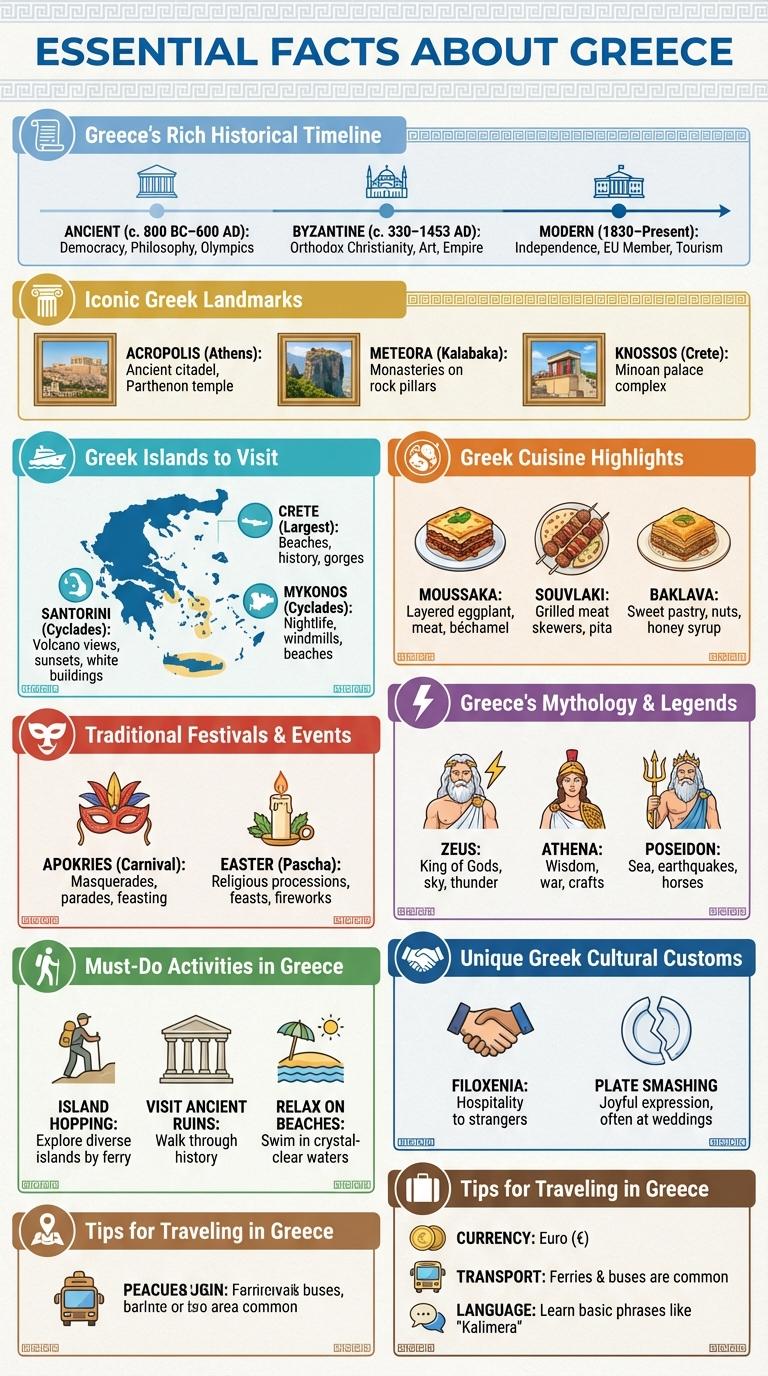
Greece offers a rich tapestry of history, culture, and breathtaking landscapes that captivate travelers worldwide. This infographic highlights key facts about Greece's ancient heritage, iconic landmarks, and vibrant traditions. Explore the unique blend of mythology, cuisine, and scenic beauty that defines this Mediterranean gem.
Essential Facts About Greece
Greece, located in southeastern Europe, is known for its rich history and cultural heritage. It is home to famous ancient landmarks such as the Acropolis and the Parthenon.
The country has a population of approximately 10.4 million people and its capital is Athens. Greek is the official language, and the currency used is the Euro.
Greece's Rich Historical Timeline
What defines Greece's rich historical timeline? Greece's history spans thousands of years, from ancient civilizations like the Minoans and Mycenaeans to the influential Classical period. Key events include the birth of democracy, the conquests of Alexander the Great, and the Byzantine Empire's legacy.
How did Greece influence Western civilization? Ancient Greece introduced foundational concepts in philosophy, politics, and the arts, shaping modern Western society. Landmark contributions include the works of Plato and Aristotle, and the establishment of Olympic Games.
What are the major historical periods in Greece? Greece's timeline includes the Bronze Age, Classical Greece, Hellenistic Era, Roman rule, Byzantine period, Ottoman occupation, and modern independence. Each period reflects significant cultural, political, and social changes.
Which historical sites in Greece represent its timeline? Sites like the Acropolis of Athens, Knossos Palace, Delphi, and Meteora monasteries showcase Greece's diverse heritage. These landmarks attract millions of visitors eager to explore ancient and medieval history.
How does Greek history impact today's culture? Greek traditions, mythology, and art influence contemporary life and global culture. Festivals, language, and cuisine remain deeply rooted in Greece's historical identity.
Iconic Greek Landmarks
Greece is renowned for its ancient landmarks that offer a glimpse into its rich history and culture. These iconic sites attract millions of visitors each year, showcasing Greece's architectural and historical significance.
- Acropolis of Athens - An ancient citadel featuring the Parthenon, symbolizing classical Greek civilization.
- Delphi - Once considered the center of the world, famous for the Oracle and the Temple of Apollo.
- Santorini Caldera - A dramatic volcanic landscape known for its white-washed buildings and stunning sunsets.
Greek Islands to Visit
Greece is renowned for its stunning islands, each offering unique landscapes, rich history, and vibrant culture. The Greek Islands attract millions of visitors annually, making them top travel destinations in the Mediterranean.
Santorini is famous for its breathtaking sunsets and iconic white-washed buildings with blue domes. Mykonos offers lively nightlife and beautiful beaches, perfect for both relaxation and entertainment.
Greek Cuisine Highlights
Greek cuisine is renowned for its fresh ingredients and Mediterranean flavors that have been shaped by centuries of tradition. The dishes emphasize olive oil, herbs, vegetables, and seafood, embodying the essence of Greece's cultural heritage.
- Moussaka - A layered casserole featuring eggplant, minced meat, and bechamel sauce, known as a classic Greek comfort food.
- Greek Salad (Horiatiki) - A refreshing mix of tomatoes, cucumbers, olives, feta cheese, and olive oil, representing healthy Mediterranean eating.
- Spanakopita - A savory spinach and feta cheese pie wrapped in flaky phyllo pastry, popular as a snack or appetizer across Greece.
Traditional Festivals & Events
| Festival/Event | Description |
|---|---|
| Apokries (Carnival) | A vibrant celebration before Lent featuring costumes, parades, and traditional dances nationwide. |
| Greek Easter | The most important religious festival with midnight church services, festive meals, and fireworks. |
| Thessaloniki International Film Festival | Annual event showcasing Greek and international cinema with premieres and awards. |
| Athens Epidaurus Festival | A summer cultural festival with performances of ancient Greek drama, music, and dance in historic theaters. |
| Rouketopolemos (Rocket War) | Unique Easter tradition in Vrontados where rival church groups launch rockets in a festive battle. |
Greece's Mythology & Legends
Greece is a land rich in mythology and legends that have shaped Western culture. These ancient stories explain natural phenomena, human behavior, and the origins of the world through powerful gods and heroic tales.
- Olympian Gods - The twelve Olympians, including Zeus, Hera, and Athena, ruled from Mount Olympus and influenced every aspect of life and nature.
- Hercules' Twelve Labors - Hercules completed twelve legendary tasks that demonstrated strength and courage, symbolizing the triumph of perseverance.
- The Trojan War - A legendary conflict involving gods and mortals, famously depicted in Homer's Iliad, illustrating themes of heroism and fate.
Greek mythology continues to inspire literature, art, and modern storytelling around the world.
Must-Do Activities in Greece
Greece offers a rich blend of history, culture, and natural beauty perfect for unforgettable experiences. Must-do activities include exploring the ancient ruins of the Acropolis, sailing the crystal-clear waters of the Aegean Sea, and savoring authentic Greek cuisine in traditional tavernas. Discover vibrant festivals, stunning beaches, and charming island villages that showcase Greece's unique heritage and warm hospitality.
Unique Greek Cultural Customs
Greece is renowned for its unique cultural customs such as the tradition of "Name Days," where individuals celebrate the feast day of their patron saint with gatherings and gifts. The custom of "Kefi," embodying joy and spiritedness, is expressed through lively music, dance, and communal celebrations. Greek Easter, marked by distinct rituals like dyeing red eggs and the midnight church service, stands as a pivotal event in Greek cultural life.