
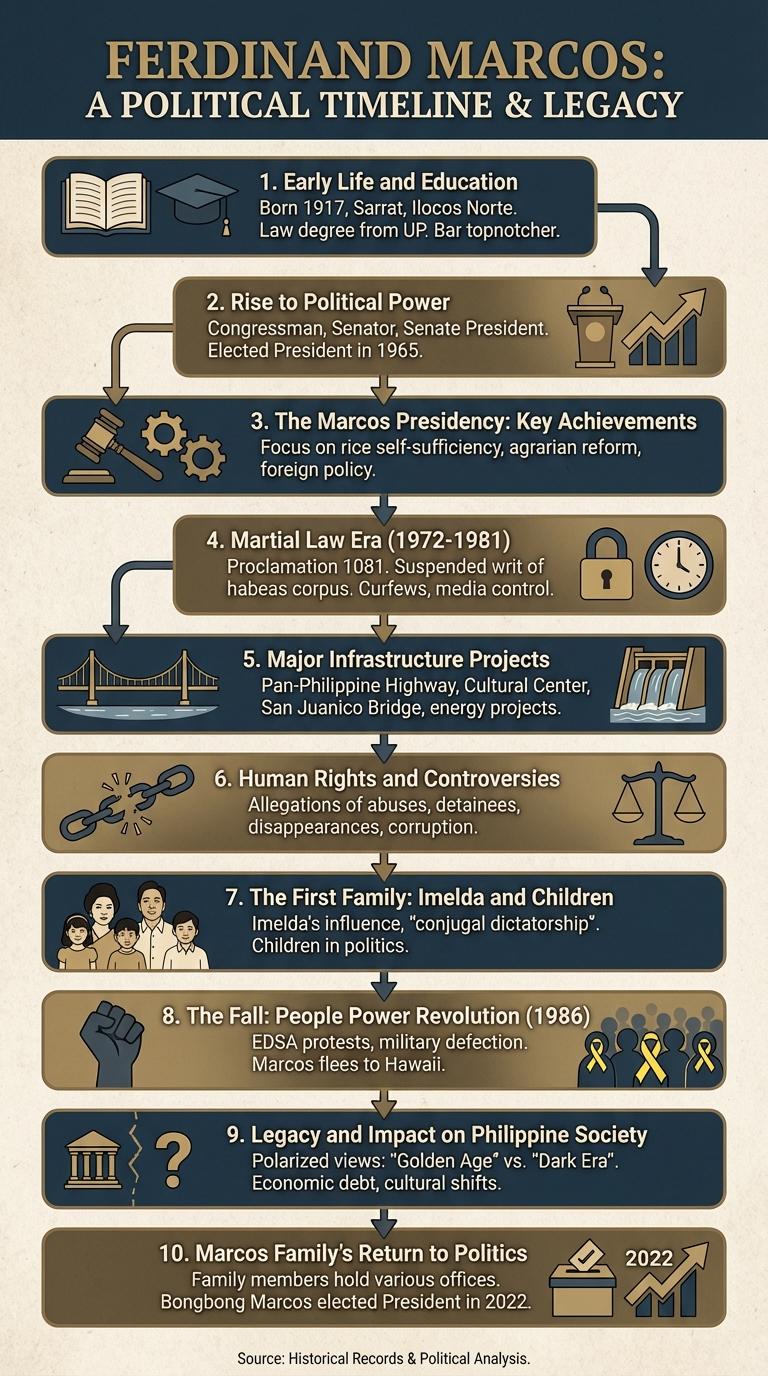
Ferdinand Marcos was a prominent political figure in Philippine history known for his long tenure as president and the declaration of martial law. His administration was marked by significant infrastructure projects alongside allegations of corruption and human rights abuses. This infographic provides a clear and concise overview of his life, presidency, and lasting impact on the Philippines.
Early Life and Education of Ferdinand Marcos
Ferdinand Marcos was born on September 11, 1917, in Sarrat, Ilocos Norte, Philippines. He came from a politically active family with deep roots in Ilocos Norte.
- Early Education - Marcos attended Sarrat Elementary School and later moved to the University of the Philippines High School in Manila.
- University Degree - He earned a law degree from the University of the Philippines College of Law, graduating in 1939.
- Academic Achievements - Marcos topped the Philippine Bar Examination in 1939, showcasing his legal expertise early on.
His strong educational background laid the foundation for his later political career as the President of the Philippines.
Rise to Political Power
Ferdinand Marcos quickly rose to political prominence in the Philippines during the mid-20th century. His ascent was marked by strategic alliances, legislative success, and military service that built his public image.
- Early Career in Law - Marcos graduated top of his class from the University of the Philippines College of Law, establishing his reputation as a skilled legal mind.
- Military Background - He served as a guerrilla leader during World War II, which bolstered his nationalist credentials and public support.
- Congressional Success - Elected to the House of Representatives in 1949, Marcos quickly gained influence as a young legislator pushing reformist policies.
- Senate Victory - In 1959, he won a seat in the Philippine Senate, where he authored significant legislation and built a strong political network.
- Presidential Campaign - His presidential campaign in 1965 emphasized development and law and order, appealing to a broad voter base and securing victory.
The Marcos Presidency: Key Achievements
| Key Achievement | Description |
|---|---|
| Infrastructure Development | Built extensive roads, bridges, hospitals, and schools under the "Build, Build, Build" program. |
| Martial Law Period | Declared Martial Law in 1972, citing the need to restore order and promote national development. |
| Green Revolution | Implemented agricultural reforms increasing rice production and achieving relative self-sufficiency. |
| Economic Modernization | Promoted industrialization and energy projects, including the development of nuclear power facilities. |
| Foreign Relations | Strengthened diplomatic ties and secured substantial foreign loans for development projects. |
Martial Law Era in the Philippines
What was the Martial Law Era under Ferdinand Marcos in the Philippines?
Martial Law was declared by Ferdinand Marcos in 1972 and lasted until 1981, marking a period of authoritarian rule. This era was characterized by the suspension of civil rights, military control, and widespread human rights abuses.
Major Infrastructure Projects Under Marcos
Ferdinand Marcos, the 10th President of the Philippines, is known for numerous infrastructure projects that shaped the country's development during his regime. His administration emphasized modernization through massive investments in roads, bridges, and public facilities.
Major infrastructure projects under Marcos included the San Juanico Bridge, the longest bridge in the Philippines connecting Samar and Leyte. The Bataan Nuclear Power Plant was also constructed, aiming to address the nation's energy needs despite its controversial legacy.
Human Rights and Controversies
Ferdinand Marcos served as the 10th President of the Philippines from 1965 to 1986. His regime became notorious for widespread human rights abuses and controversial policies.
During Martial Law (1972-1981), thousands of activists, journalists, and political opponents were arrested, tortured, or disappeared. Reports indicate over 3,000 documented extrajudicial killings and extensive censorship of media. Marcos' administration faced numerous accusations of corruption and ill-gotten wealth, estimated at billions of dollars.
The First Family: Imelda and Children
Ferdinand Marcos, the 10th President of the Philippines, led the country from 1965 to 1986. His wife, Imelda Marcos, played a prominent role as First Lady, known for her influence and extensive shoe collection. Together, they had three children: Imee, Bongbong, and Irene, all of whom became public figures.
The Fall: People Power Revolution
The Fall of Ferdinand Marcos marked a pivotal moment in Philippine history, triggered by widespread protests during the People Power Revolution in February 1986. Millions of Filipinos participated in mass demonstrations, demanding an end to Marcos' 20-year authoritarian rule. The peaceful uprising led to Marcos' exile and the restoration of democracy under President Corazon Aquino.
Legacy and Impact on Philippine Society
Ferdinand Marcos remains one of the most controversial figures in Philippine history due to his extended rule and profound influence on the nation's political landscape. His legacy continues to shape debates on governance, human rights, and economic development in the Philippines.
- Authoritarian Rule - Marcos declared martial law in 1972, leading to suppression of political opposition and centralized power.
- Infrastructure Development - His administration invested heavily in public infrastructure, contributing to modernization projects nationwide.
- Economic Challenges - Marcos's regime accumulated massive foreign debt, resulting in long-term economic difficulties for the Philippines.