
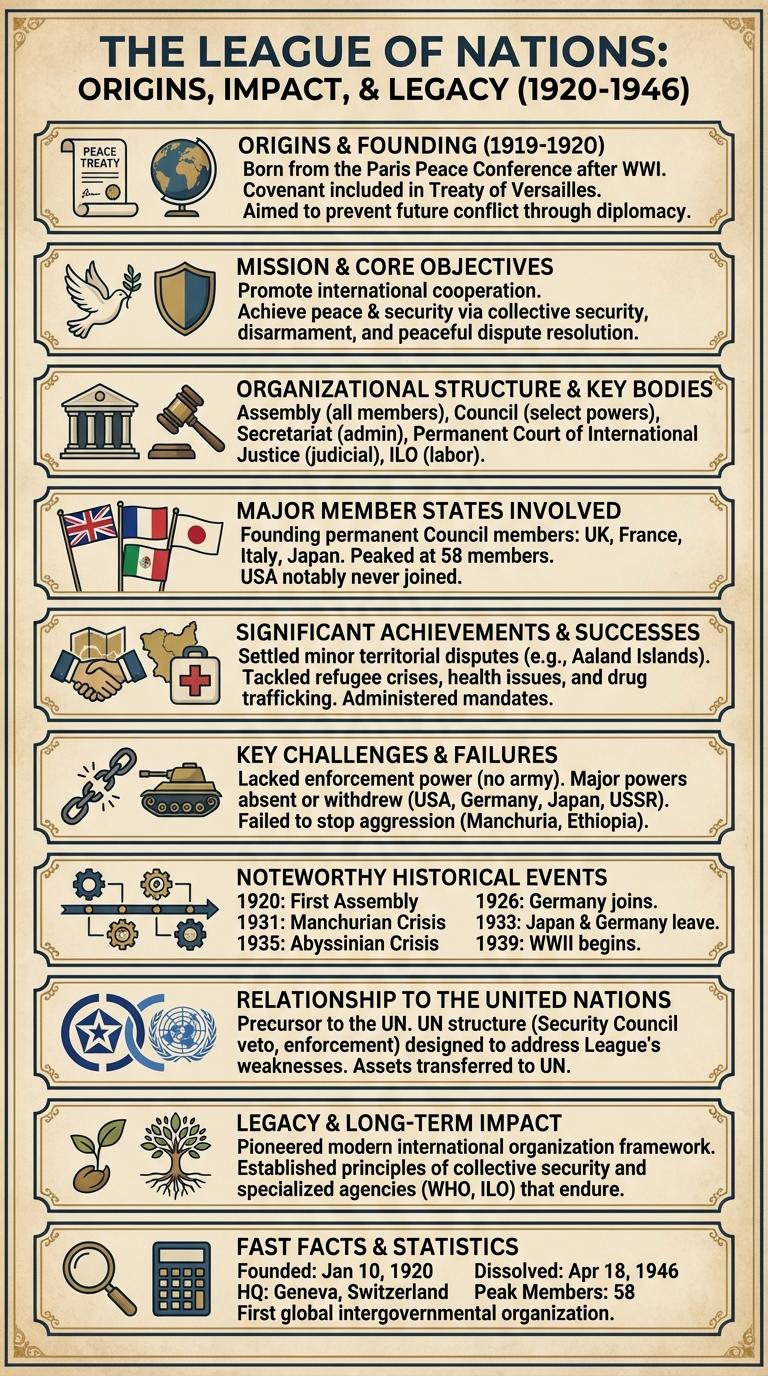
The League of Nations was the first international organization aimed at maintaining world peace and preventing conflicts after World War I. Established in 1920, it introduced innovative diplomatic approaches and collective security measures to resolve disputes between countries. Although it ultimately failed to prevent World War II, the League laid the foundation for modern international cooperation and the creation of the United Nations.
Origins and Founding of the League of Nations
The League of Nations was established after World War I to promote peace and prevent future conflicts. It emerged from the vision of global cooperation and diplomacy advocated by world leaders during the early 20th century.
- Treaty of Versailles - The League was founded in 1919 as part of the Treaty of Versailles to maintain world peace and support disarmament.
- Woodrow Wilson's Proposal - U.S. President Woodrow Wilson was a key figure advocating for the League through his Fourteen Points speech in 1918.
- International Cooperation - Founding members aimed to create a platform for resolving disputes and promoting collective security among nations.
Mission and Core Objectives
The League of Nations was established after World War I to promote peace and cooperation among countries. It aimed to prevent future conflicts through dialogue and collective security.
- Maintain World Peace - The League sought to resolve disputes diplomatically to avoid war between nations.
- Promote Disarmament - It encouraged countries to reduce armed forces and weapon stockpiles to decrease the threat of conflict.
- Foster International Cooperation - The League aimed to address global issues like labor rights, health, and refugee crises collaboratively.
Organizational Structure and Key Bodies
| Organizational Structure | Description |
|---|---|
| Assembly | Main deliberative body; composed of all member states; met annually to discuss policies and admit new members |
| Council | Executive body; included permanent and non-permanent members; responsible for decision-making and conflict resolution |
| Permanent Secretariat | Administrative arm; managed daily operations, communication, and coordination among League bodies |
| International Labour Organization (ILO) | Specialized agency addressing labor issues, social justice, and workers' rights under League's guidance |
| Permanent Court of International Justice | Judicial organ; settled international disputes and provided legal advice to League bodies |
Major Member States Involved
The League of Nations, established after World War I, included several major member states that played crucial roles in its operations. Key members comprised the United Kingdom, France, Italy, Japan, and Germany, although Germany's membership was suspended during certain periods. These countries influenced the League's policies and decision-making processes, shaping the international diplomatic landscape between 1920 and 1946.
Significant Achievements and Successes
The League of Nations was the first international organization aimed at maintaining world peace after World War I. It introduced groundbreaking mechanisms for conflict resolution and international cooperation.
The League successfully resolved territorial disputes such as the Aland Islands conflict between Finland and Sweden. It also managed humanitarian efforts, including refugee assistance and combating diseases like malaria. Its work laid the foundation for modern international organizations, influencing the creation of the United Nations.
Key Challenges and Failures
The League of Nations faced significant challenges in maintaining global peace after World War I. It struggled with limited authority and the absence of key international powers.
Major failures included the inability to prevent aggression by Japan in Manchuria and Italy in Ethiopia. The League's lack of enforcement mechanisms undermined its effectiveness in conflict resolution.
Noteworthy Historical Events
The League of Nations, established in 1920, aimed to maintain world peace following World War I. It was the first international organization designed to resolve conflicts through diplomacy instead of war.
In 1921, the League successfully resolved the Aaland Islands dispute between Sweden and Finland, demonstrating its potential for peaceful conflict resolution. The organization also addressed the crisis of the Upper Silesia plebiscite in 1921, helping to peacefully divide the territory between Germany and Poland.
Relationship to the United Nations
The League of Nations was the first international organization aimed at maintaining world peace after World War I. It laid the groundwork for the establishment of the United Nations in 1945.
- Predecessor to the UN - The League of Nations served as a prototype for the United Nations, influencing its structure and goals.
- Shared objectives - Both organizations focus on promoting peace, security, and international cooperation.
- Lessons learned - The League's limitations in enforcement and membership informed the creation of a more robust UN system.
The United Nations continues the mission of global diplomacy and conflict resolution initiated by the League of Nations.
Legacy and Long-Term Impact
What is the legacy of the League of Nations in modern international relations?
The League of Nations established the foundation for international cooperation and diplomacy. Its concepts influenced the creation of the United Nations and global peacekeeping efforts.
How did the League of Nations impact global conflict resolution?
The League introduced mechanisms for arbitration and collective security aimed at preventing wars. Although it failed to stop World War II, it set precedents for conflict mediation used today.
What role did the League of Nations play in promoting international law?
The League supported treaties and agreements that advanced international legal standards. Its work paved the way for institutions like the International Court of Justice.
In what ways did the League of Nations contribute to humanitarian efforts?
The League coordinated responses to health crises, refugees, and labor rights during its existence. These early initiatives inspired later United Nations programs focused on human welfare.
| Aspect | Long-Term Impact |
|---|---|
| International Cooperation | Inspired the United Nations structure |
| Conflict Resolution | Set models for peacekeeping and diplomacy |
| International Law | Preceded modern legal institutions |
| Humanitarian Initiatives | Early coordination of health and refugee aid |
| Collective Security | Framework influencing modern security alliances |