
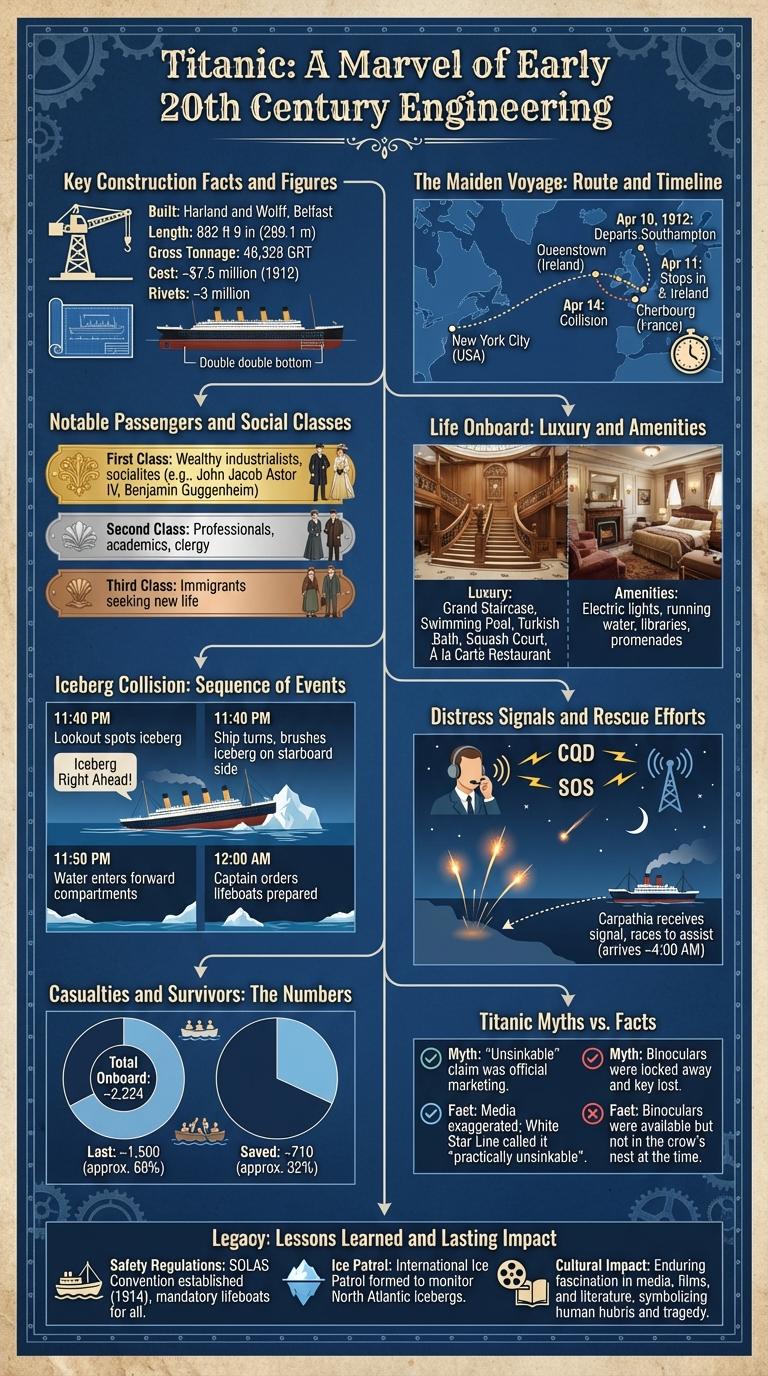
The Titanic remains one of history's most intriguing maritime disasters, capturing imaginations with its tragic maiden voyage. This infographic reveals key facts and figures about the ship's construction, journey, and sinking. Explore detailed data that brings the story of the Titanic to life with vivid visuals and concise insights.
Titanic: A Marvel of Early 20th Century Engineering
The Titanic, launched in 1912, represented a pinnacle of early 20th century maritime engineering. It combined advanced technology and luxurious design to create a ship considered virtually unsinkable at the time.
- Innovative Hull Design - The Titanic featured a double bottom and watertight compartments to enhance safety and structural integrity.
- Powerful Steam Engines - Equipped with three massive steam engines, the ship could reach speeds up to 24 knots.
- Luxurious Interiors - The Titanic's first-class cabins and public spaces boasted opulent decor inspired by the finest hotels of the era.
These engineering features made the Titanic a symbol of human ingenuity and ambition in early 1900s shipbuilding.
Key Construction Facts and Figures
| Key Construction Facts | Details |
|---|---|
| Name | RMS Titanic |
| Shipyard | Harland and Wolff, Belfast |
| Construction Period | Started March 31, 1909; Completed April 2, 1912 |
| Length | 882 feet 9 inches (269.1 meters) |
| Gross Tonnage | 46,328 tons |
The Maiden Voyage: Route and Timeline
The Titanic embarked on its maiden voyage from Southampton, England, on April 10, 1912. The ship's planned route included stops at Cherbourg, France, and Queenstown (now Cobh), Ireland, before heading across the Atlantic to New York City.
The journey was scheduled to take approximately six days, with the Titanic expected to arrive in New York on April 17, 1912. Tragically, the ship struck an iceberg late on April 14, leading to one of the deadliest maritime disasters in history.
Notable Passengers and Social Classes
Who were some of the notable passengers aboard the Titanic? The Titanic carried many famous individuals such as John Jacob Astor IV, Benjamin Guggenheim, and Molly Brown. These passengers represented a mix of wealth, influence, and social prominence during the early 20th century.
What were the distinct social classes on the Titanic? The ship was divided into First, Second, and Third Class sections, each offering different levels of luxury and accommodation. First Class passengers enjoyed opulent suites, while Third Class passengers had more modest quarters.
| Social Class | Characteristics |
|---|---|
| First Class | Luxury suites, fine dining, exclusive access to amenities |
| Second Class | Comfortable cabins, decent dining, less exclusive |
| Third Class | Basic accommodations, communal spaces, affordable tickets |
Life Onboard: Luxury and Amenities
The Titanic offered unparalleled luxury with its grand first-class accommodations, featuring ornate cabins, lavish dining rooms, and elegant lounges. Passengers enjoyed amenities such as a swimming pool, Turkish baths, a gymnasium, and a squash court, showcasing the ship's emphasis on comfort and leisure. Fine dining menus were expertly crafted, reflecting the opulence that defined life onboard for the wealthy travelers.
Iceberg Collision: Sequence of Events
The Titanic struck an iceberg on the night of April 14, 1912, at approximately 11:40 PM. The collision caused the ship's hull plates to buckle, allowing water to flood six forward compartments. Despite efforts to contain the damage, the Titanic sank in about 2 hours and 40 minutes after the initial impact.
Distress Signals and Rescue Efforts
The Titanic sent several distress signals after striking an iceberg on April 14, 1912, including the CQD and SOS Morse code messages. These signals alerted nearby ships to the disaster, prompting immediate rescue operations.
Rescue efforts were led primarily by the RMS Carpathia, which arrived approximately four hours after the Titanic sank. Crew members and survivors worked together to save over 700 people from lifeboats in the freezing North Atlantic waters.
Casualties and Survivors: The Numbers
The Titanic disaster remains one of the deadliest maritime tragedies in history, marked by a significant loss of life. Understanding the scale of casualties and survivors highlights the human impact of this historic event.
The ship carried over 2,200 passengers and crew, with survival rates varying drastically by class and demographics.
- Total Passengers and Crew - Approximately 2,224 people were on board the Titanic during its maiden voyage in April 1912.
- Casualties - Around 1,500 individuals perished after the ship struck an iceberg and sank in the North Atlantic Ocean.
- Survivors - About 710 people survived, rescued by vessels responding to distress signals, with a majority being women and children.
Titanic Myths vs. Facts
The Titanic continues to captivate the world with its tragic sinking in 1912. Many myths about the ship often overshadow the actual facts surrounding the event.
Separating myth from reality helps provide a clearer understanding of the Titanic's true story.
- The Titanic was unsinkable - The ship was considered state-of-the-art but was not truly unsinkable, as proven by its tragic sinking after hitting an iceberg.
- The ship sank quickly - Titanic took about 2 hours and 40 minutes to sink, giving many passengers time to evacuate.
- All lifeboats were filled - Many lifeboats left partially empty due to lack of proper evacuation procedures and fear among passengers.
- The band stopped playing during sinking - The band played until the very end to calm passengers as the ship went down.
- Only women and children survived - While priority was given to women and children, a significant number of men also survived the disaster.