
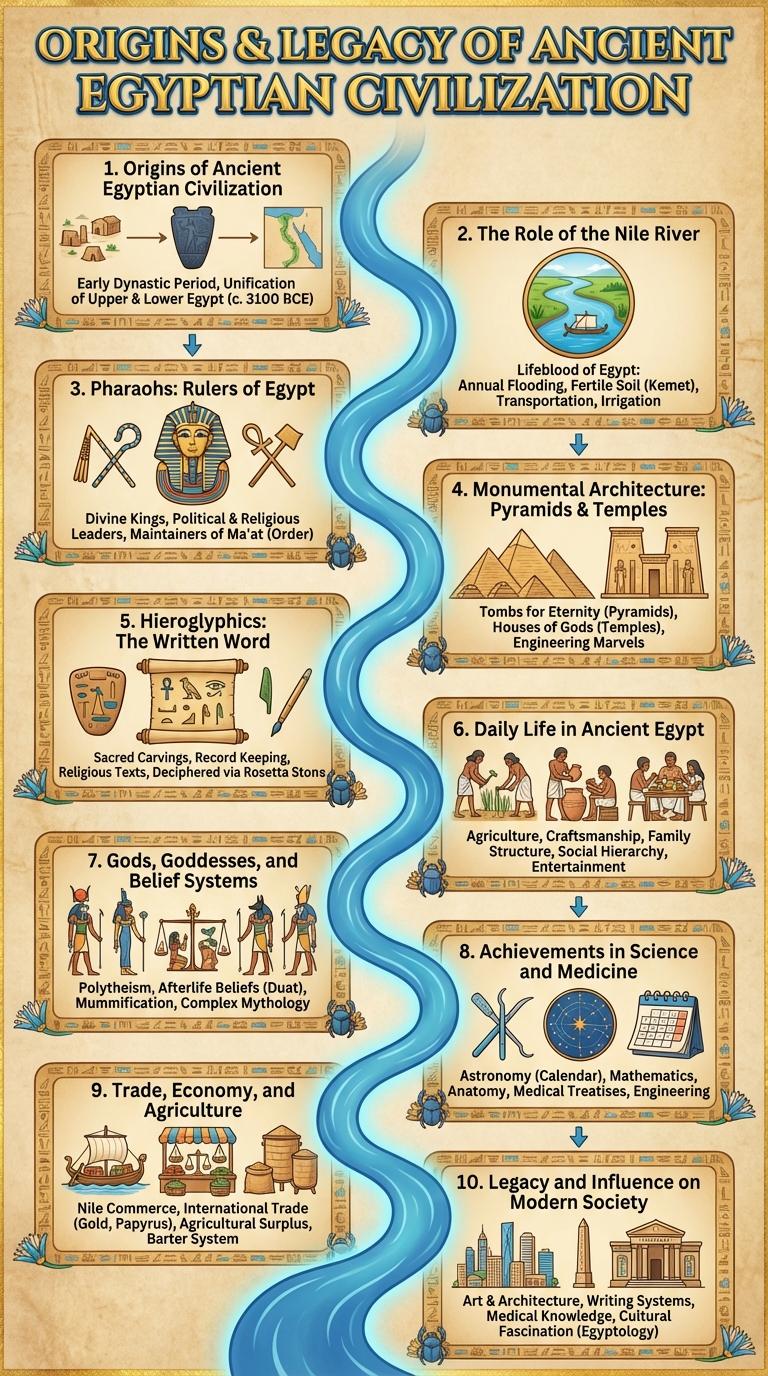
The Egyptian civilization stands as one of history's most remarkable achievements, characterized by its monumental architecture, advanced writing system, and rich cultural heritage. This infographic highlights key aspects such as the construction of pyramids, the development of hieroglyphics, and the influence of pharaohs on society. Explore how these elements contributed to Egypt's enduring legacy in art, science, and governance.
Origins of Ancient Egyptian Civilization
The Role of the Nile River
The Nile River was the lifeblood of the Egyptian civilization, providing essential resources for agriculture and daily life. This ancient waterway shaped the cultural, economic, and social development of Egypt for thousands of years.
- Source of Fertility - The annual flooding of the Nile deposited nutrient-rich silt, enabling successful crop cultivation in an otherwise arid region.
- Transportation Route - The river served as a natural highway for trade, communication, and military expeditions across Egypt.
- Cultural Significance - The Nile was deeply embedded in Egyptian religion and mythology, symbolizing life and renewal.
The Nile River remained a critical driver of Egyptian prosperity and civilization for millennia.
Pharaohs: Rulers of Egypt
The Pharaohs were the supreme rulers of ancient Egypt, considered both political leaders and divine figures. Their reign shaped the culture, religion, and architecture of one of the world's oldest civilizations.
- Divine Kingship - Pharaohs were believed to be gods on Earth, embodying the deity Horus during their reign.
- Centralized Power - They held absolute authority over the land, economy, military, and religious institutions.
- Monumental Legacy - Pharaohs commissioned iconic structures like pyramids and temples to demonstrate their power and ensure their immortality.
Monumental Architecture: Pyramids & Temples
Egyptian civilization is renowned for its monumental architecture, especially the iconic pyramids and grand temples. These structures symbolize the ancient Egyptians' advanced engineering skills and religious devotion.
The Great Pyramid of Giza, one of the Seven Wonders of the Ancient World, exemplifies precise construction techniques and serves as a royal tomb. Temples like Karnak and Luxor were central to religious worship, featuring massive columns and intricate hieroglyphs. These architectural marvels reflect the civilization's social hierarchy and commitment to honoring gods and pharaohs.
Hieroglyphics: The Written Word
Hieroglyphics represent one of the oldest writing systems, developed by the ancient Egyptians over 5,000 years ago. This intricate script combines logographic and alphabetic elements to convey complex meanings.
Used primarily on monuments and religious texts, hieroglyphics played a crucial role in preserving the culture and history of Egypt. The discovery of the Rosetta Stone in 1799 enabled modern scholars to decode these ancient symbols.
Daily Life in Ancient Egypt
Daily life in Ancient Egypt revolved around agriculture, with the Nile River providing fertile soil for crops like wheat and barley. Most Egyptians lived in small villages and worked as farmers, artisans, and traders.
Homes were built from mud bricks, often simple and functional, while families placed great emphasis on religion and rituals. Social structure was hierarchical, with pharaohs at the top and laborers and slaves at the bottom.
Gods, Goddesses, and Belief Systems
The ancient Egyptian civilization worshipped a pantheon of gods and goddesses, each embodying natural and cosmic elements. Deities such as Ra, the sun god, and Isis, the goddess of magic and motherhood, played central roles in religious practices. Belief systems emphasized the afterlife, with elaborate rituals designed to ensure safe passage and immortality for the soul.
Achievements in Science and Medicine
The Egyptian civilization made groundbreaking advances in science and medicine that laid the foundation for future knowledge. Their innovations spanned anatomy, pharmacology, and surgical techniques used for centuries.
Ancient Egyptians combined empirical observation with mystical practices to develop effective medical treatments and scientific methods.
- Development of Surgical Instruments - Ancient Egyptian physicians created specialized tools for procedures such as wound treatment and bone-setting.
- Advancements in Anatomy - Mummification practices gave Egyptians detailed knowledge of human anatomy and organ functions.
- Use of Herbal Medicine - They documented numerous medicinal plants and formulations in papyrus scrolls for treating various illnesses.
Trade, Economy, and Agriculture
What role did trade play in the Egyptian civilization?
Trade was essential for Egypt's economy, enabling the exchange of goods such as gold, papyrus, and linen. The Nile River facilitated transportation, connecting Egypt to neighboring regions.
How was the economy of ancient Egypt structured?
The Egyptian economy relied heavily on agriculture, craft production, and trade. Wealth was centralized around the Pharaoh, who controlled land and resources.
What agricultural techniques were used by the Egyptians?
Ancient Egyptians developed irrigation systems using the annual flooding of the Nile to enrich the soil. They grew staples like wheat, barley, and flax, supporting population growth.