
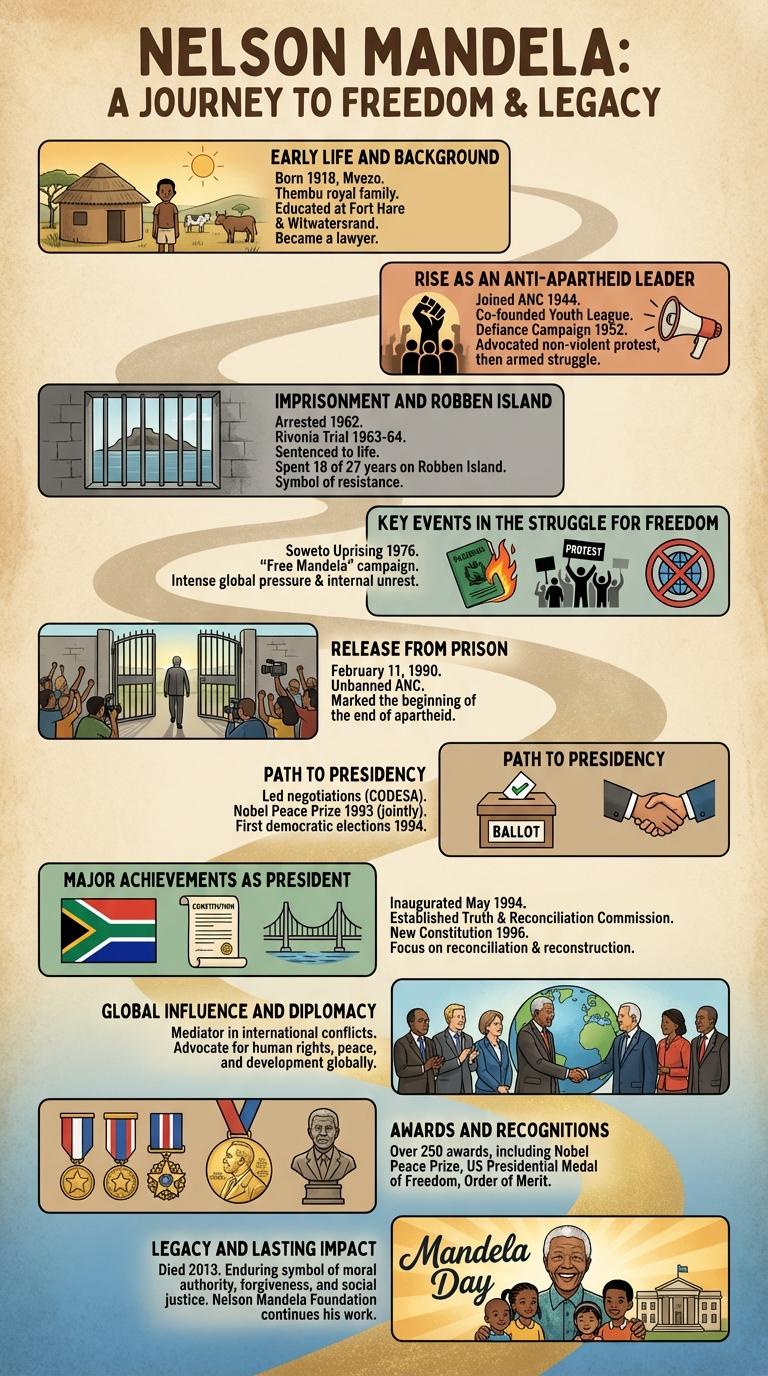
Nelson Mandela's life embodies courage and resilience in the fight against apartheid. This infographic highlights key milestones, from his imprisonment to becoming South Africa's first black president. Discover how Mandela's legacy continues to inspire justice and equality worldwide.
Early Life and Background
Nelson Mandela was born on July 18, 1918, in the village of Mvezo in Umtata, then part of South Africa's Cape Province. He belonged to the Thembu royal family and later became a leading figure in the anti-apartheid movement.
- Early Education - Mandela attended primary school in Qunu, where he was given the English name "Nelson" by a teacher.
- Tribal Leadership - He was the son of a Thembu chief, which influenced his understanding of leadership and justice.
- University Studies - Mandela studied law at the University of Fort Hare and the University of Witwatersrand, preparing for his legal career.
Rise as an Anti-Apartheid Leader
Nelson Mandela emerged as a prominent anti-apartheid leader in South Africa during the 1940s, advocating for equal rights and the end of racial segregation. He co-founded the African National Congress Youth League in 1944, which played a crucial role in mobilizing resistance against apartheid policies. Mandela's leadership and commitment to nonviolent protest later evolved into a broader strategy of armed resistance, making him a key figure in the fight for freedom and justice.
Imprisonment and Robben Island
Nelson Mandela was imprisoned for 27 years, primarily on Robben Island, a maximum-security prison off the coast of Cape Town, South Africa. During his incarceration, Mandela was confined to a small cell and subjected to hard labor in a lime quarry. His imprisonment became a symbol of the anti-apartheid struggle, drawing international attention to South Africa's racial segregation policies.
Key Events in the Struggle for Freedom
Nelson Mandela played a central role in the anti-apartheid movement in South Africa, leading efforts to end racial segregation and discrimination. His activism began in the 1940s, culminating in his leadership of the African National Congress (ANC).
In 1962, Mandela was arrested and later sentenced to life imprisonment for his role in planning sabotage against the government. He spent 27 years in prison before his release in 1990, which marked a pivotal moment in South Africa's transition to democracy.
Release from Prison
Nelson Mandela was released from prison on February 11, 1990, after 27 years of incarceration. His release marked a pivotal moment in the fight against apartheid in South Africa.
- International Pressure - Global campaigns and sanctions influenced the South African government to free Mandela.
- Negotiations Begin - Mandela's release opened the door for talks to end apartheid and establish democracy.
- Massive Public Celebration - Thousands gathered outside Victor Verster Prison to welcome Mandela's release.
Mandela's freedom symbolized hope and the beginning of a new era for South Africa.
Path to Presidency
Nelson Mandela's journey to the presidency was marked by decades of activism against apartheid in South Africa. His leadership and resilience transformed him into a global symbol of peace and justice.
- Early Activism - Mandela joined the African National Congress (ANC) in 1944, engaging in efforts to end racial segregation.
- Imprisonment - In 1962, Mandela was arrested and sentenced to life imprisonment for his anti-apartheid activities.
- Release and Negotiations - After 27 years in prison, Mandela was released in 1990 and led negotiations to dismantle apartheid.
- Democratic Elections - In 1994, Mandela became South Africa's first black president after the country's first democratic elections.
- Presidential Legacy - His presidency focused on reconciliation and building a multiracial democracy in South Africa.
Major Achievements as President
Nelson Mandela served as South Africa's first black president from 1994 to 1999, symbolizing the end of apartheid. His leadership focused on reconciliation and nation-building.
During his presidency, Mandela established the Truth and Reconciliation Commission to address past human rights violations. He promoted racial unity and worked to dismantle institutionalized segregation. Mandela also spearheaded economic reforms aimed at reducing poverty and unemployment across South Africa.
Global Influence and Diplomacy
How did Nelson Mandela shape global diplomacy and influence international relations?
Nelson Mandela played a pivotal role in promoting peace and reconciliation worldwide, serving as a symbol of resistance against oppression. His efforts inspired numerous global leaders and international organizations to adopt policies rooted in justice and human rights.
Awards and Recognitions
| Award/Recognition | Year |
|---|---|
| Nobel Peace Prize | 1993 |
| Presidential Medal of Freedom (USA) | 2002 |
| Order of Lenin (Soviet Union) | 1990 |
| Bharat Ratna (India's highest civilian award) | 1990 |
| Prince of Asturias Award for International Cooperation | 1992 |