
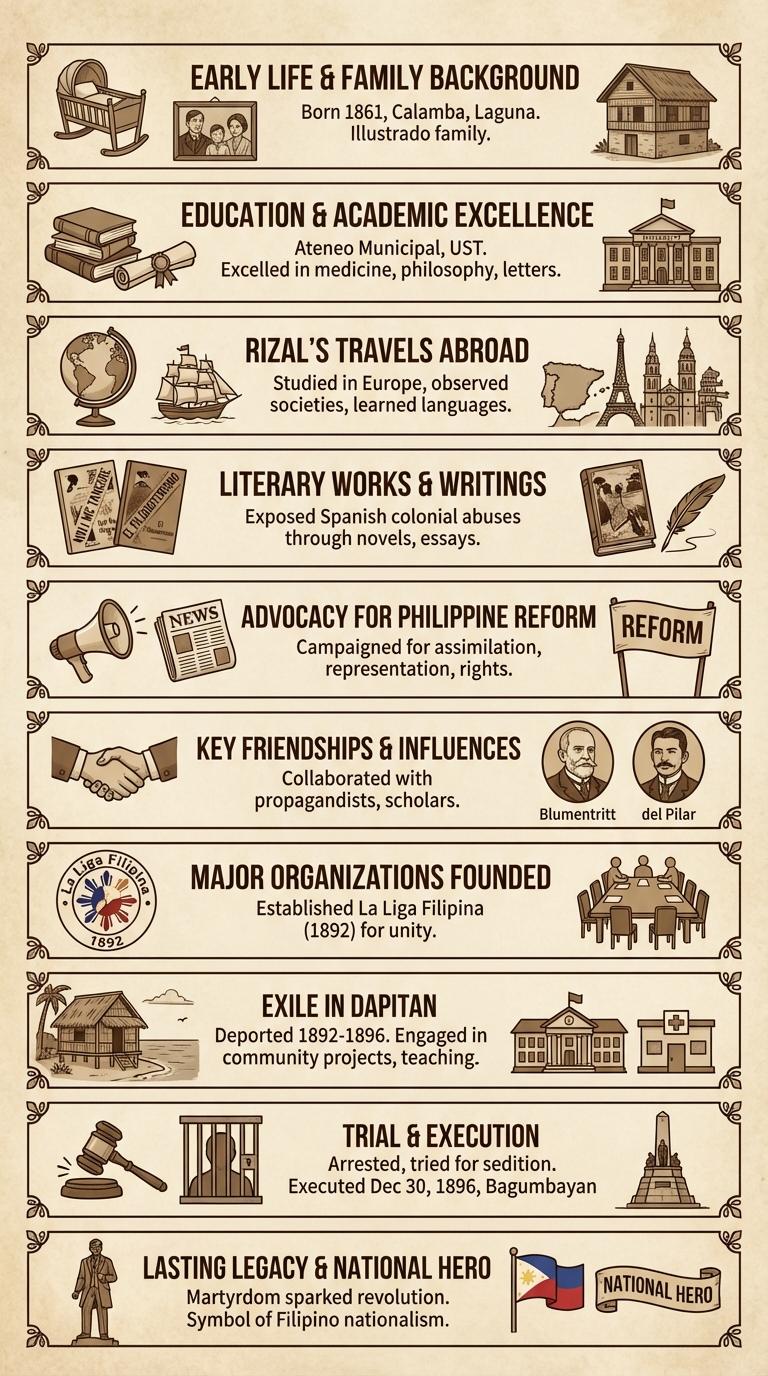
Jose Rizal's life embodies the spirit of Filipino nationalism and intellectual brilliance. His journey as a reformist, writer, and patriot is captured through key moments that highlight his contributions to Philippine history. This infographic visually presents the milestones of Rizal's extraordinary legacy.
Early Life and Family Background
Jose Rizal was born on June 19, 1861, in Calamba, Laguna, Philippines. He was the seventh of eleven children in a well-educated and affluent family.
His parents, Francisco Mercado and Teodora Alonso, were prominent members of the community. The family valued education and instilled strong moral principles in their children.
Education and Academic Excellence
| Phase | Details |
|---|---|
| Early Education | Studied under tutors and attended La Concordia College in Manila. Developed early interest in arts and literature. |
| Formal Studies | Enrolled at Ateneo Municipal de Manila; awarded Bachelor of Arts with highest honors in 1877. |
| Advanced Education | Studied Medicine at the University of Santo Tomas; later pursued further medical studies in Madrid at Universidad Central de Madrid. |
| Academic Achievements | Excelled in multiple fields including ophthalmology, philosophy, and literature; published scholarly works in various languages. |
| Legacy in Education | Recognized as a model student whose academic excellence inspired Filipino nationalism and reforms during the Spanish colonial period. |
Rizal's Travels Abroad
Jose Rizal, the Philippine national hero, embarked on extensive travels across Europe and Asia during his lifetime. These journeys significantly influenced his writings and revolutionary ideas.
- Travel to Spain - Rizal studied medicine and liberal arts at the Universidad Central de Madrid, immersing himself in European intellectual circles.
- Visit to Germany - He advanced his ophthalmology studies in Heidelberg and connected with German scholars and revolutionaries.
- Residences in France and Belgium - Rizal engaged with artists and activists in Paris and Brussels, enriching his nationalist perspectives.
- Sojourn in Hong Kong - Rizal worked as an ophthalmologist, aiding Filipino expatriates while continuing his reformist advocacy.
- Return via Japan and the United States - Rizal explored modern societies and technologies, which he documented in his travel diaries influencing Philippine reform knowledge.
Literary Works and Writings
Jose Rizal's literary works played a crucial role in the Philippine revolution against Spanish colonization. His writings reflect nationalist ideals and social reform.
- Noli Me Tangere - A novel exposing the abuses of Spanish clergy and government in the Philippines.
- El Filibusterismo - A sequel to Noli Me Tangere, advocating for reform through revolutionary means.
- Mi Ultimo Adios - A poignant poem Rizal wrote before his execution, expressing love for his country.
Rizal's literary legacy continues to inspire Filipino nationalism and pride.
Advocacy for Philippine Reform
Jose Rizal dedicated his life to advocating for meaningful reforms in the Philippines during Spanish colonization. His writings and actions inspired a peaceful movement aimed at securing equal rights and justice for Filipinos.
- Penmanship of "Noli Me Tangere" and "El Filibusterismo" - Rizal's novels exposed social injustices and galvanized public awareness about colonial abuses.
- Promotion of Education - He emphasized the importance of education and intellectual empowerment as tools for national progress.
- Advocacy through La Liga Filipina - Rizal founded this organization to promote reform via legal means and foster unity among Filipinos.
Key Friendships and Influences
Jose Rizal formed significant friendships with key figures like Marcelo H. del Pilar and Graciano Lopez Jaena, who were influential reformists during the Philippine Propaganda Movement. His interactions with European intellectuals and exposure to liberal ideas shaped his advocacies for social justice and reform. These relationships and influences were pivotal in Rizal's contributions to Philippine nationalism and his enduring legacy.
Major Organizations Founded
What major organizations did Jose Rizal found during his lifetime?
Jose Rizal founded organizations that played significant roles in the Filipino nationalist movement. These groups aimed to promote reform and unity among Filipinos under Spanish colonial rule.
| Organization | Purpose |
|---|---|
| La Liga Filipina | Advocated for social reforms, unity, and mutual aid among Filipinos. |
| La Solidaridad | Propaganda movement's publication promoting political reforms in the Philippines. |
Exile in Dapitan
Dr. Jose Rizal was exiled to Dapitan, a remote town in Mindanao, from 1892 to 1896. This period marked a significant chapter in his life, combining his roles as a physician, educator, and community leader.
During his exile, Rizal transformed Dapitan through various public works, including building a school, a water system, and a hospital. He practiced medicine, helping local residents and improving public health. Rizal's time in Dapitan reflected his dedication to reform and his belief in education as a tool for social change.
Trial and Execution
Jose Rizal faced a military trial for rebellion, sedition, and conspiracy on December 26, 1896. The trial lasted only a few hours, resulting in a guilty verdict and a death sentence. Rizal was executed by firing squad on December 30, 1896, at Bagumbayan, now known as Luneta Park, becoming a martyr for Philippine independence.