
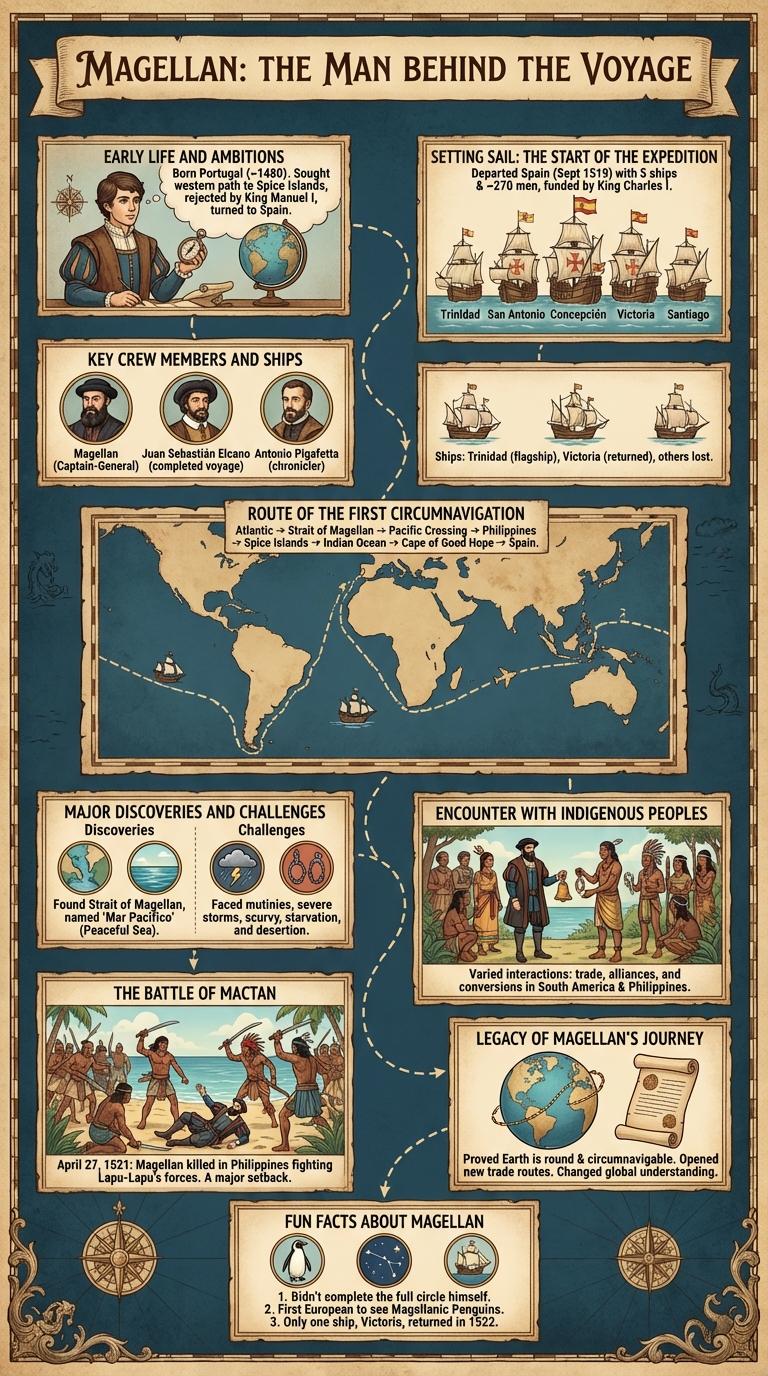
Magellan's historic voyage marked a pivotal moment in global exploration by completing the first circumnavigation of the Earth. This infographic highlights key events, routes, and discoveries from his expedition, offering a visual representation of his groundbreaking journey. Explore the challenges faced and the lasting impact of Magellan's expedition on world geography and navigation.
Magellan: The Man Behind the Voyage
Ferdinand Magellan was a Portuguese explorer born in 1480, renowned for leading the first expedition to circumnavigate the globe. His voyage, starting in 1519 under the Spanish flag, proved the Earth's roundness and opened new maritime routes. Magellan's navigation skills, leadership, and determination marked a pivotal moment in the Age of Exploration.
Early Life and Ambitions
Who was Ferdinand Magellan and what shaped his early life?
Ferdinand Magellan was a Portuguese explorer born in 1480 in Sabrosa, Portugal. His early life was marked by exposure to maritime culture, fueling ambitions to discover new sea routes.
What ambitions did Magellan pursue during his youth?
Magellan aimed to find a westward route to the Spice Islands, driven by the desire to expand trade and navigation knowledge. His ambitions were rooted in the era's spirit of exploration and competition among European powers.
Setting Sail: The Start of the Expedition
Ferdinand Magellan's expedition began in 1519, marking a historic quest to find a westward route to the Spice Islands. The journey set sail from Seville, Spain, with five ships and over 270 crew members, embarking on an unprecedented global voyage.
- Departure Date - The fleet left Seville on September 20, 1519, beginning the first circumnavigation attempt.
- Number of Ships - Five ships, including the flagship Trinidad, composed the expedition's fleet.
- Crew Size - Over 270 men from various nationalities joined the voyage, showcasing a diverse and skilled team.
Key Crew Members and Ships
Ferdinand Magellan led the first expedition to circumnavigate the globe, departing Spain in 1519. Key crew members included Juan Sebastian Elcano, who completed the voyage after Magellan's death, and Antonio Pigafetta, the expedition's chronicler. The fleet consisted of five ships: Trinidad, San Antonio, Concepcion, Victoria, and Santiago.
Route of the First Circumnavigation
| Stage | Key Locations |
|---|---|
| Departure | Seville, Spain - September 1519 |
| Atlantic Crossing | Canary Islands; Cape Verde; Brazil Coast |
| Strait Navigation | Strait of Magellan, South America - October 1520 |
| Pacific Crossing | From Strait of Magellan to Guam and Philippines |
| Return Route | Moluccas; Cape of Good Hope; Seville, Spain - September 1522 |
Major Discoveries and Challenges
Ferdinand Magellan was a Portuguese explorer known for leading the first expedition to circumnavigate the globe, expanding knowledge of the world's geography. His journey revealed significant oceanic routes and encountered numerous challenges, including dangerous navigation conditions and conflicts with indigenous peoples.
- First Circumnavigation - Magellan's fleet completed the first-ever voyage around the Earth, proving the planet's roundness and the vastness of the oceans.
- Discovery of the Strait of Magellan - Magellan identified a navigable sea route at the southern tip of South America, connecting the Atlantic and Pacific Oceans.
- Challenges with Crew and Navigation - Magellan faced mutinies, harsh weather, and limited supplies, leading to significant hardships and his eventual death in the Philippines.
Encounter with Indigenous Peoples
Ferdinand Magellan's expedition marked the first European encounter with various Indigenous peoples in the Pacific. These encounters occurred during his voyage between 1519 and 1522, significantly impacting cultural exchanges.
Magellan's crew met the Chamorro people in the Mariana Islands, noting their skilled navigation and complex social structures. On the island of Guam, initial interactions were tense but later led to trade and exchange of goods. These encounters provided valuable information about the diverse cultures of the Pacific Islands.
The Battle of Mactan
Ferdinand Magellan was a Portuguese explorer leading the first expedition to circumnavigate the globe. His voyage aimed to find a westward route to the Spice Islands.
The Battle of Mactan occurred on April 27, 1521, in the Philippines, where Magellan confronted local chieftain Lapu-Lapu. Magellan and his men were outnumbered and unfamiliar with the terrain, resulting in his defeat and death.
Legacy of Magellan's Journey
Ferdinand Magellan's voyage (1519-1522) marked the first successful circumnavigation of the Earth, proving the planet's roundness and vastness. His expedition provided critical geographical knowledge that reshaped global trade routes and maritime navigation.
Magellan's journey established Spain as a dominant maritime power and sparked European exploration of the Pacific Ocean. His legacy endures through improved nautical maps, the confirmation of global interconnectedness, and inspiration for future explorers.