
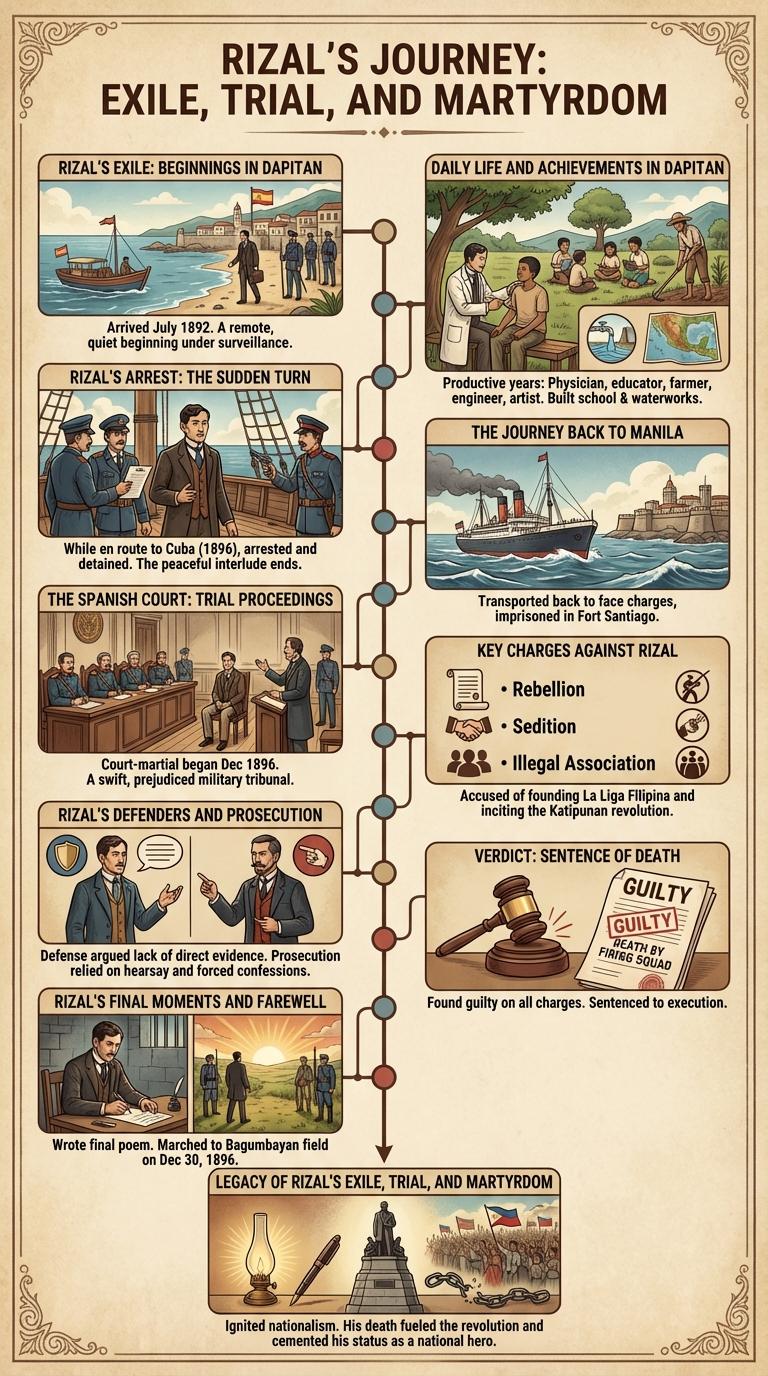
The infographic presents a detailed timeline of Jose Rizal's exile, trial, and eventual execution, highlighting key events and legal proceedings. It visualizes the political context and charges brought against Rizal, underscoring his nationalist efforts and the Spanish colonial government's response. This concise summary offers viewers a clear understanding of Rizal's sacrifice and its impact on Philippine history.
Rizal's Exile: Beginnings in Dapitan
| Rizal's Exile: Beginnings in Dapitan | |
|---|---|
| Exile Location | Dapitan, Northern Mindanao, Philippines |
| Start of Exile | July 17, 1892 |
| Reason for Exile | Accused by Spanish authorities of inciting rebellion through writings and reformist activities |
| Activities during Exile | Medical practice, community projects (water system, school), agricultural development, teaching local children |
| Duration of Exile | Approximately four years (1892-1896) |
Daily Life and Achievements in Dapitan
Jose Rizal's exile in Dapitan marked a significant chapter in his life, where he dedicated himself to community development and scientific studies. His daily routine balanced intellectual pursuits with active contributions to the town's welfare.
- Community Education - Rizal established a school, teaching local children and promoting literacy and critical thinking.
- Medical Practice - He served as the town's physician, providing free medical care to residents.
- Agricultural Innovation - Rizal managed a farm, experimenting with various crops and improving local farming techniques.
- Engineering Projects - He designed and helped build infrastructure such as water systems benefiting Dapitan's community.
- Scientific Research - His studies included cataloging local flora and fauna, contributing to natural sciences knowledge.
Rizal's exile in Dapitan reflects his resilience and dedication to progress, making notable impacts despite his constrained circumstances.
Rizal's Arrest: The Sudden Turn
Rizal's arrest marked a sudden and dramatic turn in his fight for Philippine reform. Captured in Barcelona in 1896, he was immediately transferred to Fort Santiago in Manila.
Accused of rebellion, sedition, and conspiracy, Rizal faced a military tribunal without sufficient evidence. His trial was swift, reflecting the Spanish colonial government's urgency to suppress the growing revolution.
The Journey Back to Manila
After his exile in Dapitan, Jose Rizal was summoned back to Manila to face trial for alleged rebellion, sedition, and conspiracy against Spanish colonial rule. His journey back marked a critical turning point in the Philippine revolution and his personal fate.
Rizal traveled under guard, moving from Dapitan to Manila by land and sea, enduring intense scrutiny and confinement. The trial in Manila was swift and predetermined, with Spanish authorities eager to make an example of the nationalist leader. Despite international appeals for clemency, Rizal was sentenced to death, sealing his legacy as a martyr for Philippine independence.
The Spanish Court: Trial Proceedings
The Spanish court conducted a swift trial against Jose Rizal, accusing him of rebellion, sedition, and conspiracy. The proceedings were held in a closed military tribunal, limiting Rizal's ability to fully defend himself.
Despite his eloquent defense and appeals for clemency, the court found Rizal guilty based on circumstantial evidence. The verdict led to his sentence of death by firing squad, marking a pivotal moment in Philippine history.
Key Charges Against Rizal
What were the key charges against Jose Rizal during his exile trial? Rizal faced accusations of rebellion, sedition, and forming illegal associations. The Spanish authorities also charged him with inciting insurrection through his literary works.
Rizal's Defenders and Prosecution
Jose Rizal's exile, trial, and execution marked a pivotal moment in Philippine history, highlighting the colonial struggle against Spanish rule. The defenders and prosecutors played crucial roles in shaping the legacy of the national hero's final days.
Rizal's defenders argued for his innocence and emphasized his advocacy for reform, while the prosecution focused on charges of rebellion and sedition.
- Rizal's Legal Defense Team - Comprised of Filipino and Spanish lawyers who sought to prove Rizal's loyalty to Spain and his peaceful reformist ideals.
- Family and Friends Advocacy - Advocates who petitioned Spanish authorities, highlighting Rizal's contributions to Philippine society and his non-violent stance.
- Spanish Military Prosecution - Authorities who charged Rizal with inciting rebellion, framing him as a threat to colonial order and Spanish sovereignty.
Verdict: Sentence of Death
Dr. Jose Rizal was tried by a military court in 1896 for rebellion, sedition, and conspiracy against the Spanish colonial government. The verdict was a sentence of death, reflecting the Spanish authorities' intent to suppress the growing nationalist movement. Rizal was executed by firing squad on December 30, 1896, at Bagumbayan, now known as Luneta Park, in Manila.
Rizal's Final Moments and Farewell
Jose Rizal's exile ended with a trial that condemned him to death for alleged rebellion. His final moments were marked by courage and a heartfelt farewell to his country.
Rizal faced his execution with unwavering dignity and patriotism, inspiring the Filipino people. His last written words and actions solidified his legacy as a national hero.
- Trial Verdict - Rizal was found guilty of sedition and rebellion by a Spanish military court.
- Execution Date - Rizal was executed by firing squad on December 30, 1896, in Manila.
- Final Words - He uttered "Consummatum est" ("It is finished") moments before his death.
- Farewell Letter - Rizal wrote a poignant farewell letter to his family and countrymen.
- Legacy - His death fueled the Philippine revolution and cemented his place as a symbol of freedom.