
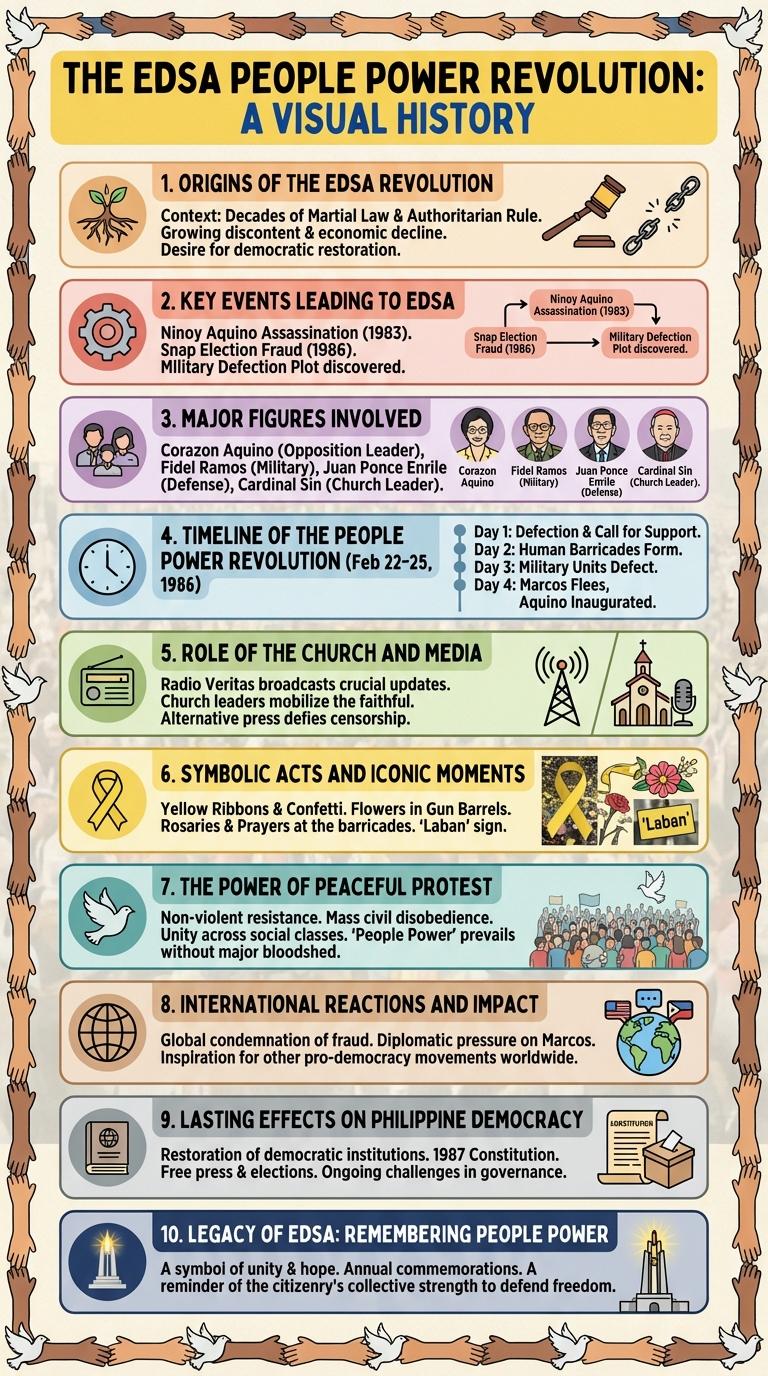
The EDSA Revolution stands as a pivotal moment in Philippine history symbolizing the power of peaceful protest against authoritarian rule. This infographic highlights key events, significant figures, and lasting impacts that shaped the nation's path to democracy. Explore how unity and nonviolent resistance led to transformative political change.
Origins of the EDSA Revolution
The EDSA Revolution, also known as the People Power Revolution, began in 1986 in the Philippines. It was a peaceful uprising that ended the 20-year rule of President Ferdinand Marcos.
Political oppression, human rights abuses, and economic decline fueled widespread public anger. The assassination of opposition leader Benigno Aquino Jr. in 1983 sparked national outrage, uniting Filipinos across all social classes.
Key Events Leading to EDSA
The EDSA Revolution, also known as the People Power Revolution, was a pivotal moment in Philippine history that led to the ousting of President Ferdinand Marcos. It marked the restoration of democracy after years of authoritarian rule.
Key events leading to EDSA began with widespread dissatisfaction over Marcos' imposition of Martial Law in 1972. Economic decline, human rights abuses, and election fraud fueled public outrage.
The assassination of opposition leader Benigno Aquino Jr. in 1983 galvanized the Filipino people against the regime. This event sparked mass protests and intensified calls for political reform.
In 1986, the snap presidential election between Marcos and Corazon Aquino exposed massive electoral fraud. The contested results triggered mass demonstrations and defections within the military.
Major Figures Involved
The EDSA Revolution, also known as the People Power Revolution, was a pivotal moment in Philippine history that led to the end of Ferdinand Marcos' dictatorship in 1986. Key figures played essential roles in mobilizing the masses and restoring democracy in the country.
- Cory Aquino - Became the symbol of the revolution and later the first female president of the Philippines, representing democratic restoration.
- Ferdinand Marcos - The authoritarian president whose regime was overthrown during the revolution.
- Juan Ponce Enrile - A military leader whose defection catalyzed the uprising against Marcos.
- Fidel Ramos - Key military figure who joined the rebellion, helping to protect protesters and secure the revolution's success.
- Jaime Cardinal Sin - The influential Catholic Church leader who called on Filipinos to support the peaceful demonstrations.
The major figures of the EDSA Revolution demonstrated remarkable courage and unity, making the event a worldwide symbol of nonviolent resistance and democratic triumph.
Timeline of the People Power Revolution
The EDSA People Power Revolution was a pivotal event in Philippine history that took place in February 1986. It led to the peaceful overthrow of President Ferdinand Marcos after two decades of authoritarian rule.
The revolution began on February 22, 1986, following a disputed snap election. Millions of Filipinos gathered on Epifanio de los Santos Avenue (EDSA) to protest peacefully. By February 25, Marcos fled the country, and Corazon Aquino assumed the presidency, restoring democracy.
Role of the Church and Media
The EDSA Revolution in 1986 was a pivotal moment in Philippine history, with the Church and media playing crucial roles in mobilizing public support against dictatorship. Both institutions provided platforms for peaceful protest and disseminated information that challenged the regime's narrative.
- Church as Moral Authority - The Catholic Church, led by figures like Cardinal Jaime Sin, encouraged non-violent resistance and provided sanctuary to protesters during the uprising.
- Media Exposure - Independent radio stations and print media broadcasted real-time updates, exposing government abuses and uniting citizens across the nation.
- Mobilization through Networks - Church-run organizations and media outlets created communication networks that facilitated coordination among diverse groups participating in the revolution.
Symbolic Acts and Iconic Moments
| Symbolic Acts | Iconic Moments |
|---|---|
| Massive Gathering at EDSA | Millions united to peacefully protest the Marcos dictatorship |
| Defection of Military Leaders | Key generals, including Fidel V. Ramos and Juan Ponce Enrile, withdrew support from Marcos |
| Use of Rosaries and Prayer | People held rosaries as symbols of peace and faith during rallies |
| Radio Veritas Broadcasts | Radio Veritas transmitted updates and calls for continued nonviolent resistance |
| Presidential Oath of Corazon Aquino | Corazon Aquino's inauguration marked the peaceful transfer of power |
The Power of Peaceful Protest
The EDSA Revolution demonstrated the immense power of peaceful protest in overthrowing authoritarian rule in the Philippines. Millions of Filipinos united without violence to demand democracy and human rights, showcasing the strength of nonviolent resistance. This historic event remains a global symbol of how collective peaceful action can achieve profound political change.
International Reactions and Impact
How did the international community respond to the EDSA Revolution? Many countries and global leaders praised the peaceful uprising as a triumph of democracy over dictatorship. The event inspired worldwide support for democratic movements in other nations.
What was the global impact of the EDSA Revolution? It signaled a shift toward promoting human rights and democratic governance in Southeast Asia. The revolution became a symbol of nonviolent resistance against oppressive regimes, influencing political reforms globally.
| Country/Region | Reaction |
|---|---|
| United States | Expressed strong support, emphasizing democracy and human rights |
| Europe | Celebrated as a successful peaceful revolution, encouraging similar movements |
| Asia | Inspired pro-democracy activists and governments to reconsider authoritarian policies |
| United Nations | Highlighted the importance of peaceful political change and human rights advocacy |
| Global Media | Broadcasted the revolution worldwide, raising awareness about Philippines' struggle |
Lasting Effects on Philippine Democracy
The EDSA Revolution of 1986 marked a pivotal moment in Philippine history, restoring democracy after years of authoritarian rule. Its legacy continues to influence political structures, citizen engagement, and governance in the country.
- Restoration of Democratic Institutions - The revolution led to the reinstatement of the 1987 Constitution, ensuring checks and balances among branches of government.
- Empowerment of Civil Society - The peaceful uprising inspired increased public participation in political processes and advocacy for human rights.
- Strengthening of Electoral Processes - Transparent and fair elections became a focus to prevent electoral fraud and uphold democratic integrity.
- Promotion of Freedom of the Press - Media regained independence, playing a vital role in government accountability and information dissemination.
- Symbol of Nonviolent Resistance - EDSA remains an enduring example of collective action achieving political change without armed conflict.