
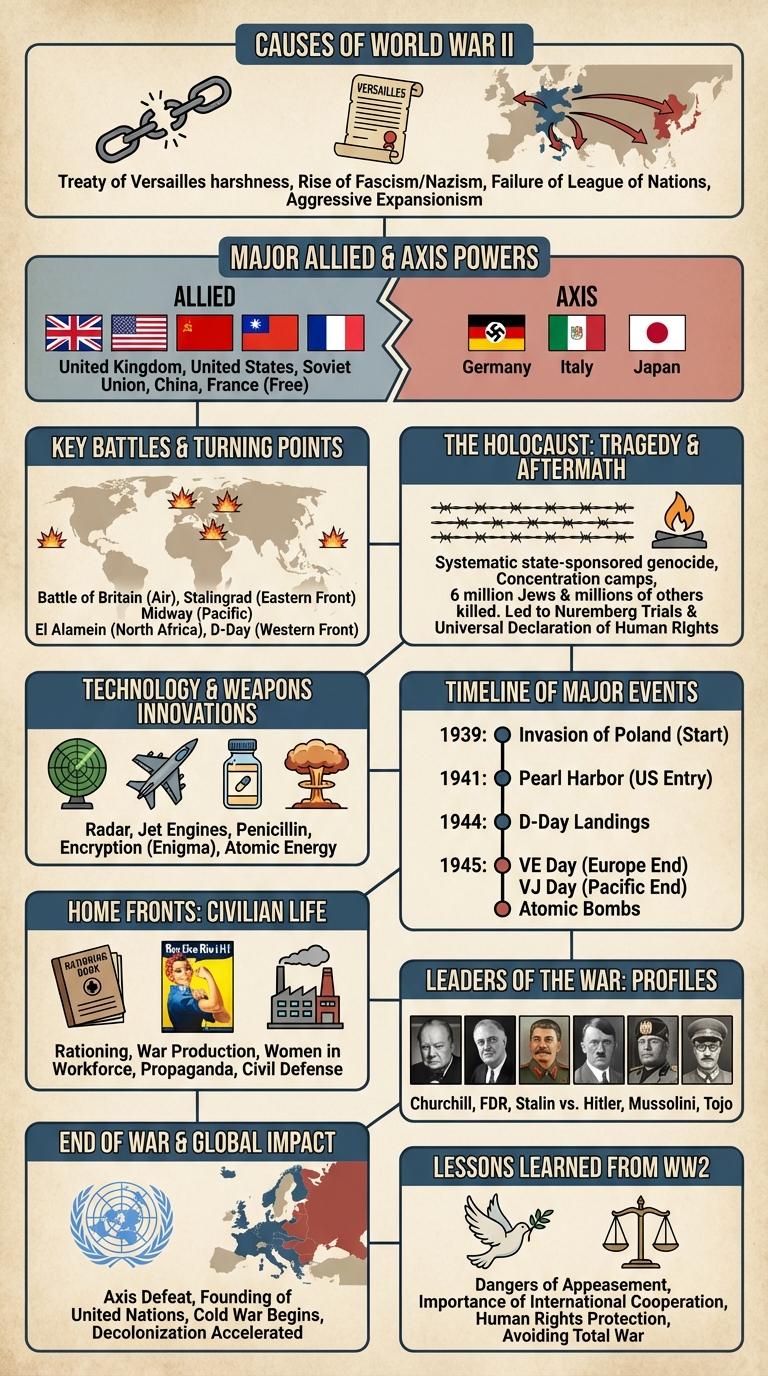
World War II dramatically reshaped the global political and social landscape, involving over 30 countries and causing unprecedented destruction. This infographic highlights key events, major battles, and significant figures that defined the conflict's course and impact. Visual data representation helps to simplify complex historical information for better understanding and engagement.
Causes of World War II
| Cause | Details |
|---|---|
| Treaty of Versailles | Signed in 1919, it imposed heavy reparations and territorial losses on Germany, fostering resentment and economic hardship. |
| Rise of Totalitarian Regimes | Authoritarian leaders like Adolf Hitler in Germany and Benito Mussolini in Italy pursued aggressive expansionist policies. |
| Economic Instability | The Great Depression of the 1930s caused global economic turmoil, heightening political instability and militarization. |
| Expansionist Policies | Japan's invasion of Manchuria (1931) and Germany's occupation of the Rhineland challenged the international order. |
| Failure of Appeasement | Western powers' concessions emboldened Axis powers, leading to increased aggression and eventual outbreak of war in 1939. |
Major Allied and Axis Powers
World War II was a global conflict that lasted from 1939 to 1945, involving major powers divided into the Allied and Axis factions. The war reshaped international relations and led to significant geopolitical changes worldwide.
The major Allied Powers included the United States, the Soviet Union, the United Kingdom, and China. These countries collaborated to defeat the Axis Powers, which consisted of Germany, Italy, and Japan.
Key Battles and Turning Points
World War II featured several key battles that shaped the course of history. These battles marked critical turning points in the conflict between the Allied and Axis powers.
The Battle of Stalingrad (1942-1943) was a decisive Soviet victory that halted German expansion in the East. The Allied invasion of Normandy (D-Day, 1944) opened a Western front, leading to the liberation of Western Europe.
The Holocaust: Tragedy and Aftermath
The Holocaust was a systematic genocide during World War II, targeting six million Jews and millions of other minorities. This atrocity left a profound impact on history, human rights, and collective memory.
- Genocide Magnitude - Approximately six million Jews were murdered by Nazi Germany between 1941 and 1945.
- Targeted Groups - Besides Jews, Roma, disabled individuals, Poles, Soviet POWs, and others were persecuted and killed.
- Aftermath - The Nuremberg Trials prosecuted key Nazi leaders for war crimes, setting precedents in international law.
Global awareness of the Holocaust fosters remembrance and education to prevent future genocides.
Technology and Weapons Innovations
World War II spurred unprecedented advancements in technology and weaponry, reshaping modern warfare. Innovations developed during this period laid the foundation for future military and civilian applications.
- Radar Technology - Enabled early detection of enemy aircraft and ships, significantly improving defensive and offensive strategies.
- Jet Engines - Revolutionized air combat by allowing fighter planes to fly faster and higher than traditional propeller aircraft.
- Atomic Bomb - Introduced nuclear weapons, marking a new era of destructive power with far-reaching geopolitical consequences.
Timeline of Major Events
World War II was a global conflict that lasted from 1939 to 1945, involving most of the world's nations. Key events shaped the course of history during this period.
The war began with Germany's invasion of Poland in September 1939. The Battle of Stalingrad in 1942 marked a turning point on the Eastern Front. D-Day, June 6, 1944, led to the Allied liberation of Western Europe.
| Year | Major Event |
|---|---|
| 1939 | Germany invades Poland |
| 1941 | Pearl Harbor attack; US enters war |
| 1942 | Battle of Stalingrad begins |
| 1944 | D-Day Allied invasion |
| 1945 | Atomic bombings of Hiroshima and Nagasaki; war ends |
Home Fronts: Civilian Life During WW2
During World War II, civilian life on the home fronts was marked by rationing, workforce shifts, and widespread propaganda. Women entered factories and offices in unprecedented numbers, supporting war production while managing household responsibilities. Communities organized scrap drives, victory gardens, and civil defense efforts to contribute directly to the war cause.
Leaders of the War: Profiles
World War II saw the rise of influential leaders who shaped the course of history with their strategic decisions and leadership styles. Their profiles reveal diverse backgrounds and pivotal roles they played during the conflict.
- Winston Churchill - The British Prime Minister known for his defiant speeches and relentless determination to defeat Axis powers.
- Franklin D. Roosevelt - The U.S. President who led America through the Great Depression and most of WWII with his New Deal policies and strong alliances.
- Adolf Hitler - The German dictator whose aggressive expansionism and ideology triggered the global conflict and massive destruction.
- Joseph Stalin - The Soviet leader who orchestrated massive military campaigns on the Eastern Front, crucial to the Allied victory.
- General Dwight D. Eisenhower - Supreme Allied Commander known for planning and executing Operation Overlord, the D-Day invasion in Normandy.
End of War and Global Impact
The end of World War II in 1945 marked the defeat of Axis powers, leading to the unconditional surrender of Germany in May and Japan in September. This war resulted in substantial geopolitical shifts, including the emergence of the United States and the Soviet Union as superpowers. The global impact of WWII included widespread economic reconstruction, the establishment of the United Nations, and the start of the Cold War era.