
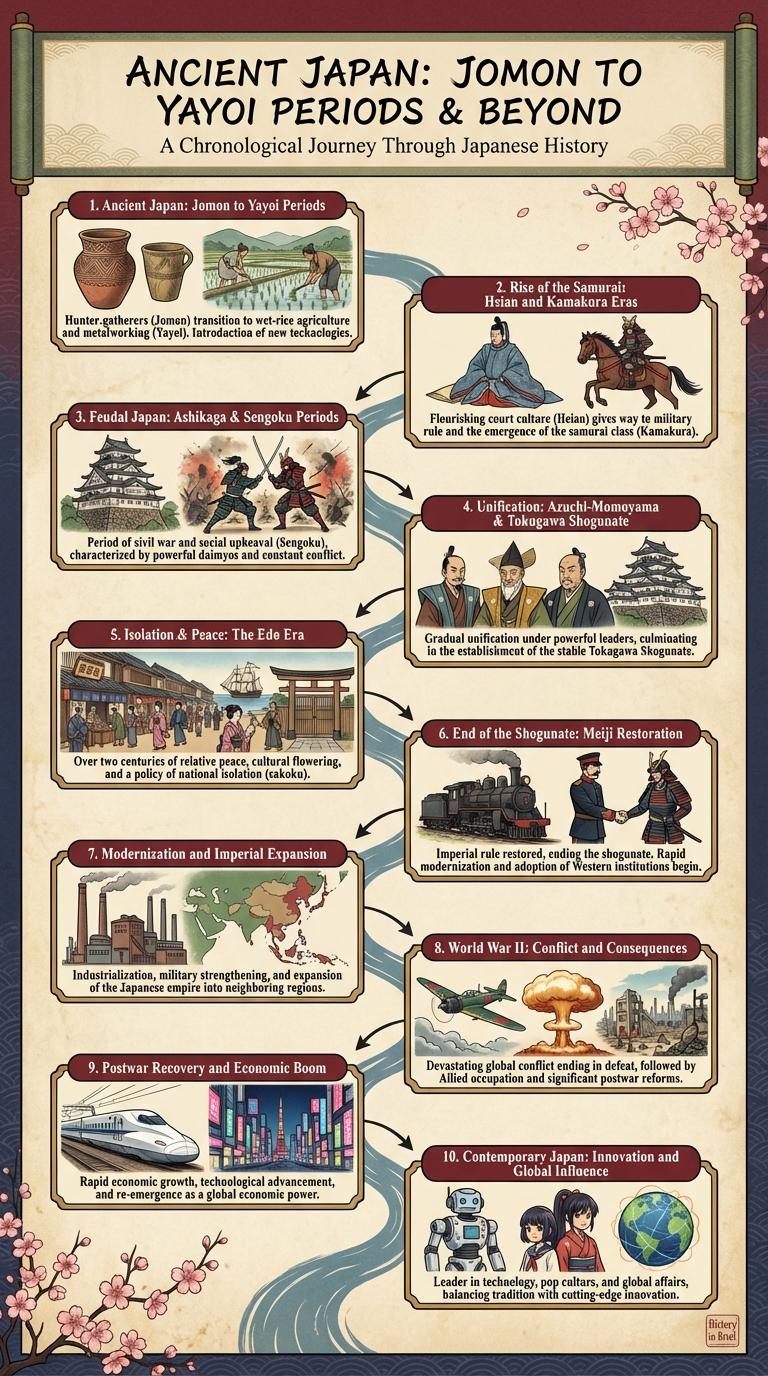
Explore the rich tapestry of Japan's history through a visually engaging infographic that highlights key events, cultural milestones, and influential figures shaping the nation. This concise overview captures ancient traditions, samurai heritage, and modernization efforts that define Japan's unique identity. Discover the chronological evolution from feudal eras to contemporary advancements in a clear and informative format.
Ancient Japan: Jomon to Yayoi Periods
What defines the Ancient Japan timeline from the Jomon to Yayoi periods? The Jomon period, dating from around 14,000 BCE to 300 BCE, is characterized by its distinctive pottery with cord-marked patterns. The subsequent Yayoi period, spanning approximately 300 BCE to 300 CE, introduced wet-rice agriculture and metal tools, marking significant technological and social developments in Japanese history.
Rise of the Samurai: Heian and Kamakura Eras
The Rise of the Samurai began during the Heian era (794-1185), a period marked by the decline of imperial power and increasing influence of provincial warrior clans. The Kamakura era (1185-1333) saw the establishment of the Kamakura shogunate, the first military government, which solidified the samurai's role as Japan's ruling class. This era introduced new warrior codes and governance structures, shaping the samurai's social and political dominance in Japanese history.
Feudal Japan: Ashikaga & Sengoku Periods
The Ashikaga period (1336-1573), also known as the Muromachi period, marked the rise of the Ashikaga shogunate, which established a decentralized feudal government in Japan. This era saw the flourishing of Japanese culture, including Noh theater, tea ceremonies, and Zen Buddhism, amidst ongoing political instability. The Sengoku period (1467-1615), known as the Warring States period, was characterized by constant military conflict among rival daimyo, leading to the eventual unification of Japan under the Tokugawa shogunate.
Unification: Azuchi-Momoyama & Tokugawa Shogunate
The Azuchi-Momoyama period marked the final phase of Japan's unification, driven by Oda Nobunaga and Toyotomi Hideyoshi. The succeeding Tokugawa Shogunate established a long era of peace and centralized feudal governance lasting over 250 years.
- Azuchi-Momoyama Unification - Characterized by military conquest and political alliances, the period unified fragmented daimyos under central leadership.
- Oda Nobunaga's Role - Nobunaga introduced innovative warfare tactics and eliminated rival clans to pave the way for unification.
- Tokugawa Shogunate Governance - Ieyasu Tokugawa solidified power through strict social order and isolationist policies, maintaining stability.
The transition from Azuchi-Momoyama to Tokugawa rule transformed Japan into a cohesive, stable nation-state with enduring societal structures.
Isolation & Peace: The Edo Era
The Edo Era (1603-1868) in Japan marked a period of enforced isolation and internal peace under the Tokugawa shogunate. This era shaped Japan's culture, economy, and political stability through strict control of foreign influence.
- National Isolation Policy (Sakoku) - Japan closed its borders to almost all foreign contact, severely limiting trade and diplomatic relations to maintain sovereignty.
- Political Stability - The Tokugawa shogunate centralized power, reducing feudal conflicts and maintaining peace for over two centuries.
- Cultural Development - Art, literature, and urban culture flourished in a stable society, giving rise to unique Japanese traditions like kabuki theater and ukiyo-e prints.
End of the Shogunate: Meiji Restoration
The Meiji Restoration, occurring in 1868, marked the end of the Tokugawa Shogunate's feudal rule in Japan. This pivotal event restored imperial power under Emperor Meiji, initiating major political and social reforms.
During the Meiji Restoration, Japan rapidly modernized by adopting Western technologies and governmental structures. It transitioned from a feudal society to a centralized, industrialized nation, setting the stage for its emergence as a global power.
Modernization and Imperial Expansion
Japan's modernization began in the Meiji Era (1868-1912), marked by rapid industrialization and the adoption of Western technologies and political systems. This transformation shifted Japan from a feudal society into a powerful, modern nation-state.
The country pursued imperial expansion from the late 19th century, exemplified by victories in the Sino-Japanese War (1894-1895) and Russo-Japanese War (1904-1905), establishing Japan as a dominant regional power. Colonies such as Korea and Taiwan were annexed, fueling Japan's ambition to control East Asia.
World War II: Conflict and Consequences
World War II marked a pivotal era in Japan's history characterized by extensive military conflict and significant post-war transformations. The war's consequences reshaped Japan's political landscape and international relations.
- Expansion and Conflict - Japan aggressively expanded its territory in East Asia, leading to clashes with Allied forces.
- Atomic Bombings - Hiroshima and Nagasaki were destroyed by atomic bombs in 1945, accelerating Japan's surrender.
- Post-War Reconstruction - Japan adopted a pacifist constitution and underwent economic reforms under U.S. occupation.
Postwar Recovery and Economic Boom
| Year | Event |
|---|---|
| 1945 | Japan surrenders, ending World War II; widespread destruction of infrastructure |
| 1947 | New Constitution of Japan established, promoting democratic governance and pacifism |
| 1950-1953 | Korean War stimulates Japanese industrial production and economic revival through U.S. military contracts |
| 1955-1973 | Period known as the "Japanese Economic Miracle"; rapid industrial growth, technological innovation, and export expansion |
| 1964 | Tokyo hosts Summer Olympics, symbolizing Japan's recovery and modernization |