
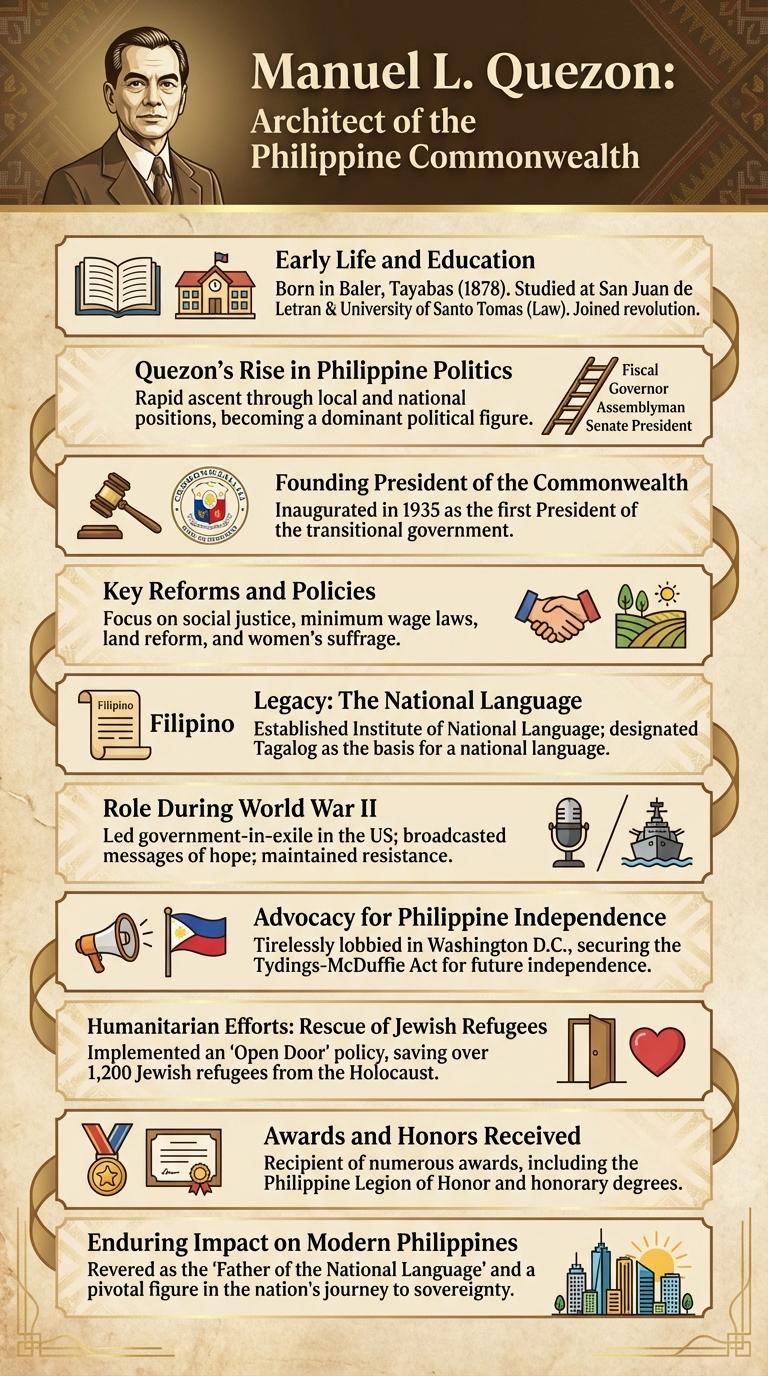
Manuel L. Quezon played a pivotal role in shaping the Philippines' path to independence as its first president under the Commonwealth government. His leadership established foundational reforms in governance, education, and social justice, which continue to influence the country today. This infographic highlights key milestones and contributions of Quezon's enduring legacy.
Early Life and Education of Manuel L. Quezon
Manuel L. Quezon, known as the "Father of the Philippine Language," played a pivotal role in Philippine history. His early life and education shaped his path to becoming the first President of the Philippine Commonwealth.
- Birthplace and Date - Born on August 19, 1878, in Baler, Aurora, Quezon's origins influenced his strong nationalistic values.
- Early Education - He attended the Escuela Normal de Manila where he earned his teaching diploma before pursuing law.
- Higher Education - Quezon graduated with a law degree from the University of Santo Tomas and later passed the bar examination in 1903.
His foundational years equipped him with the knowledge and resolve to lead the Philippines toward independence.
Quezon's Rise in Philippine Politics
Manuel L. Quezon started his political journey as a member of the Philippine Assembly in 1907, quickly gaining recognition for his leadership skills. He served as Resident Commissioner to the United States, advocating for Philippine independence. Quezon's dedication and vision led to his election as the first President of the Commonwealth of the Philippines in 1935.
Founding President of the Commonwealth
| Title | Manuel L. Quezon: Founding President of the Philippine Commonwealth |
|---|---|
| Full Name | Manuel Luis Quezon y Molina |
| Presidency Term | November 15, 1935 - August 1, 1944 |
| Key Achievement | Established the Philippine Commonwealth, laying the groundwork for eventual independence from the United States |
| Legacy | Known as the "Father of the National Language" and Philippine independence movement leader |
Key Reforms and Policies
Manuel L. Quezon is renowned as the Father of the Philippine Language and a pivotal figure in the country's journey to independence. His presidency introduced significant reforms and policies that shaped the nation's political and social landscape.
- Commonwealth Government Establishment - Quezon established the Commonwealth of the Philippines in 1935, preparing the country for self-governance and full independence from the United States.
- National Language Development - He promoted the adoption of Filipino as the national language, fostering unity and cultural identity across diverse regions.
- Social Justice Legislation - Quezon implemented land reform laws and labor protections to improve conditions for farmers and workers, emphasizing social equity.
Legacy: The National Language
Who was Manuel L. Quezon and what was his contribution to the national language of the Philippines?
Manuel L. Quezon is known as the "Father of the National Language" for his pivotal role in establishing Filipino as the country's national language. He promoted the use of Tagalog as the basis for the national language to unify the diverse linguistic groups in the Philippines.
Role During World War II
Manuel L. Quezon played a crucial role during World War II as the President of the Commonwealth of the Philippines. He led the Filipino government through the early years of the conflict against Japanese invasion.
Quezon established the Philippine government-in-exile in the United States after Japanese forces occupied the Philippines. He worked closely with President Franklin D. Roosevelt to secure support for Filipino independence and resistance efforts. His leadership helped maintain Filipino morale and laid the groundwork for post-war recovery and sovereignty.
Advocacy for Philippine Independence
Manuel L. Quezon dedicated his life to securing Philippine independence from American colonial rule. His leadership established the foundation for the country's eventual sovereignty.
Quezon's advocacy emphasized immediate self-governance and the protection of Filipino rights under foreign rule.
- Philippine Independence Mission - Quezon led multiple delegations to the United States advocating for legislative recognition of Philippine independence.
- Commonwealth Government Establishment - He became the first President of the Philippine Commonwealth, advancing autonomy before full independence.
- Promotion of Filipino Identity - Quezon championed the national language and cultural unity as key elements in the push for independence.
Humanitarian Efforts: Rescue of Jewish Refugees
Manuel L. Quezon, the second President of the Philippines, played a crucial role in rescuing Jewish refugees fleeing Nazi persecution during World War II. He authorized the entry of approximately 1,200 Jewish refugees into the Philippines, providing them a safe haven when most countries closed their borders. Quezon's humanitarian efforts demonstrated his commitment to human rights and compassion amidst global crisis.
Awards and Honors Received
Manuel L. Quezon, the second President of the Philippines, received numerous awards and honors recognizing his leadership and contributions to the nation. His legacy includes both national accolades and international recognitions that highlight his role in Filipino history.
Among his most notable honors is the Quezon Service Cross, the highest national recognition given for exemplary service to the country. Posthumously, various statues, parks, and institutions have been named after him, symbolizing his lasting impact on Philippine society.