
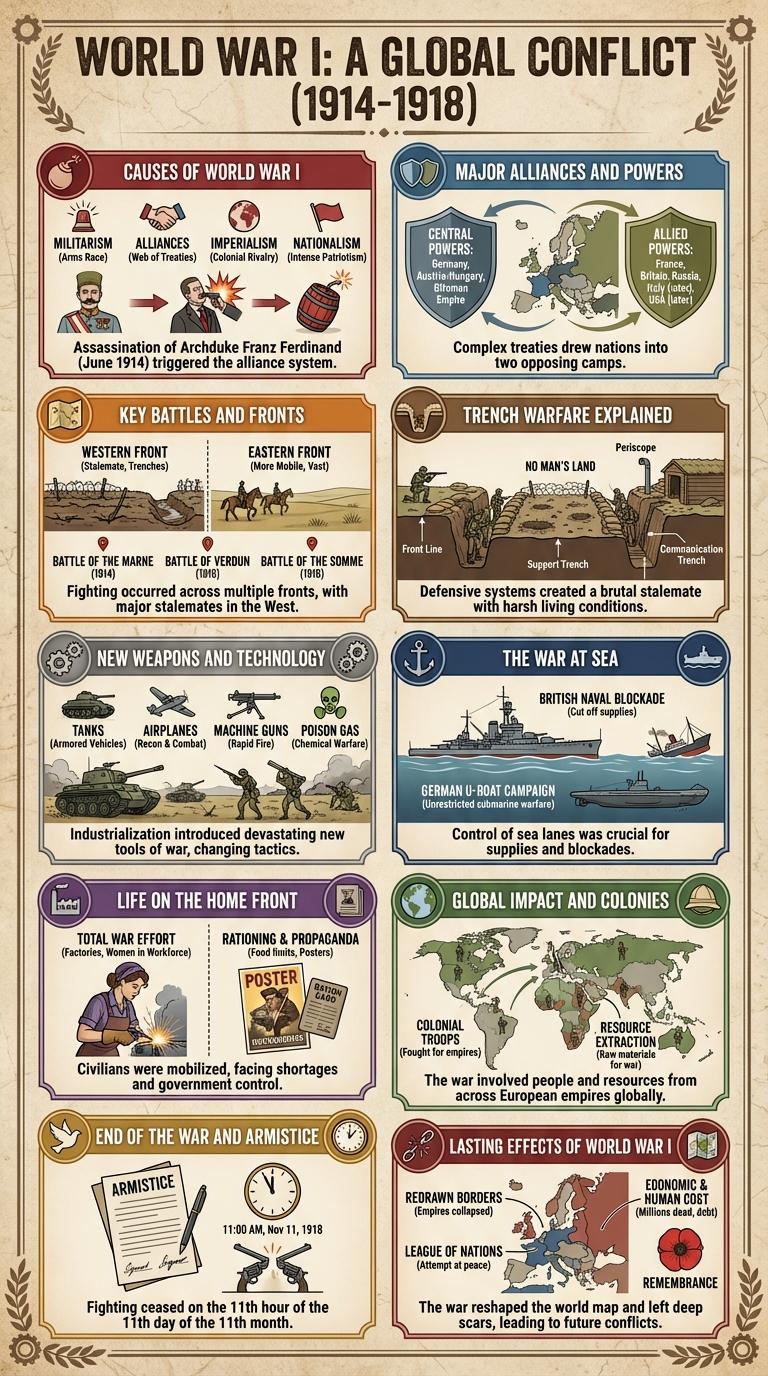
World War I dramatically reshaped global history, influencing politics, technology, and societies worldwide. This infographic highlights key events, major battles, and significant figures that defined the conflict. Visualizing complex information helps deepen understanding of the war's lasting impact.
Causes of World War I
The causes of World War I were complex and multifaceted, rooted in political, economic, and social tensions among European powers. Nationalism, militarism, alliances, and imperial rivalries created a volatile environment that eventually led to conflict.
The assassination of Archduke Franz Ferdinand of Austria-Hungary in 1914 was the immediate trigger for war. Longstanding alliances between countries quickly escalated a regional conflict into a global war involving multiple nations.
Major Alliances and Powers
World War I involved complex alliances that shaped the conflict's course. Major powers were divided mainly into two opposing groups.
- Allied Powers - Included France, the United Kingdom, Russia, and later the United States, working to counter the Central Powers' influence.
- Central Powers - Consisted of Germany, Austria-Hungary, the Ottoman Empire, and Bulgaria, seeking territorial expansion and dominance.
- Neutral Countries - Nations like Spain, Switzerland, and the Netherlands remained neutral, avoiding direct involvement in the fighting.
Key Battles and Fronts
World War I featured several key battles that shaped the course of the conflict, including the Battle of the Somme, the Battle of Verdun, and the Battle of Gallipoli. The Western Front was the primary theater of war, characterized by trench warfare stretching across Belgium and France. The Eastern Front saw vast movements between Germany, Austria-Hungary, and Russia, while secondary fronts included the Italian Front and the Middle Eastern Front.
Trench Warfare Explained
| Aspect | Details |
|---|---|
| Definition | Trench warfare was a method of combat where soldiers fought from deep, narrow ditches to protect against enemy fire. |
| Structure | Complex systems of front-line, support, and reserve trenches connected by communication trenches formed defensive networks. |
| Living Conditions | Harsh environments featuring mud, flooding, rats, lice, and constant threat of artillery and sniper attacks. |
| Tactical Purpose | Trenches minimized casualties by providing cover, slowing enemy advances, and allowing for strategic artillery coordination. |
| Impact on WW1 | Led to prolonged stalemates on the Western Front, requiring new tactics such as creeping barrages and tank warfare. |
New Weapons and Technology
World War I revolutionized combat through the introduction of innovative weapons and advanced technology. These advancements dramatically altered battlefield strategies and increased the scale of destruction.
- Machine Guns - Rapid-fire machine guns increased defensive firepower, making frontal assaults deadly and static trench warfare prominent.
- Poison Gas - Chemical weapons like chlorine and mustard gas caused severe injuries and psychological terror among soldiers.
- Tanks - Armored tanks broke the stalemate of trench warfare by crossing difficult terrain and providing mobile firepower.
- Aircraft - Fighter planes evolved from reconnaissance roles to engaging in dogfights and strategic bombing missions.
- Submarines - German U-boats disrupted Allied shipping by targeting military and civilian vessels with stealth attacks.
The War at Sea
What role did naval battles play in World War I? Naval warfare was crucial in controlling supply routes and restricting enemy trade during World War I. The British Royal Navy maintained a blockade against Germany, significantly impacting its economy and war effort.
How did submarine warfare influence the course of the war? German U-boats targeted Allied and neutral shipping, aiming to cut off supplies to Britain and France. This unrestricted submarine warfare led to significant losses and contributed to the United States entering the war in 1917.
Life on the Home Front
World War I drastically changed life on the home front, reshaping daily routines and social dynamics. Civilians faced food shortages, rationing, and increased roles in war industries to support the troops abroad.
Women entered the workforce in unprecedented numbers, taking on jobs in factories, agriculture, and transportation. Government propaganda promoted savings and resource conservation to sustain the war effort. Communities organized drives to collect materials like metal and rubber, vital for weapon production.
Global Impact and Colonies
World War 1 caused profound global shifts, impacting nations far beyond the European battlefields. Its consequences reshaped colonial territories and altered international power dynamics.
- Colonial Troop Contributions - Millions of soldiers from colonies in Africa, Asia, and the Caribbean fought for European powers, demonstrating global involvement in the war effort.
- Territorial Changes - The Treaty of Versailles and other agreements redistributed colonies, with Germany losing all its overseas possessions to Allied powers.
- Economic Exploitation - Colonies were heavily exploited to support war economies, accelerating resource extraction and labor demands under imperial control.
The war's global impact ignited anti-colonial movements, setting the stage for future independence struggles across numerous territories.
End of the War and Armistice
The First World War ended on November 11, 1918, with the signing of the Armistice between the Allies and Germany. This agreement marked the cessation of hostilities on the Western Front, effectively bringing the four-year conflict to a close.
The Armistice was signed in a railway carriage at Compiegne Forest under Marshal Foch's supervision. The end of the war led to major geopolitical changes and set the stage for the Treaty of Versailles in 1919.