
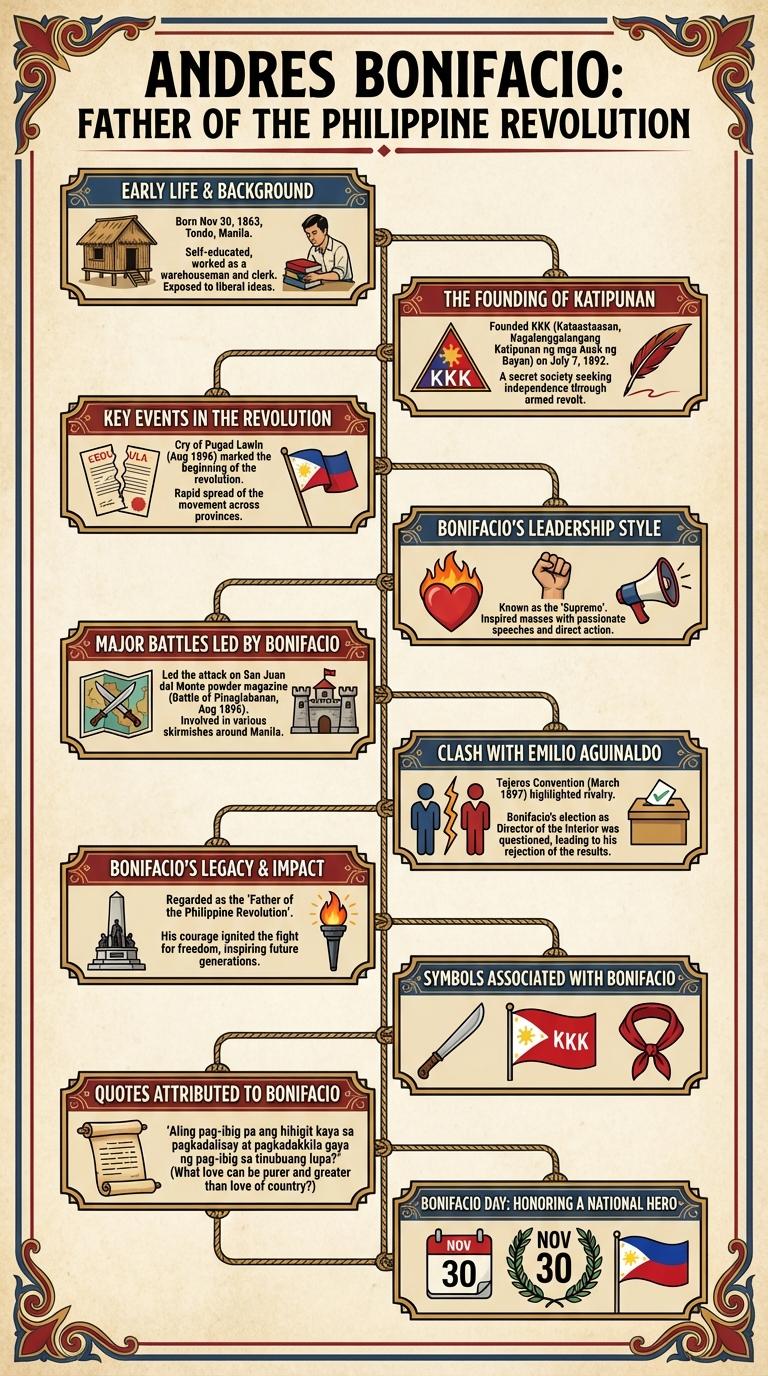
Andres Bonifacio played a pivotal role in the Philippine Revolution against Spanish colonial rule. Known as the "Father of the Philippine Revolution," he founded the Katipunan, a secret society that ignited the fight for independence. This infographic highlights key moments and contributions of Bonifacio's life that shaped Philippine history.
Early Life and Background of Andres Bonifacio
Andres Bonifacio was born on November 30, 1863, in Tondo, Manila, Philippines. He came from a poor family and received limited formal education.
Bonifacio worked as a clerk and later engaged in various trades to support his family. His humble beginnings influenced his passion for fighting colonial oppression.
The Founding of Katipunan
Andres Bonifacio played a crucial role in the founding of the Katipunan, a secret society that ignited the Philippine Revolution against Spanish rule. His leadership and vision united Filipinos in their fight for independence.
- Founding of Katipunan - Established in 1892 by Andres Bonifacio, the Katipunan aimed to gain independence from Spanish colonizers through armed revolution.
- Secret Society - The Katipunan operated covertly to avoid detection, recruiting Filipinos committed to ending Spanish oppression.
- Leadership of Bonifacio - Andres Bonifacio is known as the "Father of the Philippine Revolution" for his pivotal role in organizing and leading the Katipunan.
Key Events in the Philippine Revolution
Andres Bonifacio is a pivotal figure in Philippine history, renowned as the Father of the Philippine Revolution. He founded the Katipunan, a secret society that spearheaded the fight against Spanish colonial rule.
Bonifacio organized the initial uprisings that triggered the Philippine Revolution in 1896. His leadership mobilized thousands of Filipinos to demand independence from Spain. Despite internal conflicts, his role remains central to the country's struggle for freedom.
Bonifacio's Leadership Style
| Aspect | Details |
|---|---|
| Leadership Style | Charismatic and Revolutionary |
| Decision-Making | Assertive, based on firm conviction in independence |
| Organizational Approach | Grassroots mobilization through the Katipunan |
| Communication | Direct and inspiring speeches to unite Filipinos |
| Core Values | Patriotism, equality, and justice |
Major Battles Led by Bonifacio
Andres Bonifacio was a key figure in the Philippine Revolution against Spanish rule, leading several important battles. Major battles he led include the Battle of San Juan del Monte, which marked the start of the revolution in 1896. He also commanded forces in the Battle of Kakarong de Sili, showing his strategic leadership in the fight for Philippine independence.
Clash with Emilio Aguinaldo
Andres Bonifacio, founder of the Katipunan, played a key role in the Philippine Revolution against Spanish rule. Tensions rose between Bonifacio and Emilio Aguinaldo regarding leadership and strategy, culminating in the Tejeros Convention of 1897. This clash led to Bonifacio's arrest and eventual execution, marking a significant turning point in the revolution's history.
Bonifacio's Legacy and Impact
Andres Bonifacio, known as the "Father of the Philippine Revolution," played a crucial role in igniting the fight for Philippine independence from Spanish colonial rule. His leadership of the Katipunan inspired a nationwide movement for freedom and self-determination.
Bonifacio's legacy endures as a symbol of courage and patriotism, influencing modern Philippine nationalism and revolutionary ideals. Monuments, schools, and public holidays commemorate his impact on the nation's history and identity.
Symbols Associated with Bonifacio
Andres Bonifacio is a national hero of the Philippines, known for leading the Philippine revolution against Spanish rule. Several symbols are closely associated with his legacy and ideals.
- The Katipunan Flag - This flag represents the secret society founded by Bonifacio to fight for Philippine independence.
- The Sun with Rays - Symbolizes freedom and the bright future envisioned by Bonifacio for the Filipino people.
- The Letter K - Represents the Katipunan, the revolutionary organization led by Bonifacio.
Quotes Attributed to Andres Bonifacio
Andres Bonifacio, known as the Father of the Philippine Revolution, inspired many with his powerful words. His quotes reflect his dedication to freedom and justice for the Filipino people.
- "Ang hindi marunong lumingon sa pinanggalingan ay hindi makararating sa paroroonan" - This quote emphasizes the importance of remembering one's roots to achieve future success.
- "Walang ibang Diyos kundi ang bayan" - Bonifacio highlights the ultimate devotion to the country above all else.
- "Gusto kong makita kung sino ba talaga ang mga Pilipino, kung sino ang may tapang na lumaban." - A call to courage and patriotism among Filipinos during the revolution.
These statements continue to inspire Filipino nationalism and the fight for independence.