
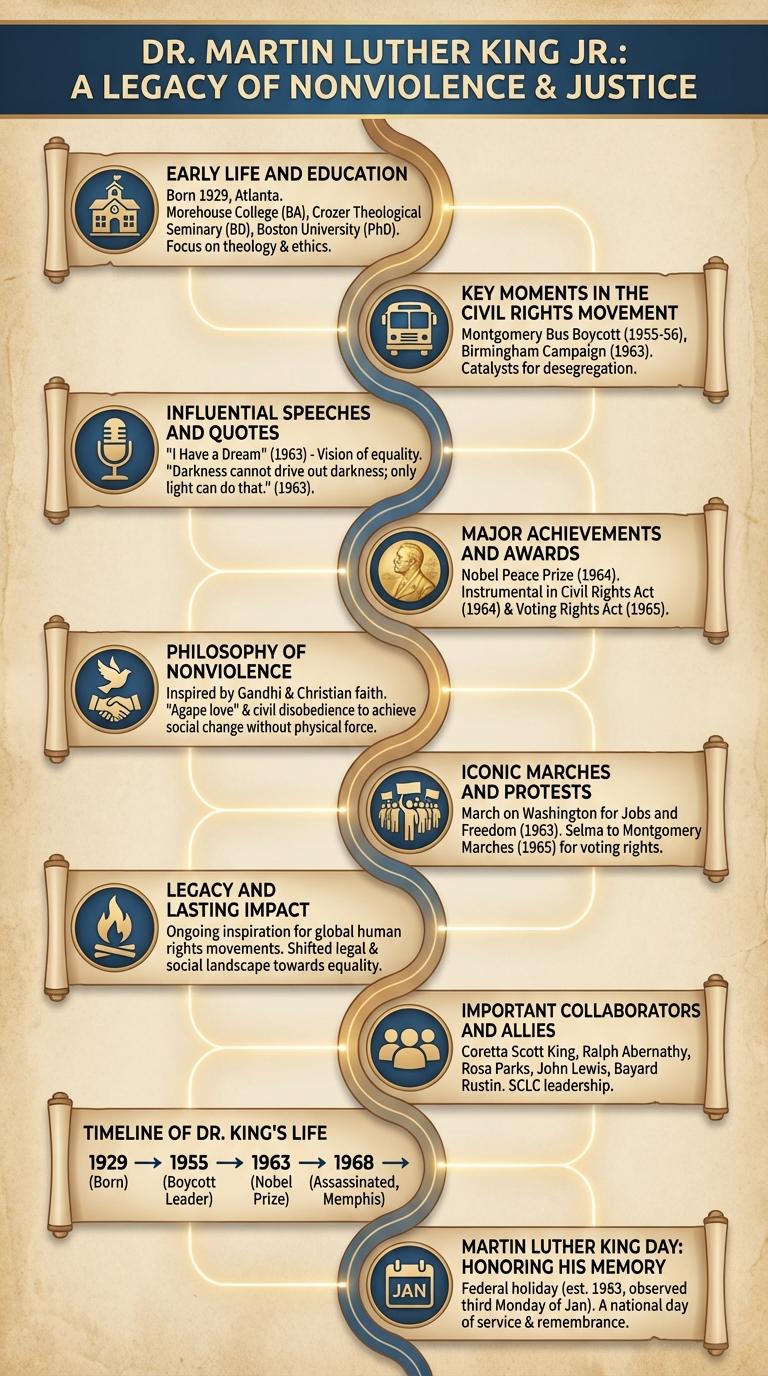
Martin Luther King Jr. remains a towering figure in the fight for civil rights, inspiring generations with his powerful speeches and nonviolent activism. This infographic highlights key moments in his life, from the Montgomery Bus Boycott to the historic "I Have a Dream" speech. Explore how his leadership shaped the movement toward equality and justice in America.
Early Life and Education
Martin Luther King Jr. was born on January 15, 1929, in Atlanta, Georgia. He attended Morehouse College, where he earned a Bachelor of Arts degree in sociology. Later, he pursued theology studies at Crozer Theological Seminary, graduating with a Bachelor of Divinity degree.
Key Moments in the Civil Rights Movement
Martin Luther King Jr. was a pivotal leader in the Civil Rights Movement, advocating for nonviolent protest to achieve racial equality. His leadership galvanized millions and led to significant changes in U.S. civil rights laws.
Key moments include the 1955 Montgomery Bus Boycott, sparked by Rosa Parks' arrest, which lasted over a year and ended segregation on public buses. The 1963 March on Washington featured King's iconic "I Have a Dream" speech, highlighting the push for racial justice and economic equality.
The 1964 Civil Rights Act was a legislative victory outlawing discrimination based on race, color, religion, sex, or national origin. King's involvement in the 1965 Selma to Montgomery marches brought attention to voting rights, resulting in the Voting Rights Act of 1965.
King was awarded the Nobel Peace Prize in 1964 for his work to combat racial inequality through nonviolent resistance. His legacy continues to inspire movements for justice and equality worldwide.
Influential Speeches and Quotes
Martin Luther King Jr. delivered many influential speeches that shaped the civil rights movement in the 1960s. His powerful words inspired millions to fight for equality and justice across the United States.
The "I Have a Dream" speech, given during the 1963 March on Washington, remains one of the most iconic calls for racial harmony. King's quote, "Injustice anywhere is a threat to justice everywhere," continues to resonate globally as a timeless reminder of social responsibility.
Major Achievements and Awards
Martin Luther King Jr. was a pivotal leader in the American civil rights movement, renowned for his commitment to nonviolent activism. His efforts led to significant legislative and social changes promoting racial equality.
- Nobel Peace Prize (1964) - King received this prestigious award for his nonviolent struggle against racial segregation in the United States.
- Civil Rights Act Influence - His leadership and activism were crucial in the passage of the Civil Rights Act of 1964, outlawing discrimination based on race, color, religion, sex, or national origin.
- March on Washington - King delivered his iconic "I Have a Dream" speech during this 1963 event, galvanizing public support for civil rights legislation.
Philosophy of Nonviolence
Martin Luther King Jr. championed the philosophy of nonviolence as a powerful tool for social change. He believed peaceful protests and civil disobedience could dismantle systemic racism without perpetuating hatred. King's approach drew inspiration from Mahatma Gandhi's principles, emphasizing love and justice over violence.
Iconic Marches and Protests
| March or Protest | Significance |
|---|---|
| Montgomery Bus Boycott (1955-1956) | Sparked nationwide civil rights movement by protesting racial segregation on public buses |
| Birmingham Campaign (1963) | Exposed violent segregation policies; gained national attention and pressured passage of civil rights laws |
| March on Washington (1963) | King delivered "I Have a Dream" speech; advocated for jobs and freedom; pivotal moment in civil rights history |
| Selma to Montgomery Marches (1965) | Highlighted voting rights suppression; led to Voting Rights Act of 1965 |
| Chicago Freedom Movement (1966) | Addressed segregation and inequality in Northern cities; expanded civil rights focus beyond the South |
Legacy and Lasting Impact
Martin Luther King Jr. remains a pivotal figure in the fight for civil rights and racial equality. His nonviolent activism inspired legislative changes and social progress across the United States.
King's leadership in the 1963 March on Washington helped bring about the Civil Rights Act of 1964 and the Voting Rights Act of 1965. His message of peace and justice continues to influence movements advocating for human rights globally. Each year, Martin Luther King Jr. Day honors his enduring contributions to equality and social justice.
Important Collaborators and Allies
Who were some of Martin Luther King Jr.'s most important collaborators and allies? Martin Luther King Jr. worked closely with key figures who played critical roles in the American civil rights movement. These collaborators strengthened the impact of his leadership and helped achieve major milestones in civil rights history.
| Ally | Contribution |
|---|---|
| Ralph Abernathy | Co-founder of Southern Christian Leadership Conference; close advisor and successor. |
| Bayard Rustin | Organized the 1963 March on Washington; strategic planner for nonviolent protests. |
| Coretta Scott King | Supporter and advocate; preserved King's legacy after his assassination. |
| Stanley Levison | Political advisor and speechwriter; helped with legislative strategy and communication. |
| John Lewis | Youth leader and Freedom Rider; key organizer in the Student Nonviolent Coordinating Committee. |
Timeline of Dr. King's Life
Martin Luther King Jr. was a pivotal leader in the American civil rights movement. His life journey is marked by significant events that shaped his legacy.
- 1929: Birth - Martin Luther King Jr. was born on January 15 in Atlanta, Georgia.
- 1955: Montgomery Bus Boycott - King rose to prominence by leading the boycott against racial segregation on public buses.
- 1963: "I Have a Dream" Speech - Delivered during the March on Washington, this speech became a symbol of the fight for civil rights.
- 1964: Nobel Peace Prize - King was awarded for his nonviolent resistance to racial prejudice in America.
- 1968: Assassination - King was tragically assassinated on April 4 in Memphis, Tennessee.
Martin Luther King Jr.'s timeline reflects a life dedicated to justice, equality, and peace.