
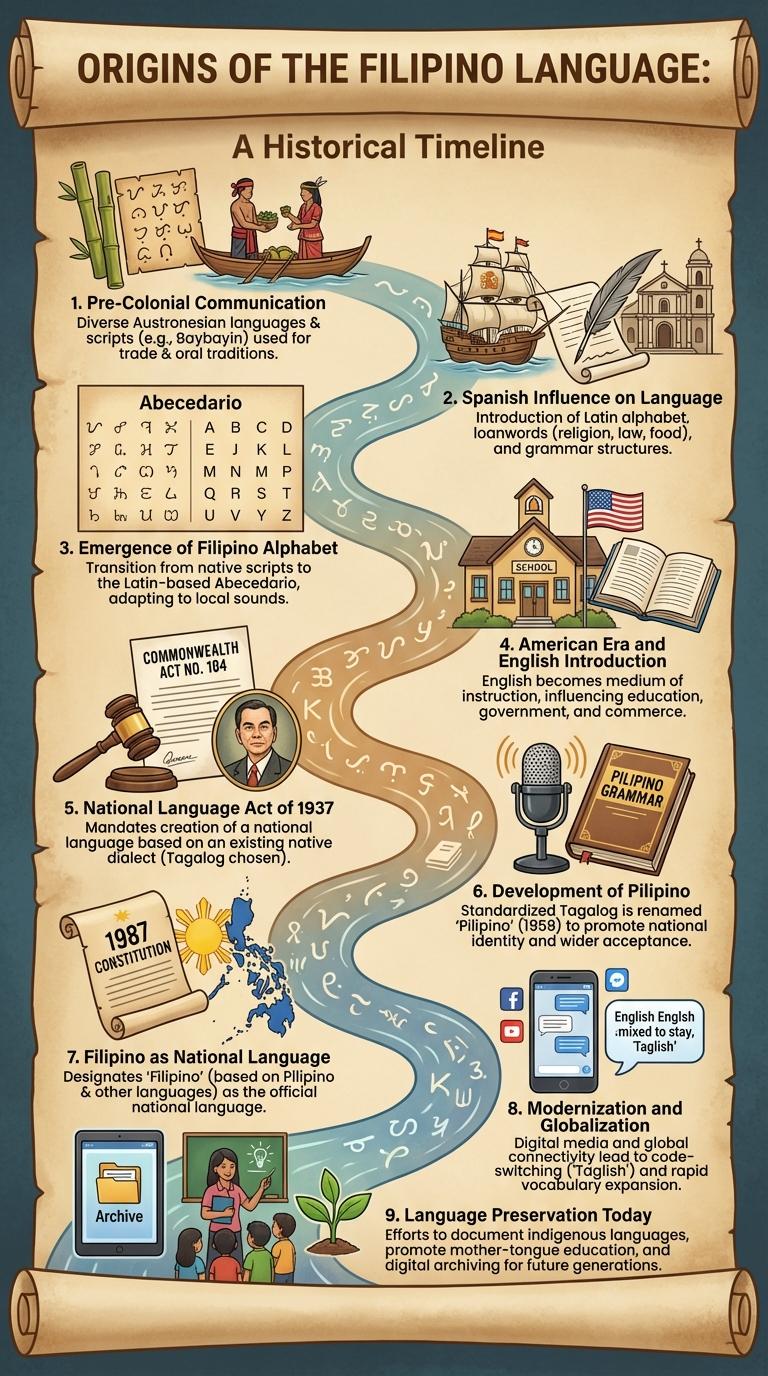
The infographic highlights the rich kasaysayan ng wika, tracing the evolution and significance of Filipino languages over centuries. It presents key milestones that shaped linguistic identity and cultural heritage in the Philippines. Visual elements illustrate the dynamic development from ancient scripts to modern Filipino language.
Origins of the Filipino Language
The Filipino language traces its roots to the Austronesian language family, which spread across the islands of Southeast Asia. It evolved from Tagalog, a native language spoken in the Manila region, enriched by Malay, Spanish, and English influences. The development of Filipino as the national language symbolizes the unification of diverse regional dialects across the Philippines.
Pre-Colonial Communication
Pre-Colonial communication in the Philippines relied heavily on indigenous scripts and oral traditions. Early Filipinos used Baybayin, a native writing system, to record information and express ideas.
Messages were transmitted through chants, poems, and storytelling, preserving history and culture. Symbols and carvings on bamboo, leaves, and stones also played a crucial role. These methods showcased the rich linguistic heritage before Spanish colonization.
Spanish Influence on Language
The Spanish language significantly impacted the evolution of Filipino languages during over three centuries of colonization. This influence is evident in vocabulary, grammar, and even writing systems.
- Lexical Borrowing - Thousands of Spanish loanwords were incorporated into Filipino languages, especially Tagalog, enriching everyday vocabulary and formal speech.
- Religious Terminology - Spanish introduced many religious terms used in Filipino Christian communities, reflecting the deep Catholic influence.
- Alphabet and Writing - The Spanish introduced the Latin alphabet, replacing indigenous scripts and shaping modern Filipino writing conventions.
The Spanish influence remains a fundamental element in the history and development of the Filipino language.
Emergence of Filipino Alphabet
The Filipino alphabet, known as "Alpabetong Filipino," evolved from the ancient Baybayin script used by early Filipinos. It was later influenced by the Spanish alphabet introduced during the colonial period.
The modern Filipino alphabet consists of 28 letters, incorporating both native and borrowed characters. This adaptation reflects the Philippines' rich linguistic history and diverse cultural influences.
American Era and English Introduction
The American Era in the Philippines began in 1898, introducing a new educational system that emphasized English as the medium of instruction. This period marked a significant shift from Spanish to English, impacting Filipino language development and communication.
English was systematically taught in schools, making it a vital tool for governance and commerce. The widespread use of English during this time laid the foundation for its status as one of the official languages of the Philippines today.
National Language Act of 1937
The National Language Act of 1937 established Tagalog as the basis for the national language of the Philippines. This law aimed to unify the diverse linguistic groups and promote a common identity among Filipinos. The act marked a significant step in the development and recognition of Filipino as the national language.
Development of Pilipino
The development of Pilipino reflects the dynamic evolution of language influenced by history, culture, and national identity. It serves as the foundation for communication among diverse linguistic communities in the Philippines.
The language's growth is marked by significant milestones that shaped its modern form.
- Pre-Colonial Era - Various indigenous languages and dialects formed the linguistic roots of Pilipino before Spanish colonization.
- Spanish Colonial Period - Spanish introduced new vocabulary and writing systems, impacting local languages including early Filipino languages.
- American Period - English was established as a medium of instruction, influencing Pilipino's vocabulary and formal usage.
- 1935 Constitution - Filipino language was recognized as a national language, sparking efforts to unify the diverse tongues.
- 1973 and 1987 Constitutions - Pilipino was further developed and standardized, evolving into the modern Filipino language used today.
Filipino as National Language
What is the significance of Filipino as the national language of the Philippines? Filipino serves as a unifying medium that reflects the diverse cultures and languages across the nation. It evolved from Tagalog and incorporates elements from various local dialects, ensuring inclusivity and national identity.
Modernization and Globalization
Modernization and globalization have significantly influenced the evolution of language. These forces have introduced new vocabulary and communication methods, reshaping how language is used and perceived worldwide.
- Technological Advancements - Innovations like the internet and social media have accelerated language change and introduced global slang and terminology.
- Cultural Exchange - Increased interaction among diverse cultures promotes borrowing and blending of languages, enriching vocabularies.
- Language Preservation Challenges - Global dominance of major languages threatens the survival of indigenous and regional languages.