
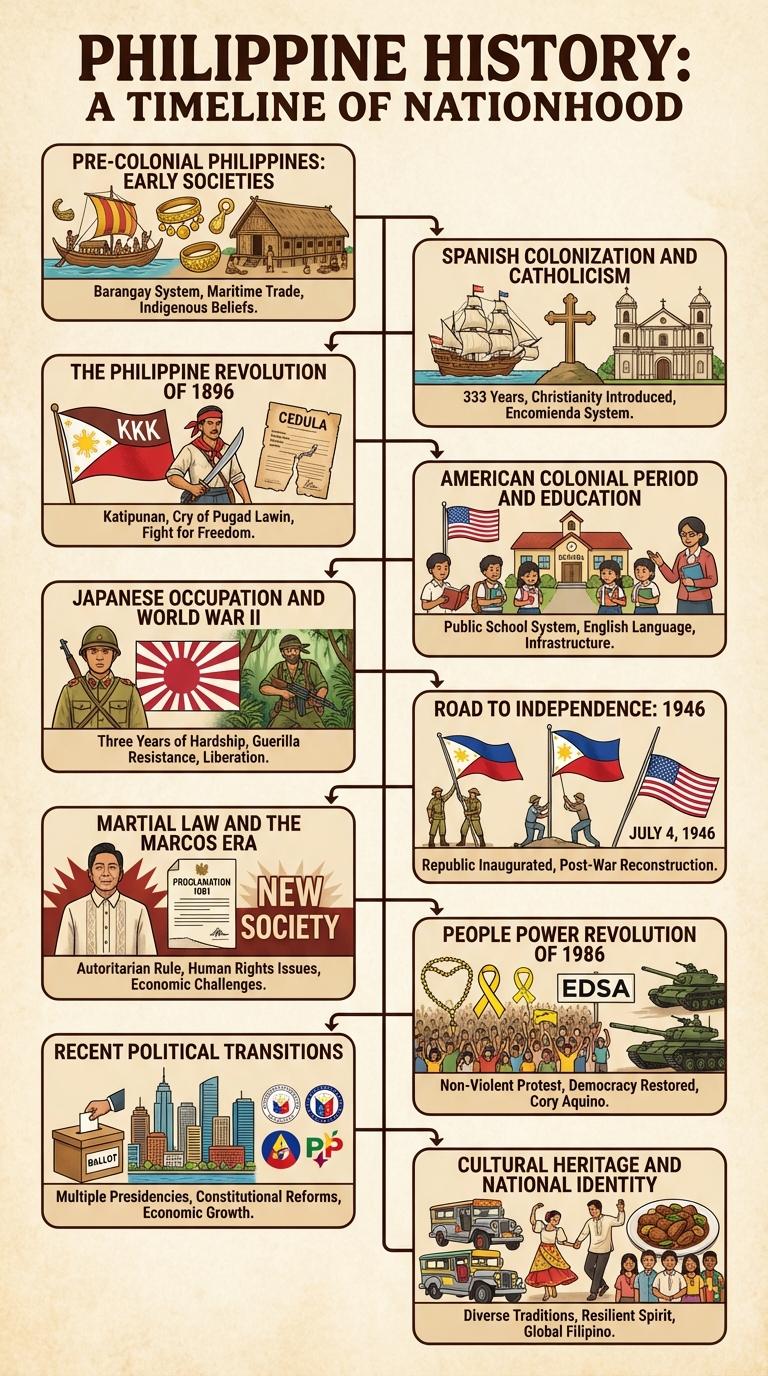
Explore the rich tapestry of Philippine history through a visually engaging infographic that highlights key events, influential figures, and cultural milestones. This concise visual guide offers a clear timeline from ancient civilizations to modern times. Designed to enhance understanding, it brings the nation's past to life with compelling facts and vibrant imagery.
Pre-Colonial Philippines: Early Societies
Pre-Colonial Philippines featured diverse early societies characterized by barangays, small independent villages led by chieftains called datu. These communities engaged in agriculture, fishing, and trade with neighboring regions such as China, India, and Southeast Asia.
Social structures were organized with clear roles for nobles, freemen, and slaves, supported by oral traditions and indigenous belief systems. Filipino early societies demonstrated advanced craftsmanship, metalworking, and a rich cultural heritage before Spanish colonization.
Spanish Colonization and Catholicism
The Spanish colonization of the Philippines began in 1565 with the arrival of Miguel Lopez de Legazpi. This era marked the introduction of Catholicism, which profoundly shaped Filipino culture and society.
Spanish rule lasted for over 300 years, influencing governance, language, and religion. Catholicism became the dominant faith, with many Filipinos converting and participating in church activities. The establishment of churches and religious festivals remains a vital part of Philippine heritage today.
The Philippine Revolution of 1896
| The Philippine Revolution of 1896 | |
|---|---|
| Start Date | August 23, 1896 |
| Key Figures |
Andres Bonifacio Emilio Aguinaldo Apolinario Mabini Gregorio del Pilar |
| Main Objective | Achieve independence from Spanish colonial rule |
| Significant Event | The Cry of Pugad Lawin; revolutionary members tore their cedulas as an act of defiance |
| Outcome | Led to the establishment of the First Philippine Republic; paved the way for Philippine independence |
American Colonial Period and Education
How did the American Colonial Period influence education in the Philippines? The American regime introduced a public school system that emphasized English language instruction. This period marked the foundation of the modern Philippine educational structure, promoting widespread access to basic education.
Japanese Occupation and World War II
The Japanese Occupation of the Philippines occurred from 1942 to 1945 during World War II. This period was marked by significant hardship and resistance by Filipino and Allied forces.
- Japanese Invasion - Japan invaded the Philippines in December 1941, leading to the occupation of Manila and other major areas by early 1942.
- Bataan Death March - Thousands of Filipino and American prisoners of war were forced to march under brutal conditions after the fall of Bataan in 1942.
- Guerrilla Resistance - Filipino guerrilla groups actively fought Japanese forces, providing intelligence and delaying enemy control.
The liberation of the Philippines began in 1944 with General Douglas MacArthur's return, culminating in the end of Japanese occupation in 1945.
Road to Independence: 1946
The Philippines achieved full independence on July 4, 1946, marking the end of nearly 50 years of American colonial rule. This historic event was formalized through the Treaty of Manila, which recognized the sovereignty of the Republic of the Philippines.
The road to independence involved significant struggles, including the Philippine Revolution against Spain and the Philippine-American War. Post World War II reconstruction and political negotiations paved the way for the final transition to an independent nation.
Martial Law and the Marcos Era
Martial Law in the Philippines was declared by President Ferdinand Marcos on September 21, 1972, marking a critical period in the country's history. This era is characterized by political repression, human rights abuses, and significant economic challenges.
- Declaration of Martial Law - Marcos cited the threat of communist insurgency and civil unrest as reasons for imposing Martial Law, giving him extraordinary powers.
- Human Rights Violations - Thousands of activists, journalists, and opposition leaders were arrested, tortured, or disappeared during this period.
- Economic Impact - While some infrastructure projects were initiated, widespread corruption and cronyism led to economic decline and increased national debt.
People Power Revolution of 1986
The People Power Revolution of 1986 was a peaceful uprising that ended the 20-year dictatorship of Ferdinand Marcos in the Philippines. It involved millions of Filipinos united in nonviolent protests along Epifanio de los Santos Avenue (EDSA). The revolution restored democracy and led to the presidency of Corazon Aquino, the country's first female president.
Recent Political Transitions
The Philippines has experienced significant political transitions in recent decades, marked by shifts in leadership and policy directions. These changes reflect the country's evolving democratic landscape and social challenges.
- EDSA People Power Revolution (1986) - A pivotal event that ended Ferdinand Marcos' dictatorship and restored democracy under President Corazon Aquino.
- Shift to Federalism Debate - Ongoing discussions aim to restructure the government to promote local autonomy and address regional disparities.
- 2016 Presidential Election - Rodrigo Duterte's election brought a controversial war on drugs and a pivot toward China in foreign policy.