
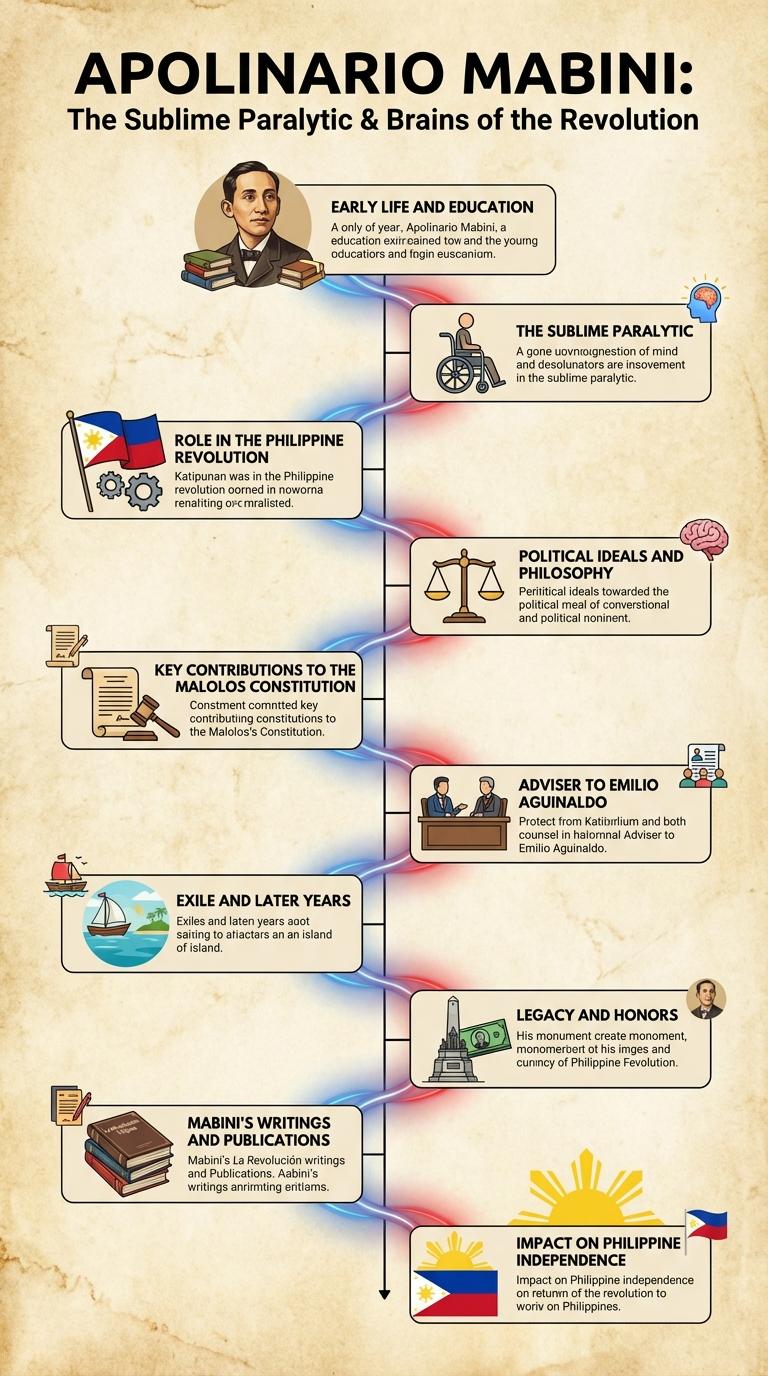
Apolinario Mabini, known as the "Brain of the Philippine Revolution," played a pivotal role in shaping the nation's fight for independence through his profound intellect and unwavering patriotism. His writings and leadership laid the foundation for the Philippine government during a turbulent era. This infographic highlights key moments and contributions that define Mabini's lasting legacy in Philippine history.
Early Life and Education
Apolinario Mabini was born on July 23, 1864, in Barangay Talaga, Tanauan, Batangas, Philippines. Despite his family's humble background, he excelled academically and earned a Bachelor of Arts degree from Colegio de San Juan de Letran. Mabini continued his education at the University of Santo Tomas, where he obtained a law degree, graduating with high honors in 1894.
The Sublime Paralytic
Apolinario Mabini, known as "The Sublime Paralytic," was a Filipino revolutionary leader and intellectual. Despite being paralyzed from polio, he played a crucial role in the Philippine struggle for independence.
- Early Life - Mabini was born in 1864 and became disabled due to polio at age 28.
- Political Influence - He served as the first Prime Minister of the Philippines during the revolutionary government.
- Legacy - Mabini is remembered as the "Brains of the Revolution" for his strategic guidance and writings.
His enduring contributions continue to inspire Filipino nationalism and governance.
Role in the Philippine Revolution
Apolinario Mabini was a key figure in the Philippine Revolution, serving as the chief adviser to Emilio Aguinaldo. Known as the "Brains of the Revolution," he played a crucial role in shaping the revolutionary government's policies and strategies.
Despite being paralyzed from polio, Mabini's intellect and writings inspired Filipino revolutionaries and helped unify the movement. His contributions significantly influenced the foundation of the First Philippine Republic in 1899.
Political Ideals and Philosophy
Apolinario Mabini, known as the "Brains of the Revolution," was a Filipino revolutionary leader and thinker. His political ideals centered on nationalism, justice, and democracy during the Philippine struggle for independence from Spain.
Mabini advocated for a government rooted in popular sovereignty and the protection of civil rights. He emphasized the importance of moral integrity and public service among leaders. His philosophy rejected colonial rule and promoted self-governance based on equality and rule of law.
Key Contributions to the Malolos Constitution
Apolinario Mabini, known as the "Brains of the Philippine Revolution," played a pivotal role in shaping the Malolos Constitution. His legal expertise and nationalist vision were instrumental in drafting this foundational document for the First Philippine Republic.
Mabini advocated for a democratic government structure emphasizing civil liberties and the separation of powers. His contributions ensured the constitution reflected the ideals of independence, justice, and sovereignty for the Filipino people.
Adviser to Emilio Aguinaldo
Who was Apolinario Mabini in the Philippine Revolution?
Apolinario Mabini served as the chief adviser to Emilio Aguinaldo, the leader of the Filipino revolutionary forces. He played a critical role in shaping the policies of the First Philippine Republic during the fight for independence from Spain.
Exile and Later Years
Apolinario Mabini spent his exile years in remote provinces after the Philippine-American War, continuing to influence the fight for independence through his writings. Despite physical hardships, Mabini remained a significant figure in Philippine history until his death in 1903.
- Exile to Guam - Mabini was exiled by American authorities to Guam in 1901 along with other Filipino revolutionaries.
- Continued Advocacy - During exile, he wrote political essays defending Philippine sovereignty and criticizing American colonial policies.
- Return and Decline - Mabini returned to the Philippines in 1903, but his health deteriorated rapidly due to polio complications.
- Death - He died on May 13, 1903, leaving a legacy as the "Sublime Paralytic" and "Brains of the Revolution."
- Legacy - Mabini is remembered as a symbol of Filipino patriotism and intellectual resistance against colonization.
Legacy and Honors
| Legacy | Honors |
|---|---|
| Apolinario Mabini is known as the "Brains of the Philippine Revolution" for his role in shaping the country's independence movement. | Mabini was declared a Philippine National Hero for his intellectual contributions and patriotism. |
| He served as the first Prime Minister and Secretary of Foreign Affairs of the Philippines under the revolutionary government. | Numerous streets, schools, and public buildings in the Philippines bear his name in recognition of his service. |
| Mabini's writings on law, governance, and social justice continue to influence Filipino political thought and legal education. | The Mabini Shrine in Batangas preserves his home and memorabilia as a historical site and museum. |
| Paralyzed early in his revolutionary activities, his resilience symbolizes dedication and sacrifice for the nation. | His image is featured on the Philippine 10-peso coin and commemorative stamps. |
| Mabini's ideals helped shape the foundation of Philippine democracy and nationalism. | The annual Mabini Day commemorates his birth and patriotic legacy every July 23rd. |
Mabini's Writings and Publications
Apolinario Mabini was a prominent Filipino revolutionary thinker known for his profound political writings during the Philippine Revolution. His works critically shaped the intellectual foundation of the Philippine struggle for independence.
Mabini's writings combined legal expertise and patriotism to inspire the Filipino people and articulate the vision for a free nation.
- True Decalogue - A set of moral and political principles advocating integrity and national sovereignty in governance.
- El Verdadero Decalogo - Mabini's expanded version of the True Decalogue, outlining ethical duties of public officials to the Filipino people.
- La Revolucion Filipina - A historical and political analysis of the Philippine Revolution emphasizing justice and democratic ideals.
- Political Essays - A series of articles providing insights into colonial oppression and calls for Filipino unity and self-governance.
- Manifestos and Letters - Key communications that articulated the Filipino revolutionary government's stance and policies.