
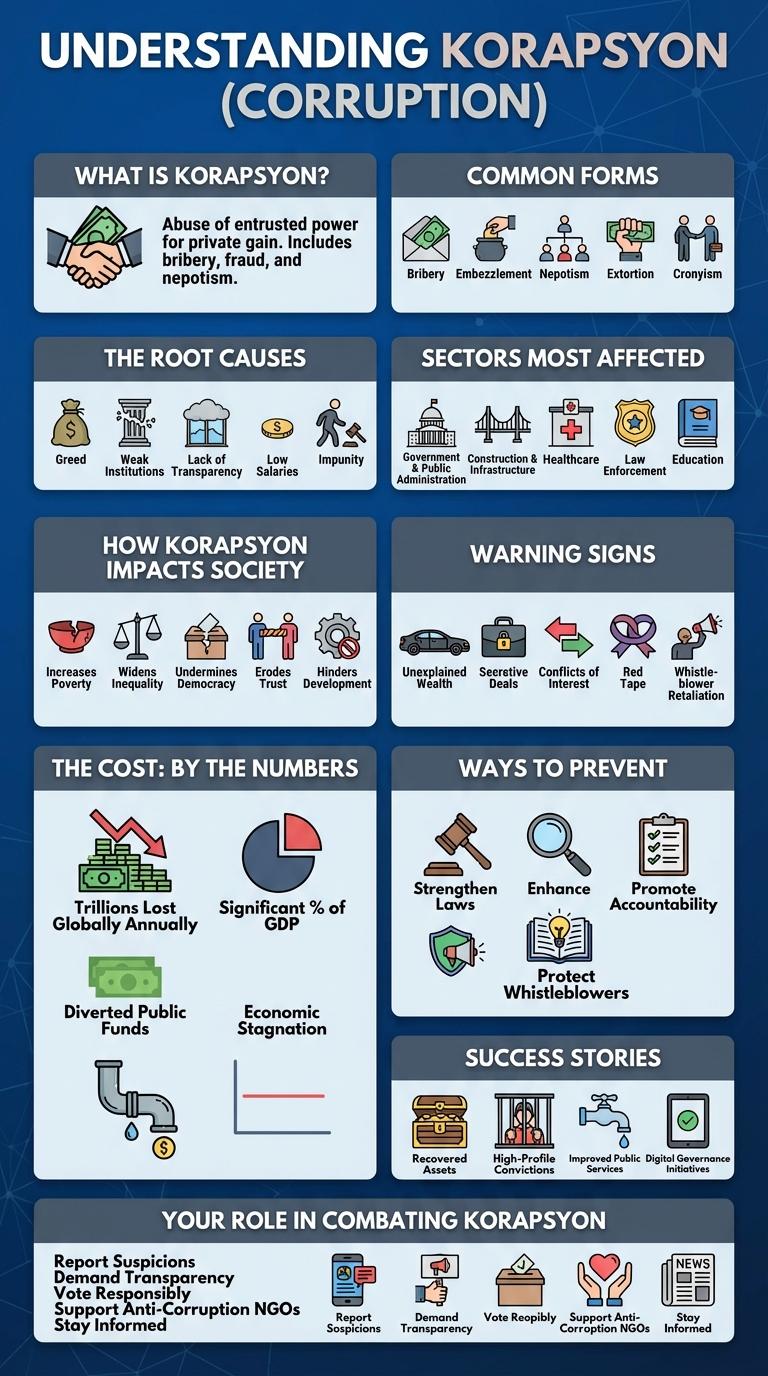
Korapsyon undermines governance, distorts economic development, and erodes public trust in institutions. This infographic highlights key statistics, causes, and consequences of corruption, emphasizing the urgent need for transparency and accountability. By visualizing these critical aspects, it aims to raise awareness and encourage collective action against corrupt practices.
What is Korapsyon?
What is Korapsyon?
Korapsyon, or corruption, is the abuse of power for personal gain. It undermines trust, weakens institutions, and hampers economic development.
Common Forms of Korapsyon
Korapsyon commonly manifests through bribery, embezzlement, and nepotism, eroding public trust and hindering economic development. Bribery involves offering money or favors to influence decisions, while embezzlement is the misappropriation of funds by officials. Nepotism favors family members or friends in hiring and promotions, undermining meritocracy and institutional integrity.
The Root Causes of Korapsyon
Korapsyon is a critical issue affecting governance and development worldwide. It undermines trust, distorts resource allocation, and hampers economic growth.
Root causes of korapsyon include weak institutional frameworks and lack of transparency in public administration. Economic inequality and limited accountability mechanisms also contribute significantly to corrupt practices.
Sectors Most Affected by Korapsyon
Korapsyon undermines development, impacting numerous sectors with significant economic and social consequences. Understanding the sectors most affected by korapsyon helps target anti-corruption efforts effectively.
- Government Procurement - Public contracts are frequently manipulated, leading to inflated costs and substandard projects.
- Healthcare - Korapsyon disrupts the delivery of medical services, resulting in shortages of medicines and equipment.
- Judiciary - Corruption within the legal system compromises justice and erodes public trust.
- Education - Misallocation of funds hampers school infrastructure and quality of teaching materials.
- Infrastructure Development - Bribery and kickbacks delay or reduce the quality of roads, bridges, and utilities.
Targeting korapsyon across these sectors is essential for promoting transparency and sustainable growth.
How Korapsyon Impacts Society
Korapsyon significantly undermines social development and trust within communities. It creates barriers to equitable access to essential services and resources.
- Economic Inequality - Korapsyon diverts public funds, increasing wealth gaps and limiting opportunities for impoverished populations.
- Reduced Public Trust - Corruption erodes confidence in government institutions and weakens civic engagement.
- Impaired Service Delivery - Corrupt practices lead to poor infrastructure, education, and healthcare systems, negatively affecting quality of life.
Warning Signs of Korapsyon
Korapsyon poses a serious threat to governance and economic development. Recognizing the warning signs of korapsyon is essential to prevent its spread and impact.
- Unexplained Wealth - Individuals showing sudden wealth without clear income sources may indicate corrupt activities.
- Favoritism in Contracts - Awarding contracts without transparency often signals biased or corrupt practices.
- Lack of Accountability - When officials avoid scrutiny or audits, it can conceal corrupt behavior.
The Cost of Korapsyon: By the Numbers
Korapsyon significantly drains national economies, with global costs estimated at over $2 trillion annually. This financial loss impacts public services, infrastructure development, and overall economic growth.
The highest corruption rates correspond to a decrease in foreign investments by up to 30%. Transparency International reports that nearly 1 in 3 people worldwide have paid a bribe to access public services.
Ways to Prevent Korapsyon
| Ways to Prevent Korapsyon | Description |
|---|---|
| Transparency in Government Processes | Implement open data initiatives and public access to government decisions to reduce corruption opportunities. |
| Strict Enforcement of Anti-Corruption Laws | Enhance the capacity of law enforcement agencies to investigate and prosecute corruption cases effectively. |
| Public Awareness and Education | Promote civic education programs that inform citizens about the negative impacts of korapsyon and how to report it. |
| Whistleblower Protection | Establish secure and confidential channels for whistleblowers and protect them from retaliation. |
| Regular Audits and Monitoring | Conduct independent audits of government agencies to detect and prevent corrupt practices early. |
Success Stories: Fighting Korapsyon
Korapsyon remains a critical issue impacting governance and development globally. Success stories in fighting korapsyon highlight effective strategies and measurable outcomes.
Countries like Singapore and Estonia have drastically reduced korapsyon through transparency reforms and strong anti-corruption institutions. Civil society involvement and digital innovation play key roles in detection and prevention. These efforts build public trust and promote sustainable economic growth.