
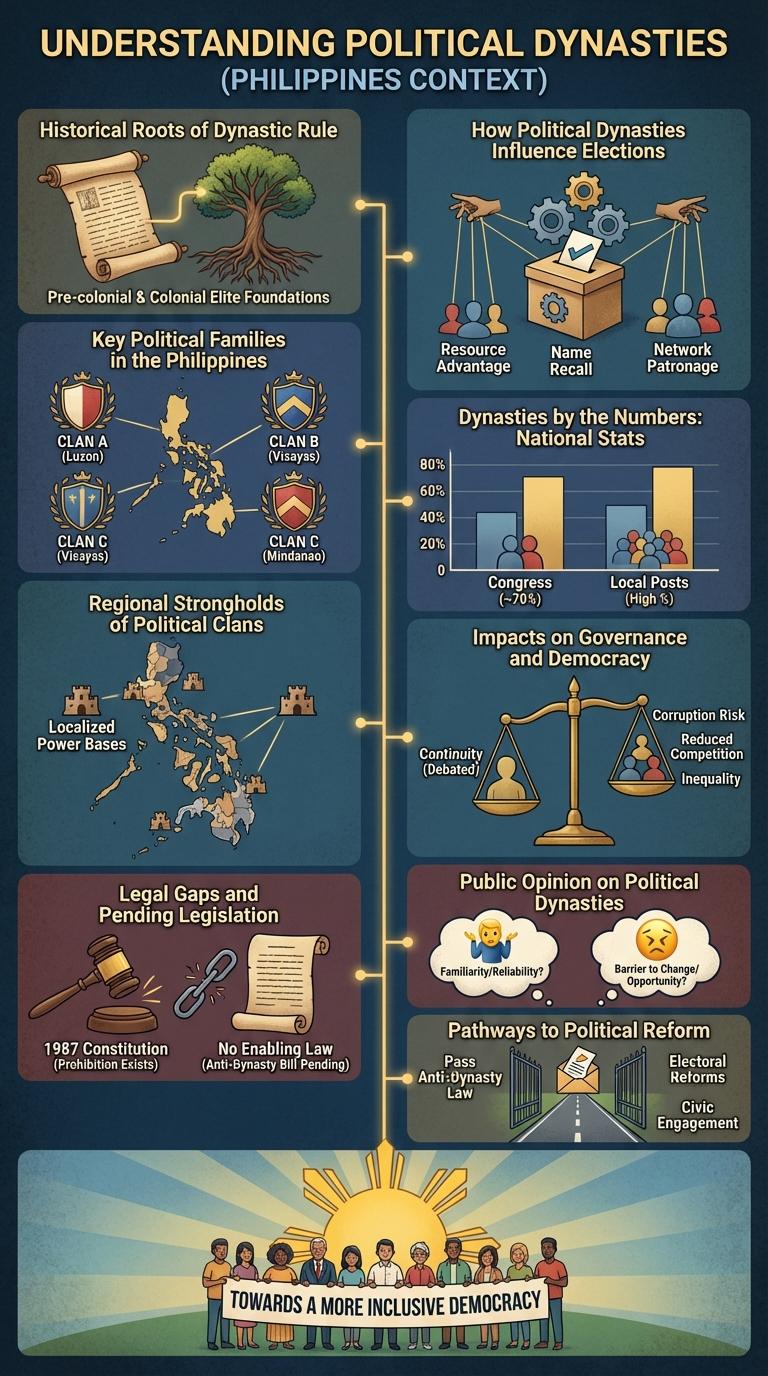
Political dynasties in the Philippines significantly influence governance, shaping policies and local leadership across generations. This infographic highlights key families, their strongholds, and the impact of dynastic politics on democratic processes. Understanding these dynamics is essential to grasping the country's political landscape and ongoing calls for reform.
Understanding Political Dynasties
Political dynasties in the Philippines refer to families that maintain control over political offices across multiple generations. These dynasties often dominate local and national government positions, influencing policy and governance. Understanding their impact is crucial for analyzing the country's political landscape and reform efforts.
Historical Roots of Dynastic Rule
The political dynasty phenomenon in the Philippines traces back to the Spanish colonial period, where local elites solidified power through landownership and familial ties. These foundations established patterns of governance that persisted into the modern democratic era.
- Colonial Landholding Structures - The encomienda and hacienda systems concentrated land and authority in the hands of a few elite families.
- Familial Political Alliances - Marriages among influential families strengthened their socio-political dominance in local communities.
- Persistence Through American Regime - Despite political reforms, elite families maintained control by adapting to new governance models.
These historical roots underpin the continuity of political dynasties in the Philippines, influencing contemporary electoral politics and power distribution.
Key Political Families in the Philippines
Political dynasties dominate the landscape of Philippine politics, with key families holding power across local and national levels. These families maintain influence through generations, often controlling multiple government positions simultaneously.
The Marcos, Aquino, and Duterte families are among the most prominent political dynasties, shaping policies and governance for decades. Their extensive networks ensure continued political presence and sway over voter behavior.
How Political Dynasties Influence Elections
Political dynasties in the Philippines hold significant power in shaping election outcomes. Their entrenched influence often limits political competition and perpetuates family control over key positions.
These dynasties use extensive resources and established networks to support their candidates. Voters often recognize family names, giving dynastic candidates a visibility advantage. This influence affects policy decisions and governance, reinforcing their dominance in local and national politics.
Dynasties by the Numbers: National Stats
Political dynasties in the Philippines continue to dominate the national landscape, influencing legislation and governance. Statistical data reveal the extent of their reach across various government positions.
- 70% of elected officials - Approximately 70% of national and local elected officials belong to political families with established dynastic ties.
- Top 10 families control 30% of seats - The ten most prominent political dynasties hold around 30% of seats in the House of Representatives.
- Regional Variation - Dynastic representation is strongest in regions such as Calabarzon and Northern Mindanao, where over 80% of officials come from political families.
Regional Strongholds of Political Clans
Political dynasties dominate key regions in the Philippines, with clans maintaining power through local government positions. These dynasties often control resources and political machinery, reinforcing their influence across multiple election cycles.
In Mindanao, families like the Ampatuans and the Datus have established strongholds, capitalizing on clan loyalty and regional alliances. Similarly, in Luzon, the Marcos and Aquino families continue to wield significant political power through entrenched networks.
Impacts on Governance and Democracy
Political dynasties in the Philippines significantly influence governance and democracy, often consolidating power within a limited number of families. This concentration affects political competition, policy-making, and the overall democratic process.
The prominence of dynastic politics has raised concerns about equitable representation and governance quality across the country.
- Reduced Political Competition - Political dynasties limit electoral competitiveness by leveraging established name recognition and resources.
- Policy Continuity and Patronage - Dynasties often maintain consistent policy agendas but may prioritize patronage networks over broad public interest.
- Weakened Democratic Institutions - Concentration of power hampers checks and balances, potentially undermining transparency and accountability.
Legal Gaps and Pending Legislation
Political dynasties in the Philippines remain prevalent due to significant legal gaps in the current legislation. The 1987 Philippine Constitution mandates the prohibition of political dynasties, yet no enabling law has been passed to define and enforce this restriction. Pending bills in Congress aim to establish clear criteria and penalties to curb the influence of entrenched political families and promote fairer electoral competition.
Public Opinion on Political Dynasties
| Public Opinion Aspect | Data / Insight |
|---|---|
| Percentage Opposing Political Dynasties | Approximately 70% of Filipinos disapprove of political dynasties according to a 2023 SWS survey |
| Reasons for Opposition | Concerns over corruption, lack of meritocracy, and perpetuation of inequality |
| Supporters' Perspective | Belief that political dynasties provide continuity and experienced leadership |
| Legislative Attempts | Multiple attempts to pass anti-political dynasty laws but none enacted due to lawmakers' self-interest |
| Demographic Differences | Younger voters and urban residents show greater opposition compared to older and rural voters |