
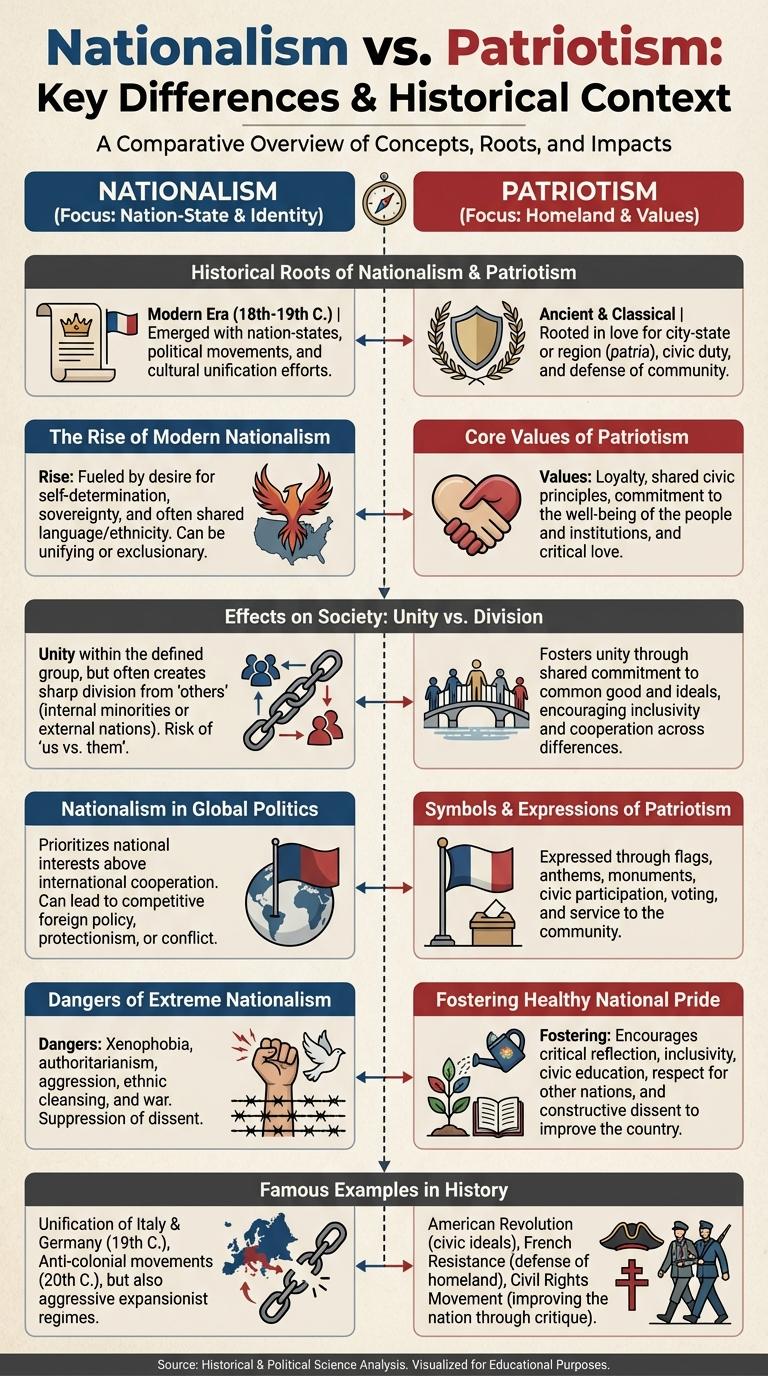
Nationalism and patriotism are powerful forces shaping national identity and political landscapes worldwide. Understanding their differences and similarities helps clarify citizens' attitudes toward their country and government. This infographic visually explores key concepts, historical contexts, and impacts of both ideologies.
Nationalism vs. Patriotism: Key Differences
Nationalism and patriotism both express love for one's country but differ fundamentally in their scope and impact. Understanding their key differences helps clarify their roles in society and politics.
- Definition - Nationalism emphasizes national superiority and often exclusion, while patriotism focuses on pride and loyalty to one's country without denigrating others.
- Emotional Basis - Patriotism is grounded in positive affection and pride, whereas nationalism is driven by a desire for dominance and sometimes hostility.
- Impact on Society - Patriotism encourages unity and constructive civic engagement, but nationalism can lead to division and conflict due to its aggressive stance.
- Identity Focus - Patriotism celebrates cultural heritage and shared values, while nationalism tends to define identity through opposition to outsiders.
- Political Expression - Nationalism can manifest in exclusionary policies and rhetoric, whereas patriotism promotes inclusive national development and respect for diversity.
Historical Roots of Nationalism & Patriotism
Nationalism and patriotism have deep historical roots that shaped the identity of nations worldwide. These concepts evolved through significant political and cultural transformations over centuries.
- Ancient Civilizations - Early forms of group identity and loyalty emerged in ancient Egypt, Greece, and Rome, laying a foundation for collective belonging.
- Medieval Period - Feudal allegiances and religious affiliations influenced early national consciousness across Europe during the Middle Ages.
- 18th Century Enlightenment - Ideas of popular sovereignty and self-determination inspired the rise of nationalism and patriotic sentiment in Europe and America.
The historical development of nationalism and patriotism reveals their roles in forging modern nation-states and citizen identities.
Core Values of Patriotism
Patriotism embodies a deep love and commitment to one's country, emphasizing pride in national identity and shared values. It fosters unity and encourages active participation in the nation's growth and well-being.
- Respect for National Symbols - Patriotic individuals honor flags, anthems, and monuments as representations of their nation's heritage and sacrifices.
- Civic Responsibility - Engaging in voting, community service, and law-abiding behavior reflects dedication to improving the country.
- Commitment to National Progress - Supporting education, innovation, and economic development drives the nation's advancement and global standing.
The Rise of Modern Nationalism
The rise of modern nationalism emerged in the 18th and 19th centuries, fueled by the spread of Enlightenment ideas and the decline of feudal structures. Nationalism emphasized the importance of a shared language, culture, and history as the foundation of political identity.
Industrialization and improved communication fostered stronger national consciousness across Europe. The French Revolution is a key example, promoting the idea that sovereignty belongs to the people, not monarchs. Patriotism grew as citizens began to support and defend their nations passionately, intertwining national pride with modern state-building efforts.
Effects on Society: Unity vs. Division
| Aspect | Effects on Society |
|---|---|
| Nationalism | Often promotes strong in-group loyalty, which can lead to societal division by fostering exclusion or hostility toward outsiders or minority groups. |
| Patriotism | Encourages pride in one's country while respecting diversity, supporting social unity and collective responsibility within a pluralistic society. |
| Social Cohesion | Patriotism typically strengthens social bonds by emphasizing shared values and democratic ideals. |
| Potential for Conflict | Nationalism can contribute to xenophobia, ethnic tensions, and intergroup conflicts due to its exclusionary nature. |
| Community Engagement | Patriotism motivates citizens to participate in civic activities, enhancing societal cooperation and peaceful coexistence. |
Nationalism in Global Politics
Nationalism is a powerful force shaping global politics, emphasizing the interests and culture of a specific nation above others. This ideology influences state behavior, often promoting sovereignty and resistance to external control.
Patriotism differs by fostering pride and loyalty toward one's country without necessitating exclusion of others. Understanding nationalism's role helps analyze conflicts, alliances, and policy decisions in the international arena.
Symbols & Expressions of Patriotism
What are the key symbols and expressions of patriotism?
National flags, anthems, and monuments serve as powerful symbols of patriotism. Public ceremonies, patriotic songs, and displaying national colors express a citizen's pride and loyalty.
Dangers of Extreme Nationalism
Extreme nationalism often leads to exclusionary attitudes and conflicts between different cultural or ethnic groups. It can foster hostility toward outsiders and undermine social cohesion within diverse societies.
Such intense national pride may encourage aggressive foreign policies and justify discrimination or violence. Recognizing these dangers is crucial to promoting a balanced patriotic spirit that respects diversity and global cooperation.
Famous Examples in History
Nationalism and patriotism have shaped history through influential figures who inspired unity and pride in their nations. Leaders such as Mahatma Gandhi in India, Winston Churchill in the United Kingdom, and George Washington in the United States exemplify these powerful ideologies. Their actions fostered strong national identities, driving social and political movements worldwide.