
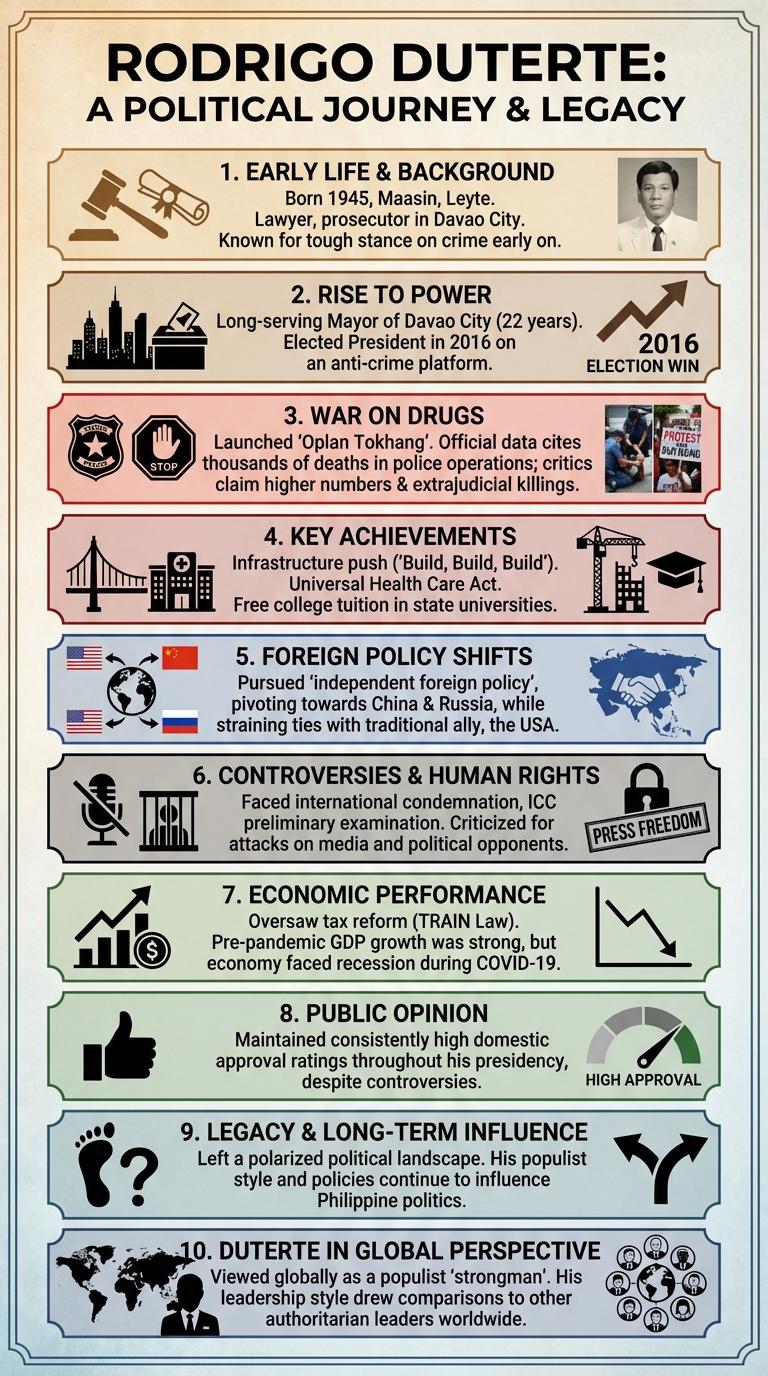
Rodrigo Duterte's political career and leadership style have significantly shaped the Philippines' recent history. This infographic highlights key moments, policies, and controversies associated with his presidency. Essential data visualizations provide a clear understanding of his impact on the nation's socio-political landscape.
Early Life and Background of Rodrigo Duterte
Rodrigo Duterte was born on March 28, 1945, in Maasin, Leyte, Philippines. He is the son of Vicente Duterte, a lawyer and governor, and Soledad Roa, a schoolteacher and civic leader.
Duterte grew up in a politically active family and pursued a law degree at San Beda College. His early life was shaped by his exposure to public service and governance, which influenced his future political career.
Rise to Power: Duterte's Political Journey
Rodrigo Duterte's political journey is marked by a steady rise from local governance to the presidency of the Philippines. His leadership style and policies have made a significant impact on the nation's political landscape.
The infographic highlights key milestones in Duterte's career, emphasizing his strategic moves and influence in Philippine politics.
- Early Local Leadership - Duterte served as Mayor of Davao City for over two decades, building a reputation for tough crime policies.
- Political Resilience - Despite controversies, Duterte maintained strong local support that propelled his career forward.
- Presidential Election Victory - Duterte won the 2016 presidential election with a populist platform focused on law and order.
War on Drugs: Policies and Impact
President Rodrigo Duterte launched an aggressive War on Drugs campaign upon assuming office in 2016. The policy aimed to eradicate illegal drug use and trafficking through strict law enforcement and community involvement.
The campaign led to thousands of drug-related arrests and fatalities, drawing both domestic support and international criticism. Human rights groups raised concerns about extrajudicial killings and due process violations associated with the policy.
Key Achievements During Duterte's Presidency
What are the key achievements during Duterte's presidency?
Rodrigo Duterte's administration focused on infrastructure development and improving public safety in the Philippines. His tenure is marked by significant projects under the "Build, Build, Build" program and intensified anti-drug campaigns.
| Achievement | Details |
|---|---|
| Build, Build, Build Program | Launched large-scale infrastructure projects including roads, bridges, airports, and railways to boost economic growth and connectivity. |
| Anti-Drug Campaign | Implemented a controversial but extensive campaign aimed at reducing illegal drug use and trafficking throughout the country. |
| Peace Agreements | Advanced peace talks resulting in agreements with rebel groups, particularly the Bangsamoro Organic Law to resolve long-standing conflicts in Mindanao. |
| Tax Reform | Enacted the Tax Reform for Acceleration and Inclusion (TRAIN) law to increase government revenue and fund social services. |
| Foreign Relations Shift | Strengthened ties with China and Russia while recalibrating relations with the United States to pursue an independent foreign policy. |
Duterte's Foreign Policy Shifts
Rodrigo Duterte's foreign policy marked a significant pivot from traditional alliances, emphasizing closer ties with China and Russia. He adopted a more independent stance, often challenging the United States' influence in the region. This shift aimed to attract economic investments and strengthen strategic partnerships beyond Western powers.
Controversies and Human Rights Issues
Rodrigo Duterte, the former President of the Philippines, is a figure marked by significant controversies and human rights concerns. His administration faced global scrutiny over policies and actions related to law enforcement and civil liberties.
- War on Drugs - Duterte's campaign against illegal drugs led to thousands of deaths, many accused of extrajudicial killings.
- International Criticism - The United Nations and human rights groups condemned alleged abuses under Duterte's policies.
- Suppression of Dissent - His government was criticized for targeting activists, journalists, and opposition members.
The controversies surrounding Duterte's tenure continue to impact the Philippines' domestic and international relations.
Economic Performance Under Duterte
Rodrigo Duterte served as the 16th President of the Philippines from 2016 to 2022. His administration focused on infrastructure development and economic reforms aimed at boosting growth.
Under Duterte, the Philippines sustained an average GDP growth rate of around 6.2% before the pandemic. Infrastructure spending increased significantly through the "Build, Build, Build" program. Inflation and unemployment rates experienced fluctuations but overall economic resilience was observed despite global challenges.
Public Opinion and Approval Ratings
| Year | Approval Rating (%) |
|---|---|
| 2016 | 91 |
| 2017 | 85 |
| 2018 | 77 |
| 2019 | 78 |
| 2020 | 72 |
Rodrigo Duterte, the 16th President of the Philippines, maintained high public approval throughout much of his term. His approval ratings peaked at 91% in 2016, reflecting strong public support for his policies and leadership style. Despite fluctuations, ratings remained above 70% until 2020, signaling sustained popularity amid various national and international challenges.
Legacy and Long-Term Influence
Rodrigo Duterte's presidency left a profound impact on the Philippines' political landscape and governance practices. His policies and leadership style continue to influence public discourse and national priorities.
- Tough Stance on Crime - Duterte's aggressive campaign against illegal drugs reshaped law enforcement approaches nationwide.
- Infrastructure Development - His "Build, Build, Build" program accelerated infrastructure projects, enhancing connectivity and economic growth.
- Populist Governance - Duterte's direct communication style and populist approach altered political engagement and electoral strategies.