
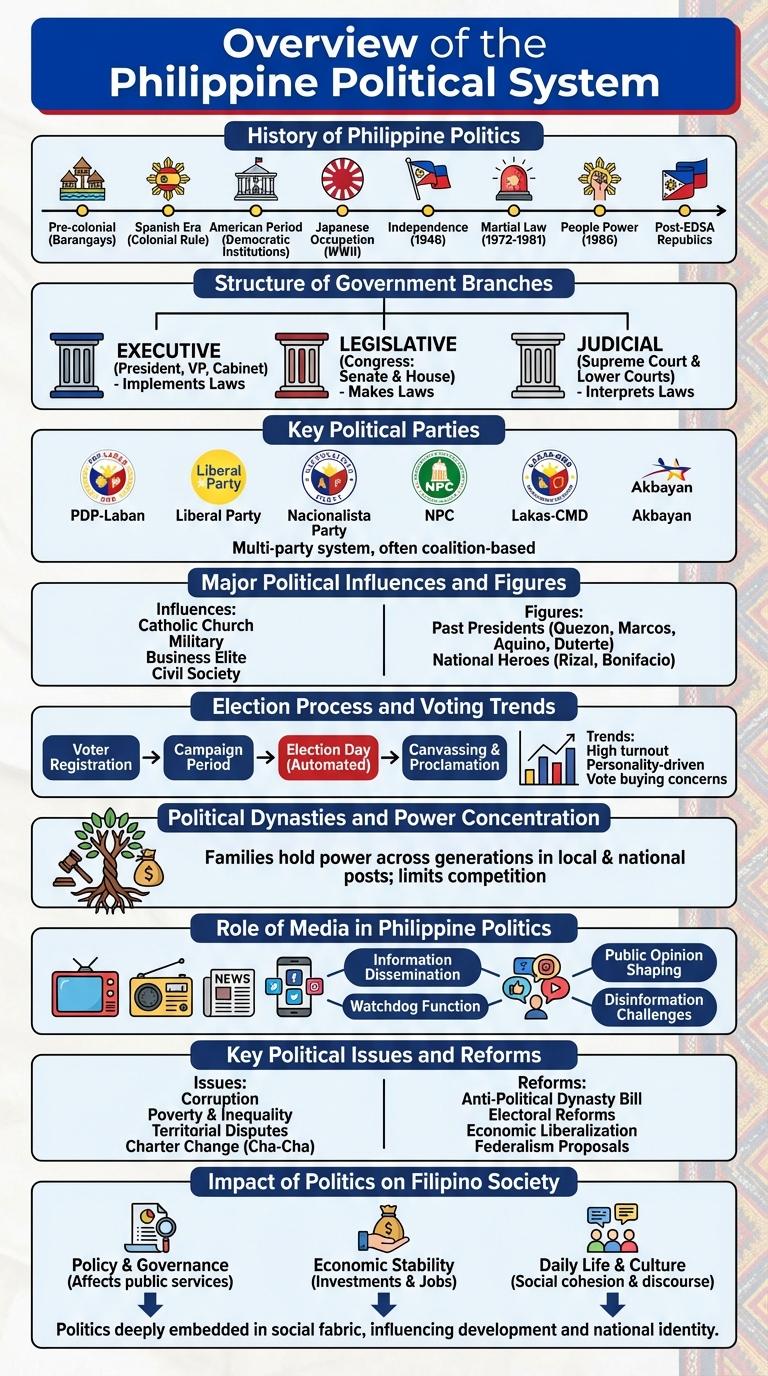
The infographic visually breaks down the complex political landscape in the Philippines, highlighting key figures, major parties, and recent election trends. It provides clear data on voter demographics, campaign finance, and government structure to enhance understanding. This visual tool serves as a concise guide for anyone interested in the dynamics shaping Filipino politics.
Overview of the Philippine Political System
The Philippine political system is a democratic republic with a presidential form of government. It operates under a constitution that establishes the separation of powers among three branches.
- Executive Branch - Led by the President, who acts as both head of state and government.
- Legislative Branch - Bicameral Congress consists of the Senate and the House of Representatives responsible for lawmaking.
- Judicial Branch - Independent courts headed by the Supreme Court ensure interpretation and application of laws.
The political landscape is shaped by a multi-party system allowing diverse representation and competition.
History of Philippine Politics
Philippine politics has a rich history shaped by colonization, revolution, and democracy. From Spanish rule to American colonization, the country's political landscape evolved through significant events and leaders.
The 1898 declaration of Philippine independence marked the start of the nation's struggle for self-governance. The establishment of the Philippine Commonwealth in 1935 laid the foundation for the modern political system. Post-independence, the country faced challenges including Martial Law under Ferdinand Marcos and the rise of democratic movements like the 1986 People Power Revolution.
Structure of Government Branches
| Branch of Government | Main Responsibilities |
|---|---|
| Executive | Headed by the President; enforces laws, manages national administration, leads foreign policy, commands the Armed Forces. |
| Legislative | Bicameral Congress consisting of the Senate and House of Representatives; creates, debates, and passes laws. |
| Judicial | Led by the Supreme Court; interprets laws, ensures justice, and oversees lower courts. |
| Local Government Units (LGUs) | Govern provinces, cities, municipalities; deliver public services and implement national policies locally. |
| Constitutional Commissions | Independent agencies like the Commission on Elections, Civil Service Commission, and Commission on Audit; maintain checks and balances. |
Key Political Parties in the Philippines
What are the key political parties in the Philippines? The Philippines has a multi-party system with several influential political parties shaping its political landscape. These parties play critical roles in governance, policymaking, and elections.
| Political Party | Description |
|---|---|
| PDP-Laban | Partido Demokratiko Pilipino-Lakas ng Bayan, known for progressive policies and strong support from President Rodrigo Duterte's administration. |
| Liberal Party (LP) | Established in 1946, it advocates for liberal democracy and human rights, historically one of the largest parties. |
| Nacionalista Party (NP) | The oldest political party in the Philippines, emphasizing nationalism and economic development. |
| Nationalist People's Coalition (NPC) | Founded in 1992, the NPC focuses on agrarian reform and economic progress. |
| Katipunan ng Kamalayang Kayumanggi (K3) | A newer party advocating for social justice and cultural identity issues in the Philippines. |
Major Political Influences and Figures
Politics in the Philippines is shaped by a complex history and diverse cultural influences, resulting in a dynamic political environment. Key political figures and powerful families have played significant roles in shaping the country's governance and policies.
- The Aquino Family - Known for their critical role in the People Power Revolution, they remain influential in democratic reforms and political activism.
- Rodrigo Duterte - Served as President from 2016 to 2022, recognized for his controversial anti-drug campaign and populist policies.
- The Marcos Dynasty - A long-standing political family, with Ferdinand Marcos Sr. ruling as president and his descendants still active in politics today.
Election Process and Voting Trends
The election process in the Philippines involves multiple levels of government, including national, provincial, and local positions. Citizens aged 18 and above are eligible to vote, participating in both general and local elections held every three years.
Voting trends show a strong preference for personality-driven campaigns rather than party platforms. Voter turnout typically ranges between 70% and 80%, reflecting high political engagement across the country.
Political Dynasties and Power Concentration
Political dynasties dominate the Philippines, with over 70% of local government positions held by families with longstanding political ties. Power concentration among these dynasties limits political competition and perpetuates economic inequality. Efforts to pass anti-dynasty laws face strong resistance, sustaining the influence of elite families in governance.
Role of Media in Philippine Politics
The media plays a crucial role in shaping public opinion and political discourse in the Philippines. It serves as a platform for information dissemination, government accountability, and citizen engagement. Through various channels, the media influences voter behavior and policy-making processes.
Key Political Issues and Reforms
The political landscape in the Philippines faces critical issues such as corruption, electoral fraud, and human rights concerns. These challenges affect governance, public trust, and democratic processes nationwide.
Reforms focus on enhancing transparency, strengthening electoral systems, and promoting social justice. Key initiatives include anti-corruption laws, automated voting systems, and measures to protect civil liberties.