
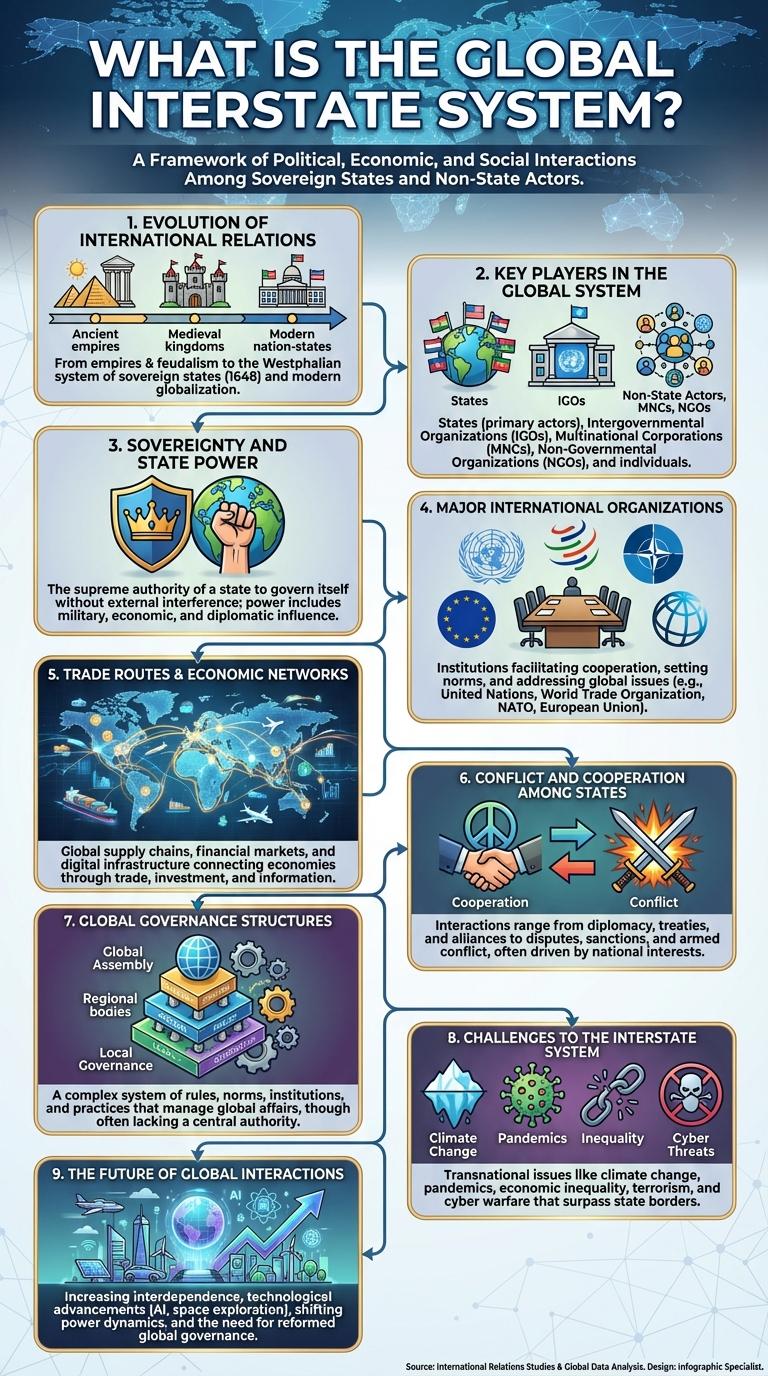
The global interstate system connects countries through a vast network of highways, facilitating international trade and travel. This infographic highlights key routes, economic hubs, and infrastructure development across continents. Understanding these connections reveals the critical role highways play in global commerce and cross-border integration.
What Is the Global Interstate System?
The Global Interstate System refers to the complex network of political, economic, and diplomatic interactions among sovereign states. It governs international relations, cooperation, and conflicts across the world.
- Political Sovereignty - Each state operates as an independent entity with defined territorial boundaries and government authority.
- Diplomatic Relations - Countries engage through treaties, alliances, and negotiations to manage peaceful coexistence and collaboration.
- Economic Interdependence - Nations participate in global trade, investment, and financial exchanges forming interconnected markets.
This system provides the framework for understanding global power dynamics and international law enforcement.
Evolution of International Relations
How has the global interstate system evolved over time? The evolution of international relations reflects shifts from power-based diplomacy to cooperative multilateralism. Key historical events such as the Treaty of Westphalia, World Wars, and the formation of the United Nations shaped modern global interactions.
What major frameworks define the current international system? The global interstate system relies on principles of sovereignty, collective security, and international law. Institutions like the United Nations, NATO, and the World Trade Organization facilitate dialogue, conflict resolution, and economic cooperation among states.
How have ideological shifts influenced global diplomacy? The Cold War era introduced bipolar competition between the US and USSR, impacting alliances and foreign policies worldwide. Post-Cold War dynamics emphasize globalization, human rights, and sustainable development within international relations.
What role do emerging powers play in evolving interstate relations? Countries such as China, India, and Brazil assert greater influence through economic growth and strategic partnerships. Their involvement reshapes power balances and encourages multipolarity in global governance.
How does technology impact the global interstate system? Advances in communication, cyber capabilities, and information sharing enhance diplomacy and security coordination. Digital innovation also introduces new challenges including cybersecurity threats and information warfare.
Key Players in the Global System
The global interstate system is shaped by powerful actors who influence international politics, economics, and security. Key players drive global stability, conflict resolution, and cooperation across regions.
These states and organizations hold significant sway in shaping policies that affect worldwide relations and governance.
- United States - The United States is a dominant military and economic power with extensive diplomatic reach influencing global policy.
- China - China is a rising superpower shaping global trade, infrastructure, and diplomatic strategies through initiatives like the Belt and Road.
- European Union - The European Union acts as a major economic bloc promoting regional integration, regulatory standards, and multilateral diplomacy.
Sovereignty and State Power
The global interstate system is defined by the principle of sovereignty, where each state holds supreme authority within its territorial borders. State power manifests through control over resources, governance, and diplomatic relations, ensuring national interests are protected. International law recognizes sovereignty, yet states navigate complex interactions balancing power and cooperation.
Major International Organizations
The global interstate system is structured around key international organizations that facilitate cooperation, security, and economic development among nations. These organizations set rules and norms that govern interactions between states to promote stability and peace worldwide.
Major international organizations include the United Nations (UN), the World Trade Organization (WTO), the North Atlantic Treaty Organization (NATO), the International Monetary Fund (IMF), and the World Health Organization (WHO). Each organization plays a distinct role in addressing political, economic, security, and health issues on a global scale.
Trade Routes & Economic Networks
The global interstate system connects major trade routes that facilitate the movement of goods, services, and capital across continents. Key economic networks include maritime corridors, transcontinental highways, and international rail links that support global commerce.
These routes enable efficient supply chains and foster economic integration among countries, enhancing regional development. Strategic chokepoints such as the Suez Canal and the Strait of Malacca are vital nodes within this interconnected infrastructure.
Conflict and Cooperation Among States
The global interstate system is characterized by both conflict and cooperation, shaping international relations and global stability. States constantly navigate power dynamics to protect interests while seeking alliances and partnerships for mutual benefit.
- Security Dilemmas - Competitive military buildups often arise from mutual distrust among states, increasing the risk of conflict.
- Economic Interdependence - Trade agreements and economic partnerships incentivize cooperation and peaceful relations between nations.
- International Organizations - Institutions like the United Nations facilitate dialogue and collective action, reducing tensions and promoting conflict resolution.
Global Governance Structures
| Global Governance Structure | Description |
|---|---|
| United Nations (UN) | Primary international organization promoting peace, security, and cooperation among 193 member states worldwide. |
| World Trade Organization (WTO) | Regulates international trade rules, resolves trade disputes, and promotes free trade among 164 member countries. |
| International Monetary Fund (IMF) | Provides financial stability, monetary cooperation, and economic surveillance to its 190 member countries. |
| World Health Organization (WHO) | Leads global public health efforts, coordinates pandemic responses, and supports healthcare systems in 194 countries. |
| G20 | Forum of 19 countries and the EU representing major economies, focusing on international financial stability and economic policy coordination. |
Challenges to the Interstate System
The global interstate system faces numerous challenges that undermine international stability and cooperation. Conflicting national interests and power struggles complicate the enforcement of international laws and agreements.
Economic disparities between states create friction in negotiations and global policymaking. Territorial disputes and rising nationalism increase the risk of conflicts and weaken diplomatic relations. Cybersecurity threats and misinformation campaigns destabilize international trust and collaboration.