
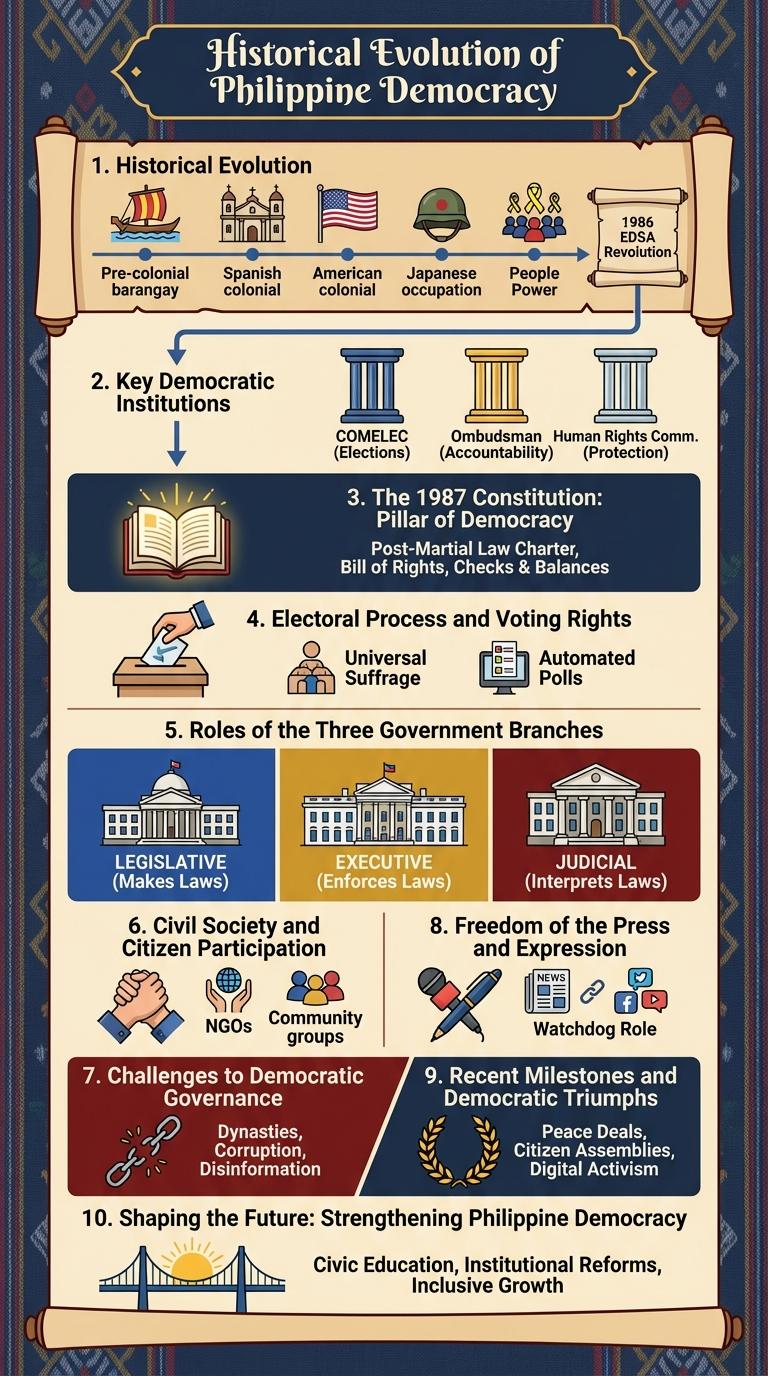
Democracy in the Philippines thrives through vibrant electoral processes and active citizen participation. This infographic breaks down key elements such as voter turnout, political institutions, and civil rights that shape the nation's democratic landscape. Visualizing these components highlights how Filipino democracy evolves and adapts in a complex sociopolitical environment.
Historical Evolution of Philippine Democracy
The historical evolution of democracy in the Philippines traces back to the late 19th century with the Philippine Revolution against Spanish colonial rule. The 1898 Declaration of Independence marked the birth of the First Philippine Republic, the first democratic government in Asia.
American colonization introduced democratic institutions, culminating in the 1935 Constitution that established the Commonwealth government. Post-World War II independence in 1946 solidified the Philippines as a sovereign democratic republic under a new constitution in 1987 following the People Power Revolution.
Key Democratic Institutions
What are the key democratic institutions in the Philippines?
The Philippines has three main democratic institutions: the Executive, the Legislative, and the Judiciary. These institutions work together to uphold democracy and ensure the rule of law in the country.
| Institution | Role |
|---|---|
| Executive | Led by the President, it enforces laws and manages government operations. |
| Legislative | Comprised of the Senate and House of Representatives, it creates laws and oversees their implementation. |
| Judiciary | Interprets laws and ensures justice through courts, headed by the Supreme Court. |
| Commission on Elections (COMELEC) | Manages and supervises all elections to maintain transparency and fairness. |
| Civil Society Organizations | Encourage citizen participation and hold government accountable. |
The 1987 Constitution: Pillar of Democracy
| Aspect | Details |
|---|---|
| Introduction | The 1987 Philippine Constitution serves as the fundamental legal framework establishing and protecting democratic governance. |
| Key Features | Separation of powers, Bill of Rights, Multi-party system, Checks and balances. |
| Democratic Principles | Popular sovereignty, rule of law, accountability, transparency, and protection of human rights. |
| Impact on Governance | Restored democratic institutions after Martial Law, ensured free elections, strengthened civil liberties. |
| Significance | Foundation for Philippine democracy, safeguarding freedoms and promoting citizen participation. |
Electoral Process and Voting Rights
The Philippines practices a democratic system where citizens actively participate in electing their leaders through a structured electoral process. Voting rights are protected by law, ensuring inclusivity and fairness for all eligible voters.
Transparency and accuracy in elections are maintained by the Commission on Elections (COMELEC), the official government body overseeing electoral activities.
- Voter Registration - Citizens aged 18 and above must register with COMELEC to be eligible to vote in local and national elections.
- Automated Elections - The Philippines uses a computerized voting system to increase efficiency and minimize fraud in the voting process.
- Voting Rights - All Filipino citizens have the right to vote regardless of gender, religion, or socioeconomic status, promoting equal participation in democracy.
Roles of the Three Government Branches
Democracy in the Philippines is upheld by the separation of powers among the Executive, Legislative, and Judicial branches. The Executive branch, led by the President, enforces laws and manages national administration. The Legislative branch creates laws, while the Judicial branch interprets laws and ensures justice.
Civil Society and Citizen Participation
Civil society in the Philippines plays a crucial role in strengthening democracy by promoting transparency, accountability, and civic engagement. Numerous non-governmental organizations (NGOs) and community groups work actively to educate citizens and advocate for social reforms.
Citizen participation in the Philippines is evident through voter turnout, grassroots movements, and public consultations. These activities empower Filipinos to influence political decisions and hold leaders accountable, contributing to a vibrant democratic process.
Challenges to Democratic Governance
Democracy in the Philippines faces multiple challenges that affect its stability and effectiveness. These obstacles hinder the full realization of democratic principles in governance and society.
- Political Dynasties - Concentrate power within families, limiting political competition and citizen participation.
- Corruption - Undermines public trust and diverts resources away from essential services and development.
- Weak Rule of Law - Leads to inconsistent enforcement of laws and protects influential individuals from accountability.
- Electoral Fraud - Distorts election outcomes, affecting the legitimacy of elected officials.
- Media Restrictions - Curtails freedom of expression and limits the public's access to unbiased information.
Freedom of the Press and Expression
Democracy in the Philippines is characterized by active freedom of the press and expression, essential for a transparent society. These freedoms empower citizens to participate fully in democratic processes and hold leaders accountable.
- Constitutional Guarantee - The 1987 Philippine Constitution explicitly protects freedom of speech, of the press, and expression as fundamental rights.
- Media Diversity - The Philippines has a pluralistic media landscape including broadcast, print, and digital outlets contributing to diverse perspectives.
- Press Challenges - Despite legal protections, journalists often face threats and violence, impacting press freedom rankings globally.
The freedom of the press and expression remains a cornerstone of Philippine democracy, fostering accountability and public awareness despite ongoing challenges.
Recent Milestones and Democratic Triumphs
The Philippines has recently celebrated significant milestones in its democratic journey, reflecting its commitment to upholding democratic values. Key democratic triumphs highlight the resilience of its electoral processes and the active participation of its citizens in governance.
In the 2022 national elections, voter turnout reached over 83%, one of the highest in recent history, showcasing strong public engagement. The peaceful transition of power marked a critical democratic benchmark, reinforcing institutional stability. Efforts to enhance election transparency, such as increased use of automated voting systems, have strengthened trust in electoral integrity.