
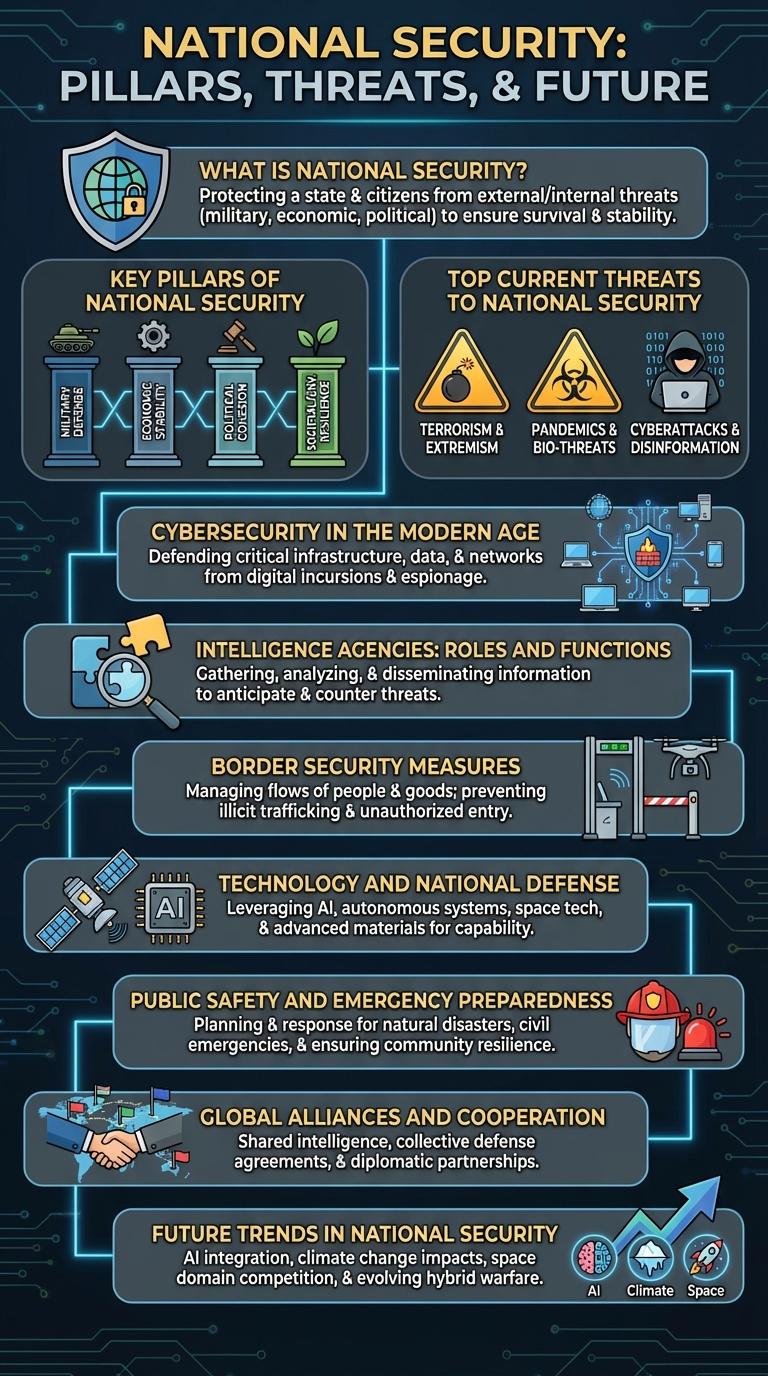
National security remains a top priority for governments worldwide, encompassing the protection of citizens, infrastructure, and information from diverse threats. This infographic breaks down the key components, challenges, and strategies involved in safeguarding a nation. Understanding these elements helps clarify how countries maintain stability and respond to evolving risks.
What is National Security?
National security refers to the protection of a nation from threats that could harm its citizens, government, and infrastructure. It encompasses defense measures, intelligence gathering, and policies designed to prevent espionage, terrorism, and cyber attacks. The goal of national security is to maintain stability, safeguard sovereignty, and ensure the safety of the population.
Key Pillars of National Security
National security encompasses the protection of a nation's citizens, economy, and institutions from external and internal threats. It relies on multiple key pillars that work together to ensure stability and safety.
These pillars include defense, intelligence, cybersecurity, economic security, and emergency preparedness. Each pillar plays a crucial role in identifying risks, preventing attacks, and responding effectively to crises.
Top Current Threats to National Security
National security faces a range of evolving threats that challenge the stability and safety of nations worldwide. Cyberattacks, terrorism, and geopolitical conflicts top the list of current dangers undermining security frameworks. Understanding these threats is crucial for developing effective strategies to protect citizens and national interests.
| Top Threat | Description |
|---|---|
| Cyberattacks | Target critical infrastructure, government networks, and private data, causing disruption and economic damage. |
| Terrorism | Involves violent acts aimed at creating fear, destabilizing governments, and harming civilians. |
| Geopolitical Conflicts | Rivalries between nations that result in military confrontations, sanctions, and proxy wars. |
| Pandemics | Global disease outbreaks that threaten public health and economic stability. |
| Disinformation | Spread of false information to manipulate public opinion and undermine trust in institutions. |
Cybersecurity in the Modern Age
Cybersecurity in the modern age is a critical element of national security, addressing threats from cyberattacks, data breaches, and cyber espionage. Advanced technologies and interconnected systems increase vulnerabilities that must be protected.
Modern cybersecurity strategies involve continuous monitoring, threat intelligence, and incident response to safeguard critical infrastructure. Government agencies collaborate with private sectors to strengthen defenses against state-sponsored attacks and cybercriminals. Public awareness and training enhance resilience to phishing, ransomware, and other digital threats.
Intelligence Agencies: Roles and Functions
Intelligence agencies play a critical role in safeguarding national security by gathering, analyzing, and disseminating information. Their functions range from counterintelligence to cyber defense, ensuring a comprehensive approach to threat assessment.
- Information Gathering - Collects data from various sources to identify potential threats.
- Analysis - Evaluates intelligence to provide actionable insights for policymakers.
- Counterintelligence - Detects and prevents espionage and sabotage activities.
- Cybersecurity - Protects national infrastructure from cyberattacks and digital espionage.
- Covert Operations - Conducts secret missions to counteract hostile activities abroad.
Border Security Measures
What are key border security measures implemented to protect national sovereignty?
Modern border security relies on advanced surveillance technology, including drones and sensors, to detect unauthorized crossings and threats. Physical barriers such as fences and checkpoints complement these systems to control and monitor border activity effectively.
Technology and National Defense
Technology plays a crucial role in strengthening national defense capabilities. Advanced systems enhance security, intelligence, and threat response strategies.
- Cybersecurity - Protects critical infrastructure from cyber attacks and data breaches.
- Surveillance Systems - Utilize AI-powered drones and satellites for real-time intelligence gathering.
- AI and Machine Learning - Automate threat detection and improve decision-making in defense operations.
Investing in cutting-edge technology ensures a resilient and adaptive national security framework.
Public Safety and Emergency Preparedness
| Aspect | Details |
|---|---|
| Public Safety | Enforcement of laws, crime prevention, and protection of citizens through police, fire, and medical services. |
| Emergency Preparedness | Planning and training for natural disasters, terrorist attacks, and other crises to minimize impact and ensure rapid response. |
| Communication Systems | Robust networks for real-time information sharing among agencies and public alerts during emergencies. |
| Community Involvement | Public education programs and volunteer opportunities to enhance resilience and situational awareness. |
| Resource Management | Allocation and coordination of personnel, equipment, and technology for effective disaster response and recovery. |
Global Alliances and Cooperation
Global alliances form the backbone of modern national security strategies, enabling countries to collaborate on threat detection and defense. Effective cooperation enhances intelligence sharing, joint training, and coordinated responses to international crises.
- NATO Partnership - NATO unites 30 countries to provide collective defense against security threats through shared military resources.
- Five Eyes Alliance - An intelligence alliance among the US, UK, Canada, Australia, and New Zealand focused on global surveillance and information exchange.
- UN Peacekeeping - The United Nations deploys multinational forces to stabilize conflict zones and protect civilians worldwide.