
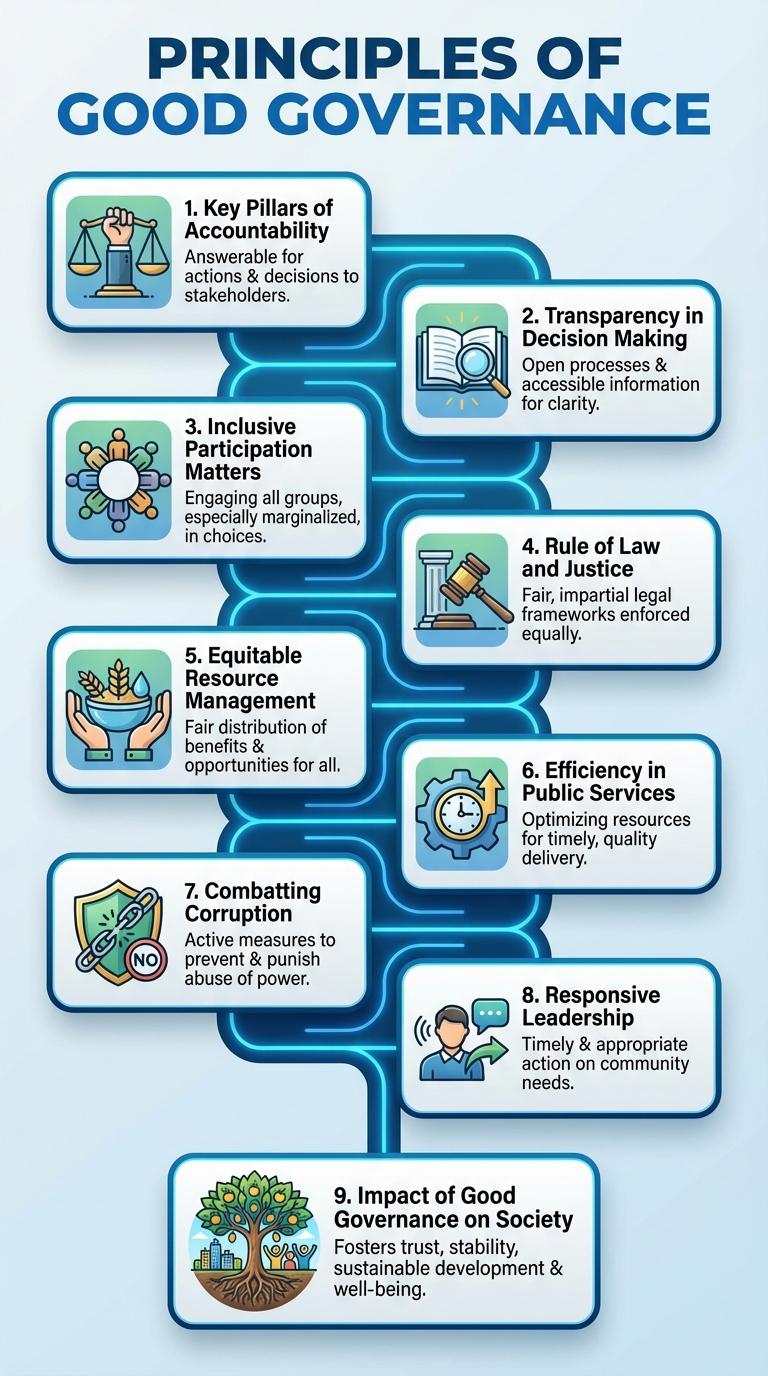
Good governance ensures transparency, accountability, and efficient decision-making within organizations and governments. It fosters trust among stakeholders by promoting ethical practices and responsiveness to public needs. Visualizing these key principles in an infographic helps clarify their impact on sustainable development and societal well-being.
Principles of Good Governance
What are the essential principles of good governance? Good governance is guided by transparency, accountability, and inclusiveness to ensure effective decision-making. These principles foster trust and promote sustainable development in organizations and governments.
How does transparency contribute to good governance? Transparency involves open communication and clear information sharing, allowing stakeholders to understand decisions and actions. This principle helps prevent corruption and builds public confidence.
Why is accountability crucial in good governance? Accountability ensures that leaders and institutions are responsible for their actions and decisions. It creates mechanisms for monitoring performance and enforcing consequences for misconduct.
What role does participation play in good governance? Participation allows citizens and stakeholders to engage in decision-making processes, reflecting diverse perspectives. Inclusive participation strengthens legitimacy and responsiveness of governance systems.
How do effectiveness and efficiency enhance good governance? Effective governance achieves desired outcomes while using resources wisely and minimizing waste. Efficiency maximizes benefits and supports sustainable growth and service delivery.
Key Pillars of Accountability
Good governance relies heavily on accountability to ensure transparency and responsibility in leadership. It promotes trust and effective management in public and private sectors.
- Transparency - Openness in decision-making processes and clear communication with stakeholders.
- Responsiveness - Timely addressing of concerns and feedback from the public or members.
- Rule of Law - Enforcing laws fairly and consistently to uphold justice and integrity.
Transparency in Decision Making
Transparency in decision making is a fundamental principle of good governance that ensures all stakeholders have access to clear and accurate information. It builds trust and promotes accountability by allowing citizens to understand how decisions are made and who is responsible.
Open communication channels and public disclosure of policies enhance transparency in governance processes. Implementing transparent practices reduces corruption and encourages informed participation from the community, strengthening democratic institutions.
Inclusive Participation Matters
Inclusive participation in governance ensures diverse voices contribute to decision-making processes. It strengthens democracy by promoting equity and representation across all community sectors.
Engaging marginalized groups leads to policies that address broader societal needs and reduce inequalities. Transparency and accountability improve when citizens actively participate in governance structures.
Rule of Law and Justice
| Aspect | Key Points |
|---|---|
| Rule of Law | Ensures all individuals and institutions are accountable to laws that are publicly promulgated, equally enforced, and independently adjudicated. |
| Justice | Guarantees fair treatment through impartial courts, protection of human rights, and accessible legal processes for all citizens. |
| Transparency | Promotes openness in legal frameworks and decision-making processes, building trust in governance systems. |
| Accountability | Holds government officials and institutions responsible for their actions under established laws and regulations. |
| Legal Framework | Provides a structured system that supports enforcement of laws and equitable resolution of disputes. |
Equitable Resource Management
Equitable resource management ensures fair distribution of resources across all community sectors, promoting social justice and reducing inequality. Transparent decision-making processes involve stakeholders to maintain accountability and build trust. Sustainable practices prioritize long-term benefits, balancing economic growth with environmental protection to support future generations.
Efficiency in Public Services
Efficiency in public services ensures timely delivery of essential amenities, reducing costs and minimizing waste. Good governance employs transparent processes and technology to streamline operations and enhance accountability. Optimized resource management leads to improved citizen satisfaction and sustainable development outcomes.
Combatting Corruption
Good governance promotes transparency, accountability, and integrity to ensure public trust and effective service delivery. Combatting corruption is essential to maintain these principles and foster sustainable development.
Combatting corruption involves implementing strong legal frameworks and enforcing anti-corruption laws consistently. Public institutions must adopt transparent procedures and support whistleblower protections. Citizen participation and oversight play a key role in detecting and preventing corrupt practices.
Responsive Leadership
Responsive leadership is a key pillar of good governance, ensuring that leaders actively listen and address the needs of their communities. This approach fosters transparency, accountability, and trust between government and citizens.
- Active Engagement - Leaders prioritize open communication channels to understand and respond promptly to public concerns.
- Accountable Decision-Making - Decisions are made transparently with clear justification to maintain public trust.
- Adaptability - Leaders adjust policies based on feedback and changing community needs to deliver effective governance.